What a week to be an outspoken fan of Quentin Tarantino and an outspoken feminist.
Uma Thurman's interview with The New York Times was a gut churning read, that filled me with mixed emotions. More than anything, recognizing Thurman's own mixed emotions and pain left me sitting with a rock in my stomach. There was a lot of debate around that interview, and I stayed out of most of it precisely because I didn't know what I really thought or felt. After Tarantino gave Thurman the video footage she wanted, and she said he had "Courage" and she was proud of him, it might have been the end of it. If her issues with him are resolved, who am I to carry a grudge?
Unfortunately, before I read the news item outlining Tarantino's statements on Thurman's interview and her response, I read the one that contained audio from a 2003 Howard Stern interview where he claimed that Roman Polanski wasn't really a rapist, and that the 13 year old girl at the center of Polanki's case had "wanted it."
When I read it, I truly couldn't think of anything to say.
I'm not naive. I went through my teens and early twenties like a lot of people did - with "heroes" and putting people I admired on a pedestal. One by one, they disappointed me. Worse, sometimes they didn't disappoint me, so much as I grew and learned, and looked back to be disappointed in myself. So by now, I don't have celebrity heroes (except maybe Ruth Bader Ginsburg), so it surprised me to feel so crushed.
Samantha Geimer, the now grown woman Tarantino was commenting on, came forward to say he was wrong, that she'd "feel better" if he realized that, and then asked that no one be outraged on her behalf. Tarantino apologized, apparently both in a private call with Geimer and in a public statement.
Here's the thing - I still don't know how I feel. Far be it from me to assume Tarantino is the same man he was fifteen years ago, if he says differently. I don't know him, but I do know that I was a worse person fifteen years ago than I am now. The problem I am having, the one that's making this all so difficult to parse, is, I have to pair the comments he made fifteen years ago and the way he interacted with Thurman fifteen years ago, with his earliest statement on the Weinstein controversy, where he owns the fact that he knew Weinstein was a predator but didn't take any action.
At the heart of all the items combining to make a bigger controversy is a rich and powerful man, who didn't trust the women around him and/or didn't feel the women around him were worth as much as his career and success (or in the case of Geimer, the career and success of a director he admired).
What I want to do is respect Geimer's wishes, and not be outraged on her behalf. I am sure that after forty-years of people supporting, criticizing, and debating Polanksi she's had enough. I think it's important to respect victims, and she's made it clear more than once that, like many sexual assault victims, she just wants this whole thing to be over. The tragedy is that it has gone on so long, with no end in sight.
I also want to remain true to my own principles.
And I want to be honest and clear about how Tarantino's art has influenced and inspired me.
The problem is I don't think I can do all three at once.
Do good people ignore accusations of sexual abuse? Yes, they absolutely do. I know many people reading this will say that's a deal breaker, only a terrible person would do that. But I know, from my own experience, from the stories I have heard from many women, that it happens all the time. One of the best men I ever knew, who sacrificed for others and always went the extra mile to care for those in need - that man sent me to work alone with a known predator. I can't talk to him now and ask why. I have theories, some which paint him in a better light and some which paint him in a terrible light - but it doesn't change the fact that in every single instance but one, he was a good person.
I am not arguing that Tarantino is a good person. I don't know him, and based on his interviews over the years, even without the recent controversy, I don't think we'd get along. I am not even arguing that the man I mention above deserves forgiveness for his role in my assault. I'm just saying - it's complicated.
I have participated in victim blaming. I can think of two instances. They both fill me with deep shame. I didn't know what I know now, I had a great deal of learning and unlearning to do. If someone were to say that the way I spoke/behaved then reflected who I am now, I would be heartbroken. I cannot take back the damage caused by not believing the people who were mistreated, or asking questions/making statements I now recognize as awful ("But you let him in your room..." "But you were BOTH drinking..."), but I can grow and learn. I can do better.
Does that absolve me of the damage I caused? I don't know. Probably not.
So back to Tarantino... was he a good, or at least half decent man who now feels deep regret for not listening to Mira Sorvino, Uma Thurman, and others? Does his apology to Samantha Geimer, his acknowledgment of wrong doing, and harm caused, change my feelings about the statements he made?
Fuck, I don't know.
Like I said, I'm balancing three desires here. I want to respect Geimer's wishes not to be outraged for her. And Thurman seemed to accept Tarantino's apology, too. I want to respect my own principles which tell me that rich, powerful men get away with too much, and we have to put our foot down. I want to recognize and honor the influences in my life.
No matter what happens, the influence of Tarantino's films is never going to leave my work. It's never going to disappear from the story of my creative life. There will always be that moment when I watched From Dusk Till Dawn and felt lit up with the possibilities of story telling. There will always be the hundreds of viewings of Reservoir Dogs where I picked apart and analyzed everything I could. There will always be the friendships formed over a mutual appreciation for film, and Tarantino's films specifically. There will always be the memories of watching these movies with my dad - one of the few things we were able to do together and truly enjoy, toward the end of his life.
Separate the art from the artist? Not sure I can. But I can't separate myself from the art, either. That's what this all really comes down to. I don't know Tarantino as a person, I can't decide if he's grown and changed, if he's learned from all his mistakes and has resolved to be a better man. If he says as much, I still won't know, because people lie and make half assed pronouncements all the time. But I know the effect the films he's made have had on me as a creator, and as a person. So I think I am doomed to be conflicted for a long time.
Showing posts with label tarantino. Show all posts
Showing posts with label tarantino. Show all posts
Friday, February 9, 2018


Friday, July 14, 2017
Tarantino and True Crime?
If you've been reading my weekly posts here for any amount of time, it's safe to assume you know two things about me: I love Tarantino movies, and I have major reservations about true crime as entertainment.

Given no precedent in his oeuvre to work from, it's impossible to know how this will shake out. I'm hoping for the best but fully aware I might be signing up for the worst when I inevitably go see it. When the news notification popped up on my phone, I think I made a face. I've always thought crime fiction and true crime serve different purposes, and it generally makes me nervous when they cross too far. Given what I know of Tarantino from my long time love of his movies, I just can't imagine what this movie will look like - or, perhaps the problem is, I can. And it's not a look that makes me feel good.
The recent announcement that Tarantino would be tackling the Manson Family in an upcoming film has left me deeply ambivalent. The things I love about Tarantino are the exact kind of things I can't imagine loving in a film about real people, real crimes, and real victims. The Hollywood Reporter states that "one of the stories" will be based on the murder of Sharon Tate, her unborn child, and four other people.
The copious amounts of fake blood, snappy dialogue, and brutal depictions of violence that Tarantino is known for aren't the kind of care I'd hope for in a true crime film. Lifetime Original Movies have made bread and butter of movies based on violence against women, and despite having an almost exclusively female audience, they over-sensationalize (and almost always over sexualize) their true crime stories. Imagine if they had free range to get as brutally violent as an R rated film?
The copious amounts of fake blood, snappy dialogue, and brutal depictions of violence that Tarantino is known for aren't the kind of care I'd hope for in a true crime film. Lifetime Original Movies have made bread and butter of movies based on violence against women, and despite having an almost exclusively female audience, they over-sensationalize (and almost always over sexualize) their true crime stories. Imagine if they had free range to get as brutally violent as an R rated film?

None of this is to say that Tarantino can't possibly get it right. Recent years have him going in different directions with his films. Where he hasn't felt the need to be historically accurate in his historical films, I hope he won't lean sensational in this venture into true crime. It's almost an odd move for someone like Tarantino. It seems like true crime is having a huge moment in popular culture, and he's jumping on the bandwagon. Tarantino has been accused of a lot of things (fairly and unfairly alike) but being trendy isn't usually one of them.
Given no precedent in his oeuvre to work from, it's impossible to know how this will shake out. I'm hoping for the best but fully aware I might be signing up for the worst when I inevitably go see it. When the news notification popped up on my phone, I think I made a face. I've always thought crime fiction and true crime serve different purposes, and it generally makes me nervous when they cross too far. Given what I know of Tarantino from my long time love of his movies, I just can't imagine what this movie will look like - or, perhaps the problem is, I can. And it's not a look that makes me feel good.
Friday, May 5, 2017
Twenty-Five Years of Reservoir Dogs

When I was in junior high we had a small, family owned video store around the corner called U.E.P. Video. I never knew what it stood for, but I'd regularly get a few bucks from my mom to go down and rent a video. There was never any real restriction on what we watched (though, I suppose my mom would have put her foot down on porn), so the small store was full of possibilities. My uncle has recommended From Dusk Till Dawn to my parents and we watched it together. He didn't mention it was a vampire movie, and none of us had seen the previews that made it clear. It was a huge, fabulous surprise. At least, for me. My parents hated it.
The internet was young back then. Only two or three people I knew had it at home, and it seemed like the majority of the internet was shitty message boards and porn we didn't even want to see (and weird shit edited to get through the parental filters, and absolutely no such thing as "Safe Search"). But even then, if you typed "Quentin Tarantino" or "Robert Rodriguez" into a search engine, you could find out what other movies they made.
Armed with a few bucks and new knowledge, I went down to U.E.P. to rent Reservoir Dogs.
They wouldn't let me.

Now, I had rented R rated movies before, I'm sure of it. This was before you had to have an ID or parental chaperone to see R rated movies in the theater. People generally guessed that parents would do whatever parents do, and kids would probably find ways around it, and R rated movies couldn't hurt anyone too badly or require too much therapy in adulthood. But they wouldn't let me rent Reservoir Dogs. I was fucking pissed. I called my mom at work to tell her about this grave injustice, told her that now U.E.P. said she would have to sign some waiver letting me rent R rated movies or that she would have to rent them for me. And just what the hell was I supposed to do today between finishing homework and my parents getting home? How was I going to relish these beautiful hours when no one was fighting over the TV (I always lost).
My mom went down to U.E.P. on her way home from work to sign the waiver and pick the movie up. I got a call from the store, my mom on the other line, "What was the movie you wanted? River Rats?"
I corrected her, and she got the movie for me. I had to wait until the next day to watch it, because by that time of day, I was on the losing side of every argument about what would be on TV. The next day, I guess my mom was at work because I remember what happened so clearly.
I was watching Reservoir Dogs (for the second time), and my mom was standing behind the sectional listening to Tarantino's Mr. Brown give his theory on the song "Live A Virgin." Right after he says, "Dick, dick, dick, dick, dick, dick, dick" my mom took a deep breath, like she wanted to say something, and then shook her head. "I was going to make a comment about the language in this movie but I guess it's not any worse than what you hear in your own living room." She walked out.
I don't remember buying it, but I must have because I saw it easily fifty times that year in between sampling all of Tarantino's movies and dipping into Robert Rodriguez's oeuvre as well. I had the most fun showing them to my dad who loved crime movies and had no reservations about watching Tarantino wax philosophical about big dicks with me sitting next to him. As strained and tumultuous as my relationship with my dad was, we could always have a good time with Tarantino or Rodriguez. Always.
So it's the 25th anniversary of Reservoir Dogs. I haven't got to watch it again this week because I've got a sick kid at home who isn't sleeping at her regular times and I'm zonked by the time I get her to bed, but I could probably recite the movie from first line to end line (including Mr. Pink begging for mercy outside the warehouse at the end). I told my brother recently that Reservoir Dogs was always going to be my favorite movie because it's been my favorite movie for so long. There's so many memories attached to it, it opened so many ideas for me. I know it's maybe a little ironic, being the outspoken feminist, and citing the one Tarantino film were not a single woman exists in the foreground as my favorite, but it is what it is. It fascinated me, it gripped me. The dialogue lit me up (I was already experimenting with writing novels by then), and everything about it was exciting. It held up to second, third, and thirtieth viewings. Even now, all these years later, I find new and different things to love about the story, about the way it's shot, about how fucking insane Michael Madsen is as Mr. Blonde.
Friday, December 2, 2016
Scott & Renee discuss The Hateful Eight (2)
Renee: Definitely no pressure going into the second half of this discussion after getting a response from the first!
We covered some heavy stuff, so I'm going to take the opportunity to lighten it up a little. A couple weeks ago I went to see the twentieth anniversary release of From Dusk Till Dawn in theater, and before the movie they did an interview with Tarantino and Robert Rodriguez. My favorite anecdote from that, was Rodriguez saying that while they were shopping at around people kept telling them, "We can't do this, it's two movies in one." After Pulp Fiction came out, they'd take it around and people would say, "Oh this is so great! It's two movies in one!"
I'd venture that Hateful 8 is three movies.
First, you have this act that's very 90s Tarantino. Basically a crime film set after the Civil War. Then you end up in this closed room murder mystery, and then, seemingly out of nowhere it's a horror film. Personally, I loved it. I watched it with my husband who didn't love it as much, but I always thought that Tarantino's films always veered to almost horror. This movie seems to take it to the next level. Of course, if it's a horror movie, then Daisy is the monster, and Warren and Mannix are the final "girls."
Scott: How Tarantino plays with narrative and story and chronology has always been one of my very favorite things about him. No exception here, as you say. In this case I read one or two reviews before seeing the film, which I regretted because if you knew nothing going into the movie, the whole Agatha Christie like mystery section would have come as a twist out of left field. I really liked that turn, and that suddenly there's a narrator, who after telling the viewers what they need to know, drops away. Tarantino's not afraid to use whatever technique will work to suit his narrative, conventionality be damned. We shouldn't overlook, too, that the "investigator" during the mystery section, the one using his powers of deduction and questioning the suspects, is Major Warren, so I guess he qualifies as one of cinema's black detectives.
The last section - I hadn't seen it as a horror film, but you're absolutely right. The movie does become that. And that's a great way to put it, where two quite masculine men are the "final girls," the ones who survive the monster's carnage. Great inversion of that trope. And seriously, Tarantino should do a full out horror film one day. He helped do half of one, I realize, with From Dusk Till Dawn. It's a genre he obviously loves and he could make a great one.

Renee: I went in with no spoilers at all, so that moment with the coffee was really great. I saw a few people making a heavy criticism of the narration bit, but I agree with you - it's Tarantino's willingness to do whatever he has to do to tell the story he wants to tell.
And I would kill for a Tarantino horror movie! He's got the gore elements down already. You can see how he gets so close and then backs away in a lot of his films - which is fun because they aren't horror movies, but to see him go all out Kill Bill style "I'm going to do whatever I want with this" would be a spectacle for sure.
My big question, though, and this is more on the fun side than anything else. Do you think Mannix was really the Sheriff of Red Rock? As the movie progresses we learn that almost no one in the room are who they say they are, or at least, aren't there for the reasons they say (exception being Daisy) but we never get a moment where Mannix's truth is laid out cleanly. The only hint is when he says "So you finally believe that I'm the Sheriff of Red Rock," to Major Warren, but Warren dismisses that.
Scott: Yeah, that is a tough question. I was wondering exactly that myself re-watching the movie the other night. I'd have to say, no, he isn't the sheriff. Partly because, as you've said, it would be consistent with the deceptiveness of everybody there, and finally, he just didn't seem like a sheriff. There's always that wonderful slightly weaselly quality Walton Coggins brings to a role, and if it can be said, he just doesn't carry himself as a sheriff, I felt. At the very least, after the coffee poisoning deaths, you think he'd try to take command of the scene and do the questioning himself. He's awfully passive when Major Warren takes over that role.
Did you think he was the sheriff?
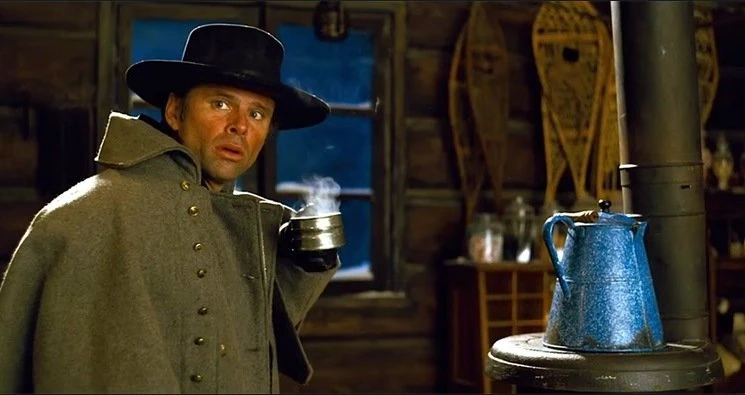
Renee: I really don't know. My first viewing, it didn't really concern me, I was caught up in what was going on, but on the second watch it became a more interesting mystery. If he's lying about being the sheriff, then surely he'd be in hot water once they all arrived, but we never get there, so there's no way to know for certain. I totally bought Tim Roth as the hangman, he seemed to know what he was talking about and had opinions that seemed formed through experience. Then we learn the truth about him, and it does kind of turn everything on it's head. If he's not really the hangman, despite being incredibly knowledgable and opinionated on hangings, then maybe Mannix is the sheriff, despite not acting like a sheriff at all.
Renee: I really don't know. My first viewing, it didn't really concern me, I was caught up in what was going on, but on the second watch it became a more interesting mystery. If he's lying about being the sheriff, then surely he'd be in hot water once they all arrived, but we never get there, so there's no way to know for certain. I totally bought Tim Roth as the hangman, he seemed to know what he was talking about and had opinions that seemed formed through experience. Then we learn the truth about him, and it does kind of turn everything on it's head. If he's not really the hangman, despite being incredibly knowledgable and opinionated on hangings, then maybe Mannix is the sheriff, despite not acting like a sheriff at all.
I thought it was an interesting way to present a character, especially after everyone else's lies and secrets came to the front. The question was left hanging there, but not in a way that made the viewer feel cheated for an answer.
I think we've proven there are a lot of things in the movie to think on long after the viewing, so this was almost like an Easter Egg - once you've picked apart all the lies and subterfuge, and considered all the issues brought up in the room, there's still something to chew on, even though it's of little consequence.
My assumption is that it was intentional. The last remaining mystery. You also have to consider that the final scene makes a good case that it didn't matter at all who Mannix and Major Warren actually were, in the end they were in the same position and suffering the same fate. They were even able to put aside deep seated differences to bond.
I also question whether Major Warren really met the General's son. He had a clear motivation for telling that story, it fit with what he said in the coach about the Confederate soldiers coming after him for the bounty, but it was almost too perfect. And we know Warren is capable of saying the right thing to people to catch them off guard and get what he wants. So maybe his story is just a story. When the General says "If he did what he went there to do, he'd have come home" it's easy to assume he meant that he went to kill Warren. But it doesn't exactly fit with the small show of respect the men give each other right before Warren tells the story.
Did you wonder about that at all?
Scott: I definitely wondered whether Major Warren's story was made up. He could have told that story just to upset the General as much as he could because he hates the man, or he could have told it to provoke the General into pulling his gun so he could have an excuse to shoot him. Even that small show of respect they share, how much of that was feigned by Warren to give him the excuse to get close to the General to tell that story? And what the nature of the job the General's son had in Wyoming was a mystery to me. Could have been he went to kill Warren or maybe something entirely unrelated. There are indeed a lot of little mysteries within the movie.
Thinking about it now though, this whole aspect of characters who say they are something but may in fact be something else. Maybe what Tarantino's getting at is the whole idea of self-invention. I mean, that is an idea so central to the whole US character and identity. In this country, supposedly, with all its fluidity, you can be what you want if you play the role and set your mind to it. It's the frontier, and if you go someplace new in the country, you can be someone new. Tim Roth's character sure does sound like a knowledgeable hangman and Mannix is or would like to be sheriff and Warren claims he secured a letter from Lincoln himself. American self-mythologizing and reinvention of self. In that way, by showing all these freewheeling unapologetic tall tale tellers, maybe the movie actually contains more optimism than is apparent on the surface.
 Renee: Ah, that is a great point. Tarantino said something in an interview I saw awhile back about how he's really writing about deeper themes in all of his films, but he does it through a totally different lens that what we might consider a "deep" movie. I think there's a case for the movie being about re-invention and self-mythologizing, for sure. That's especially interesting when paired with the point you made early on about the "alternate history" movies in his oeuvre being about revenge and creating a better (or at least more just) past.
Though, if everyone is putting forward what they want to be, rather than what they are, it does raise some interesting questions about Joe Gage's book and his relationship with his mother!
Speaking of family, Daisy's only real shows of emotion are directed at Jody (Channing Tatum). Another amazing piece of acting by Jennifer Jason Leigh, the look on her face when she realizes he's there says so much. We see a lot of sibling pairs in fiction and film, but it tends to be same sex pairs. There was something really amazing about how much was implied about their relationship in such a short timeframe.
There is some optimism, or at least some depth, in that as well.
You might have inadvertently convinced me that this was a "feel good" movie.
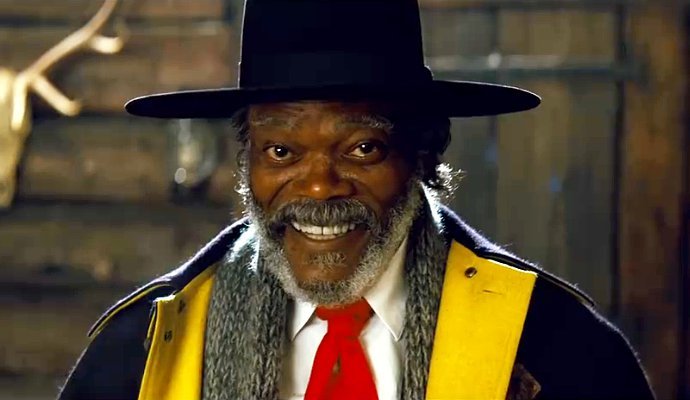
Scott: Haha. Tarantino's very violent, obscenity-laced feel good epic. That's as good a way as I can think of to describe this movie as we wrap up.
Friday, December 18, 2015
Alabama Worley, You're So Cool
By Renee Asher Pickup
I never got into romantic comedies. I can't suspend my disbelief, and half the time the woman "finding love" would be the bitch in a story told to you by your friends: "So then, she LEAVES HIM AT THE ALTAR and runs off with her high school boyfriend! Can you fucking believe that?"
But I do love a good love story.
Not many love stories are written with people like me in mind. Maybe my father over-romanticized Bonnie & Clyde when I was a kid, or maybe there is just something fundamentally wrong with the part of my brain that processes traditional love stories, but when I say "a good love story" I mean a story like True Romance.
There are a hundred different ways to approach explaining my love for this film, and how heavily it influenced what I consider "a good love story" and "a good crime movie" and "a good performance by Christopher Walken", but I want to focus on the real badass in this film:
Alabama Worley.

Look, Clarence is a sweet guy. Bama didn't choose poorly, even if marrying a guy on the first date is ABSOLUTELY INSANE. But the facts are the facts - without Bama, Clarence would have been dead three to five times in the course of the film. This movie could have been about a hooker with a heart of gold, but Tarantino and Tony Scott didn't take the easy way with any of the characters.
Arquette plays Alabama with a sweet sort of naivety that tricks the viewer into thinking she needs saving, but when push comes to shove - don't fuck with Bama. I don't know if Arquette going head to head with Gandolfini is the best fight scene I've ever seen - but I know that if you didn't fall in love with Alabama Worley the moment she starts laughing at him and flips him off you don't have a soul.

It's easy to forget that Alabama was already in a bad situation when she met Clarence. Whatever lead her to Drexl didn't take the childlike innocence out of her, but it definitely hardened her in ways we don't immediately see. She sees a pile of coke and her brand new husband and thinks "sure, let's do this!" You might even believe she just drifts into whatever life throws at her, hoping for the best, until you realize this woman actually laughed her way through a brutal beatdown and came out on top. Then, she doesn't run scared or go running to Clarence with second thoughts - she puts on her Elvis shades and gets down to business.
I have a real hard time with happy endings, I really do. The darker and ending, the better I like it. If this film had ended the way Tarantino originally wrote it, I wouldn't have minded one bit. But you can't help but be happy that Tony Scott changed it at the last minute (he really didn't decide to let Clarence live until midway through shooting the movie). I will go as far as to say, if it had ended with Alabama alone, driving away with the money, it would have been a killer movie, but it would have lost it's ranking as a "love story."
Regardless, Bama earned that ride into the sunset. She was hot on her feet and, as usual, took care of business.
Bullets are flying, Clarence is shot, no one is getting out alive. She doesn't run. She doesn't go somewhere to hide and cry. She gets the money, gets her man, and gets the hell out of Dodge. Nothing stops Alabama. Nothing throws her off her game.
She's so cool.
Friday, November 20, 2015
Ramblers, Let's Get Ramblin'
The first scene in From Dusk Till Dawn is a Ranger and a cashier talking the absolute worst shit you can imagine about a disabled kid. It's cringeworthy and terrible - and quite fucking perfect because when George Clooney pops out of the background and puts a gun to the cashier's head, the viewer doesn't mind one bit. Within seconds the liquor store explodes in an intense gunfight, and you don't even realize you're not rooting for the victims until the Gecko Brothers walk out of the burning building arguing like an old married couple.
I tell people all the time "From Dusk Till Dawn changed my life,"and they think I'm joking. I saw this movie for the first time with my parents, and none of us knew what was coming. I vividly remember both of them cursing my uncle's name for recommending "this stupid fucking movie."

I was exhilarated.
I was thirteen and had never seen anything like any of it. Forget the twist - the raw, unadulterated violence of it, the so-cool-it's-fucking-cold characterization of Seth Gecko, and the terrible unease I felt every time Richie had a scene - it was an awakening. I'd been writing for years at this point, something that had been encouraged by family and teachers, a lauded nascent talent, but I didn't even realize anti-heroes were a thing. To be honest, I didn't realize it when I watched the movie the first time or the fiftieth time. I was along for the ride and the only thinking I had time for was making a list of every Tarantino and Rodriguez film ever made so I could walk down to the video store and rent them (on VHS for 99 cents).
As I've grown up, watching the film over and over again, it's struck me that the real strength in this film is how it makes you love The Gecko Brothers despite them being two of the worst, despicable criminals to grace the screen. Is it controversial to say that no one sympathizes with a rapist? Probably not. But somehow you don't mind rooting for Richie, because the film manages to make you view him through his brother's eyes - is he fucked up? Sick? Wrong? Yeah, but Seth loves him. How much does the viewer have to love Seth to give a fuck about that?
It comes drips and drops. Of course, Seth is fucking cool. Everybody likes a cool criminal. He appeals to the part of all of us that wants to take whatever we want and ignore the needs of anyone but ourselves. Most works of fiction can get a long way on that alone, but if you're going to love him enough to love his brother, there's more work to be done. Seth doesn't want to kill you, but he will - even so, when he opens the door in the hotel room and sees what Richie has done to their hostage his horror is palpable. Seconds later, when he's shaking Richie, hitting his head against the wall, the horror is replaced by true helplessness. As we travel through Texas with the brothers we get to know Seth better. He won't kill unless he has to, he lives by his word, he loves his brother.

The genius part of this characterization, though, is how the film quietly shows everyone around Seth to be much, much worse than he is. The Texas Ranger and cashier come first, but then there is the news reporter grinning like an idiot as she reports on the body count they've racked up. At the Titty Twister, he reflexively knocks out the bouncer who comments on his young hostage's body. Seth may be a real mean motor-scooter, but he's a product of his fucked up world. When it comes time to lay it down and fight for survival, he doesn't let Jacob and his family down - he gladly joins up.
What makes Seth so relatable, so easy to root for, is the idea that he might not be that much worse than anyone else - he's just better at being bad. I mean, what's the big loss if he has to take out a couple assholes just as bad as he is?
A friend (Tony McMillen) once pointed out that From Dusk Till Dawn was just a new (and incredibly fucked) way of telling the story told in Of Mice and Men - El Rey is "the fat of the land", Seth and Richie the George and Lenny - cursed to be tied to one another on their ill-fated journey. Everybody's retelling an old story - Tarantino just added vampires.
There is something truly special about making people who are easy to hate easy to root for. FDTD makes it happen in the first seven minutes.
So yeah, I tell people the movie changed my life because instead of writing poorly realized love stories or Hardy Boys style adventures I was writing alternate endings to the Geckos story, hiding them behind passwords on my DOS word processor. Somewhere along the line I started writing my own characters, and while they may not be as cool as Seth Gecko, I hope they're at least half as tortured, one tenth as sympathetic in light of how terrible my characters tend to be.
I tell people all the time "From Dusk Till Dawn changed my life,"and they think I'm joking. I saw this movie for the first time with my parents, and none of us knew what was coming. I vividly remember both of them cursing my uncle's name for recommending "this stupid fucking movie."

I was exhilarated.
I was thirteen and had never seen anything like any of it. Forget the twist - the raw, unadulterated violence of it, the so-cool-it's-fucking-cold characterization of Seth Gecko, and the terrible unease I felt every time Richie had a scene - it was an awakening. I'd been writing for years at this point, something that had been encouraged by family and teachers, a lauded nascent talent, but I didn't even realize anti-heroes were a thing. To be honest, I didn't realize it when I watched the movie the first time or the fiftieth time. I was along for the ride and the only thinking I had time for was making a list of every Tarantino and Rodriguez film ever made so I could walk down to the video store and rent them (on VHS for 99 cents).
As I've grown up, watching the film over and over again, it's struck me that the real strength in this film is how it makes you love The Gecko Brothers despite them being two of the worst, despicable criminals to grace the screen. Is it controversial to say that no one sympathizes with a rapist? Probably not. But somehow you don't mind rooting for Richie, because the film manages to make you view him through his brother's eyes - is he fucked up? Sick? Wrong? Yeah, but Seth loves him. How much does the viewer have to love Seth to give a fuck about that?
It comes drips and drops. Of course, Seth is fucking cool. Everybody likes a cool criminal. He appeals to the part of all of us that wants to take whatever we want and ignore the needs of anyone but ourselves. Most works of fiction can get a long way on that alone, but if you're going to love him enough to love his brother, there's more work to be done. Seth doesn't want to kill you, but he will - even so, when he opens the door in the hotel room and sees what Richie has done to their hostage his horror is palpable. Seconds later, when he's shaking Richie, hitting his head against the wall, the horror is replaced by true helplessness. As we travel through Texas with the brothers we get to know Seth better. He won't kill unless he has to, he lives by his word, he loves his brother.

The genius part of this characterization, though, is how the film quietly shows everyone around Seth to be much, much worse than he is. The Texas Ranger and cashier come first, but then there is the news reporter grinning like an idiot as she reports on the body count they've racked up. At the Titty Twister, he reflexively knocks out the bouncer who comments on his young hostage's body. Seth may be a real mean motor-scooter, but he's a product of his fucked up world. When it comes time to lay it down and fight for survival, he doesn't let Jacob and his family down - he gladly joins up.
What makes Seth so relatable, so easy to root for, is the idea that he might not be that much worse than anyone else - he's just better at being bad. I mean, what's the big loss if he has to take out a couple assholes just as bad as he is?
A friend (Tony McMillen) once pointed out that From Dusk Till Dawn was just a new (and incredibly fucked) way of telling the story told in Of Mice and Men - El Rey is "the fat of the land", Seth and Richie the George and Lenny - cursed to be tied to one another on their ill-fated journey. Everybody's retelling an old story - Tarantino just added vampires.
There is something truly special about making people who are easy to hate easy to root for. FDTD makes it happen in the first seven minutes.
So yeah, I tell people the movie changed my life because instead of writing poorly realized love stories or Hardy Boys style adventures I was writing alternate endings to the Geckos story, hiding them behind passwords on my DOS word processor. Somewhere along the line I started writing my own characters, and while they may not be as cool as Seth Gecko, I hope they're at least half as tortured, one tenth as sympathetic in light of how terrible my characters tend to be.
 |
| Psychos don't explode when they're hit by sunlight, I don't give a fuck how crazy they are. |
Subscribe to:
Posts (Atom)