Showing posts with label bestseller lists. Show all posts

Saturday, April 2, 2022

What are Some Book Examples of The AC/DC Rule?

by
Scott D. Parker

Quick: What’s the most famous album by AC/DC?

If you, like me, instantly thought of the 1980 album Back in Black, you are not alone. It’s the band’s top-selling album and one of the best-selling albums of all time. But that seminal album never reached Number 1 on the Billboard charts. That was the next album, For Those About To Rock.

A year ago on the Hit Parade podcast, an episode dropped entitled “The AC/DC Rule.” This podcast discusses music history and quirky things about the chart performances of various songs and bands. It spent two episodes discussing what they dubbed The AC/DC Rule. Put simply, it’s this: there are famous albums by major musicians, ones we all know and love, with our favorite songs on them, but those albums are not always the ones that topped the album chart. It was the next album, the album that rode the coattails of the more-famous album to the top of the charts but may not be as fondly remembered or sold as many copies.

The episode details how Cat Stevens, Boston, Billy Joel, and others all experienced the AC/DC Rule. It happens for movies as well. The second Austin Powers movie, The Spy Who Shagged Me, scored more money in its opening weekend than the debut film did in its entire run.

The pattern exists for the second Pirates of the Caribbean movie, the second Hangover movie, and others. I can’t remember all the other albums the host, Chris Molanphy, discusses, but it’s a curious thing.

Which naturally got me to thinking about this rule for books. A few instantly jump to mind. The Da Vinci Code by Dan Brown was a massive success, but that was Brown’s fourth book. As well as Da Vinci Code sold, his follow-up, The Lost Symbol, sold a million copies on the first day. Yes, you read that correctly. Now, Lost Symbol ultimately didn’t outperform Da Vinci Code, but you can see the pattern.

I think it’s safe to say this kind of thing applies to debut authors as well. Be it music or books, it’s the dreaded sophomore slump. The debut album by Hootie and the Blowfish, Cracked Rear Window, sold more than 21 million copies. Their second album, Fairweather Johnson, sold only 3 million. Kinda funny to write "only" in that sentence. On the book side of the ledger, The Martian by Andy Weir and Ready Player One by Ernest Cline both took the world by storm but their next books did not meet with the same success.

I’ve been trying to determine if there are other books that fall into this category so that’s what I’ve been pondering this week. Can y’all help me?

Saturday, February 19, 2022

What Are the Famous Books of the 1990s?

by

Scott D. Parker

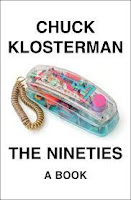
For the past couple of weeks, I’ve been listening to The Nineties by Chuck Klosterman. I’d never heard of him but the book’s cover caught my attention. Couple that with my son’s musical tastes currently residing in the 1990s and I thought why not take a chance with the new book.

It’s a fascinating read and I thoroughly enjoyed. I annotated my audible file with interesting clips and I’ve got the ebook on hold via my library to potentially re-read some passages.


Klosterman focuses on pop culture, politics, TV, music, movies as a means to explain that last decade of the century. It was only by the end that I realized something: I don’t think he mentioned any books. Which got me to thinking about an obvious question:

What are the famous books of the 1990s?


Okay, do something with me. Think about that decade and see if you can recall any titles or authors but do not use the internet. Heck, don’t even look at your bookshelves. Just see if you can come up with any famous books strictly from your memory. I’ll wait.

Okay, so how many did you remember? Truth be told, as I’m writing this, I have not yet turned to Google. I’ve not even turned my eyes to my various bookshelves. In real time, I’ve been thinking about this question, off and on, for about a day, and only in the last few minutes did I remember an author and book that emerged in the 1990s: John Grisham’s The Firm.

I struggled to even remember many books. I went through my mental Stephen King list but could only remember Bag of Bones from 1998. Grisham’s status as the premier writer of the legal thriller instantly brought his other books to my mind. And I think Midnight in the Garden of Good and Evil was a 1990s book. But those were all I can remember.

So, if you’ll excuse me, I’m going to Google now. I suspect I’ll have more than a few “Oh, right! That book!” forehead slaps but such is my memory.

And I’m back, and I’ve slapped my forehead more than once in the category of “How could I have forgotten that book.” Among the titles that slipped my mind are Jurassic Park by Michael Crichton (1990), The Bourne Ultimatum by Robert Ludlum (1990), Truman by David McCullough (1992; my historian cred just went down the tubes), The Bridges of Madison County by Robert James Waller (1993), Men Are from Mars, Women are From Venus by John Gray (1993), Primary Colors by Anonymous [AKA Joe Klein] (1996), and many books by Danielle Steel and Mary Higgins Clark. I used this site to get the Top 10 books per year and not what someone thinks are the important books.

How many did you remember? More than me? That’s good. Heck, I couldn’t even remember all the Stephen King books of that decade. And how many mystery/thrillers did you recall? The presence of Clark and Ludlum tells me that our genres was at least at the table—as was Tom Clancy (more than once) and James Patterson.

Here’s a larger question: how many of those books were influential? How many changed things? I’ll come back to the Truman biography. I was in grad school and in 1992, many of my professors grumbled at McCullough’s book because it was too popular. Like the study of history had to be impenetrable to be good. I, for one, appreciate it when a historian writes a popular enough book that it becomes a bestseller (or a Broadway musical). I saw more history books written in McCullough’s style after 1992 than before.

What is the Nevermind of Books?


What about fiction? Is there a Nirvana moment (there was a Before Nevermind and then there was an After Nevermind) or a Matrix moment (same concept) for books? Historically, I’m guessing something like Agatha Christie or Dashiell Hammett (The Maltese Falcon) or Raymond Chandler’s work (The Big Sleep?) or Mickey Spillane (Mike Hammer’s first book) or Ian Fleming (was he the first huge spy writer?) or Tom Clancy (techno-thriller) or Grisham (legal thriller). I guess Grisham in the 1990s can count as the guy who put legal thrillers back on the map (Erle Stanley Gardner’s Perry Mason was king but I can’t think of any other ones other that Scott Turow’s Presumed Innocent in the interim).

Now, I also admit that I also did a more specific search for mysteries and thrillers in the 1990s. Here is that link. This is likely not an end-all, be-all list, but something is obviously apparent if you scan the list: the large majority of top mystery books in the 1990s involve series characters. I counted twelve out of 100 that were not series related. My guess is that a respective list for the 2000s, the 2010s, the 1980s, will reveal the same thing. Series sell. It’s a testament to a certain type of writer who can publish different stories within a genre and not do a series.

This essay is a thought exercise but also a real question. Were there any truly game-changing books published in the 1990s? Did they influence pop culture? If not, when was the last time a book sat in the middle of pop culture and dominated the national conversation or, at least added to the greater conversation? (I’m mainly talking about fiction because there are certainly non-fiction books that have made their mark on society.)

Sunday, May 21, 2017

UnCHARTed Waters


Amazon has just thrown another rock in the pond of bookselling. 
It announced this week that it will begin publishing a weekly list of bestselling titles. Sound familiar?
Publishing bestseller lists since Rip Van Winkle was young.
Amazon will chart its top twenty bestsellers in fiction and nonfiction. This sounds similar to the NYT, or USA Today, or other such lists. But Amazon has a whole other level of data at its dot-com fingertips. It’s “Most Sold” list will include titles purchased or pre-ordered through Amazon.com, Audible.com, and Amazon physical bookstores, as well as titles borrowed through Prime Kindle, Kindle Unlimited, and Audible. That’s a heck of a lot more sales points than what other bestseller lists have access to.
But that’s not all. Amazon also will have a “Most Read” list, that tallies the average number of daily Kindle readers and Audible listeners for that week. Yeah. Back to that whole other level of data. No one else can compile that. Not even close.
This is particularly interesting to me in terms of pre-orders. Authors are told that pre-orders are extremely important – they gauge advance interest in the book. Now here’s something that will, theoretically, tell the world in real time (well, weekly time) how those pre-orders are coming along. This raises some questions for me. If a book that hasn’t even come out yet generates enough pre-orders, will it sail to the top of the list, thereby bumping off a hardworking, already released title? Will those books, likely by big-name authors with good name recognition, now gobble up list spots before and after they’re released, instead of just afterward, like with the already existing lists? Or will more bestseller real estate mean more spots for everyone? My cynic’s heart tends to think the former, but we’ll have to wait and see.
The New York Times recently eliminated its mass market bestseller list, which disproportionately impacts certain genres, like cozy mysteries and romances, that are published primarily in that format. No matter how many an author sells – oftentimes a lot more than a hardcover title – there’s no getting on the NYT any more. So will Amazon’s new Charts be a chance for those kinds of books to regain a bestseller crown?
Only time will tell. I, for one, will be watching closely.

Sunday, December 4, 2016

Tis the Season for Genre


It’s that time again. Holiday gift shopping. And it probably comes as no surprise, but I tend to give books as gifts. A lot. So I always peruse those holiday recommendation lists in generalist magazines and newspapers. And then I throw them out.
Because, really, how many literary novels or enormous coffee table books can one person be in the market for? The lists are pretty and prestigious, but they’re not practical as gift-giving advice. Because what do people really read?
Genre.
Crime fiction, science fiction, horror, romance, fantasy, western. Some people stick to one. Others freely admit to loving several. But their tastes are rarely – if ever – factored in when it comes to the gift lists in general publications. Genre is the dirty little word they won’t talk about.
To me, these lists should have two purposes. The first is to introduce people to books they might not otherwise know about (say, if there was a new ten-pound coffee table pictorial history of hard cheeses). The lists usually achieve this. The second goal should be to also recommend books that people would actually be interested in reading.
Forget about it. They don’t do it.
And this, especially to me as a former reporter, is just shoddy reporting. The list-makers should be examining the tastes of the book-buying public. It might be difficult and time-consuming and – oh, wait.
Bestseller lists. There are several, easily obtainable by pretentious listers and anyone else with an internet connection. And they all say one thing. Genre rules.
The most recent New York Times bestseller list for combined print and ebook sales has nine genre books in the top ten – one romance and eight EIGHT! crime fiction/thrillers. (The same thing held true the week before, with an adventure novel replacing the romance.)
And this trend has existed for a long time. People are putting their money where their bookcases are. They like genre novels. A lot.
So I’m going to go out on a limb here and bet that the kinds of books people buy are also the kinds of books they’d like to receive. That's the point of a gift, right? It should be the point of a gift recommendation list, too.