Showing posts with label amazon. Show all posts

Saturday, January 25, 2020

Year 5 of an Indie Writer: Week 4 AKA How Best to Sell Direct and Book Murder

by
Scott D. Parker

Other than my typical writing and publishing books this year, the big goal is to create an online store in order to sell my books directly to readers.

The thing is, how best to do it.

Why Sell Direct?


I've had a few folks ask me why I'm creating a website to sell books and other products directly to readers? Aren't there enough other places--sites like Amazon or Kobo or Audible--where users are more accustomed to go? Yes, there are. But there are some compelling reasons to try.

One, naturally, is money. Minus the transaction fees assessed by the companies like PayPal, I would keep a higher percentage of each sale. Nothing wrong with that.

Of more importance, however, is the bond between buyer and seller. As it is now, readers can buy my book via an online store and they will get the book. The store takes its cut and I get the rest. But the store is the middle man, and the middle man can make any rules he wants.

Take ownership. Right now, when you purchase an ebook from an online retailer, you only purchase the license. If the online store negotiates a new deal with a different company, then the book you paid for vanishes from your device. It happened this week with the game Tetris and it happened last year to owners of ebooks purchased via Microsoft's store.

A key component of any store I create is ownership. When I reader buys an ebook from me, they get the digital file. It'll be theirs to keep and do with what they want. Kind of like a paperback. Ownership. It's a fundamental thing for me, even though I still purchase ebooks via online stores. But at least I know it going in.

One might say, for example, that it'll never happen to Amazon because they're too big to fail. Well, so was AT&T in the 1980s.

Which Platform to Use?


When it comes to the selling platform, there are a wide range of choices. A friend of mine started up an online business in the last few months and he selected Shopify. They take any payment method he knows about and the onus is on Shopify to collect payment and distribute the money to his bank account. Now, you might think this contradicts my ownership argument, but when it comes to money, that's a whole other thing. Better to let Shopify, Stripe, or Apple take care of that.

Shopify has a decent number of templates you can use to get the store started. The minimum viable product, the MVP, or the 1.0 version of the store. I am simultaneously getting my store started while helping my wife get hers up, too. We can tweak as we go, so it's better to get it up and running.

Late this week, however, I learned about Payhip. Joanna Penn (as J.F. Penn) uses it and I dove into a bit of research about it. Payhip enables sellers of digital products (ebooks, software, music) to sell direct to customers. In terms of an MVP, I can enable Payhip on my author website with little effort, so I might try it first while I get the store setup.

I'll admit: I'm leaning to Shopify for many of the same reasons my friend used to start his store. If the new store grows rapidly, I can always upgrade along the way. It's remarkable the number of tools and services available to use creatives to distribute and sell what we make.

For any writers reading this, do y'all sell direct? I'd love to hear some real-world tales, pros and cons, about the various services.

Book Murdering?

As it does multiple times a day, the internet exploded when a tweet was launched into the world. As best as I can discern, writer Alex Christofi posted a photo on Twitter of a few paperbacks that were ripped in half. The reason: better portability.


I love physical books: the smell, the feel, the shelf appeal. I have long taken pencil, pen, and highlighter to the pages of books I'm reading. Always in the Bible, often in non-fiction, and occasionally in fiction books when I see a particularly good piece of storytelling. I dogear pages if I don't have a bookmark or if I don't have any post-it notes handy. Basically, I view the book as mine and I can do with it whatever I want in order for me to get the most out of the reading experience.

Maybe it's the ebook reader in me, but I can't imagine ripping books in this manner. Granted, I don't have a commute via mass transit where carrying a heavy tome is something I do. I do all of my physical book reading at home where this isn't an issue.

But I can't imagine ripping a book like this. I don't find it particularly abhorrent. See my rational for book ownership above. But if Alex or other use this method to get the most out of the words on the pages--the real reason you buy a book in the first place--who am I to judge.

They would look weird on the shelf, however. Then again, you'd know exactly which books you've actually read.

TV Show of the Week: Modern Love


Just got around to seeing this show. Holy cow, is it good.

Modern Love, on Amazon Prime, is an eight episode series showcasing not only excellent acting and storytelling, but the various ways in which people love each other. From romantic love to familial love, old love to happenstance love, this show is a wonderful reminder that kindness and love can pierce through the mundane and the sadness we too often see in our world. The full review is here.

Highly Recommended

Sunday, June 30, 2019

A Word-of-Mouth Business


I wrote a review this week—not for a book, but for a service. We had some construction work done, and the company did a great job. I told the owner that, and he said, “Do you ever go on Yelp?” Because that helps tremendously. Reviews get the word out, he said. Lets people know that you provide a good service.
I had to laugh—for two reasons. One, because of course I checked reviews before I chose a construction company. I went on Yelp and Angie’s List, and I carefully read what people had to say. That helped me steer clear of unreliable companies and make a good decision. So me taking the time to post a good review for the next folks looking for a contractor is extremely valuable currency for somebody in a word-of-mouth business.
I’m sure you’ve figured out the second reason why I laughed. Guess who else is in a word-of-mouth business? Me. And all authors. We’re just as dependent on reviews as that neighborhood contractor is.
Taking the time to post a review on Amazon or Goodreads is one of the greatest gifts you can give an author you like. It doesn’t have to be lengthy—one sentence is enough. And it doesn’t matter where you read it. If you checked something out at the library (yes, please do!), you can still review it anywhere you please. Because the blunt fact is, the more the better. The higher the number of reviews for a book, the more prospective readers it attracts. Because they legitimately want to know if a book is going to be worth their money and their time.  
I had a conversation recently with a lovely lady in my book group, who was gushing about a literary novel she’d just read. She said no one she talked to about it had heard of it or the author. I asked if she’d written a review. She said no, because she felt like she would be going out on a limb because no one else was familiar with it. But think about how valuable your review would be, I said. A glowing review for someone who only has a few would carry a lot of weight. It would be like you recommending it to hundreds of book clubs, instead of just to our little group. This lovely lady lit up. She hadn’t thought of it that way. I haven’t talked to her since, but I hope she wrote that review.

Thursday, January 17, 2019

The Evil We All Do


By David Nemeth

Prior to 2004, Google brought forth the idea of "don't be evil". Some held hope that this would come true, but alas, it did not. Facebook is the easy target for evilness. If they had access to your soul, Zuckerberg would sell it in a cyborg heartbeat. In fact, some of you have left the time suck that is Facebook and moved on, all while turning a blind eye to Amazon.

Most of us look the other way when it comes to Amazon. I know I do. Hell, over at Unlawful Acts, I have purchase links to Amazon. I'm a Prime subscriber and I even subscribe to Kindle Unlimited. And that's something I need to address, something I think we all need to address.

But let's forget about Facebook knowing your every move for one second and look hard at what Amazon is doing to its warehouse workers.
Timed toilet breaks, impossible targets and exhausting, “intolerable” working conditions are frequent complaints. Staff have been paid less than the living wage, and it even emerged drivers had faced fines for “early” deliveries. (The Daily Mirror)
Even when Amazon gives raises, its workers fume.
But in Amazon warehouses across the country, many longtime workers are fuming that — based on the information they have received so far — they may end up making thousands of dollars less a year. 
Yes, Amazon is increasing wages, which will benefit most employees. But it will no longer give out new stock grants and monthly bonuses. Some workers believe that means their total compensation will shrink.
Hell, even the white collar workers have got it bad.
At Amazon, workers are encouraged to tear apart one another’s ideas in meetings, toil long and late (emails arrive past midnight, followed by text messages asking why they were not answered), and held to standards that the company boasts are “unreasonably high.” The internal phone directory instructs colleagues on how to send secret feedback to one another’s bosses. Employees say it is frequently used to sabotage others. (The tool offers sample texts, including this: “I felt concerned about his inflexibility and openly complaining about minor tasks.”)
So while you think it's great that you left Facebook 'cause you need to protect your privacy––that you're making a stand against the man––I ain't too fond that you're out there shilling for Amazon reviews to try and beat that algorithm. Fuck the guy standing 12-hours a day at the printing press shipping your $17.99 print-on-demand book out. Am I right? But at least you're off Facebook.

Not cool, bro, not cool at all.

Friday, March 30, 2018

Sex OR Violence

Vice published an article outlining how Amazon has (again) throttled erotic books on their site. The official statement from the retail giant is that it was an accident, and it's fixed now, but this isn't the first time Amazon's policies and practices with erotic books has affected the authors that depend on Amazon for the vast majority of their sales.

I find it interesting because our genre never comes under attack here. Even the ones that feature a lot of sex (many Amazon romance authors report being labeled erotica when they were simply "hot" romances). Seems crime fiction writers can have their characters shoot at each other, stab each other, beat the living shit out of each other, and whatever else we please because we haven't made the mistake of focusing on sex (or being a female dominated genre that deals with love - oft regarded as the most feminine genre, and not surprisingly, oft the most derided).

It's unsurprising that Amazon's policies would favor violence over sex. It's an American tradition, after all. Recently, a tv series I enjoy, (The Last Man On Earth) featured Fred Armisen as a cannibal. We saw him murder and eat people, we saw him dig a corpse out of the ground and eat various parts of his body, and finally, we saw him blow himself up with a puzzle box bomb. But when Will Forte and Kristen Schaal's characters have sex it's an awkward, perfectly still scene, just as last week's SNL featured a "sex scene" that featured a fully clothed woman on the lap of a fully clothed man - perfectly still. Both shows have confirmed it was to appease network censors. See - you can slit throats, eat corpses, and be blown to smithereens on network TV - but if two people wiggle a little during sex, all hell breaks loose.


In a society overrun with violence, and with weird, often harmful views of sex and sexuality, we're still letting whatever violence creators can imagine through, and hiding any instance of two people enjoying each other in a sexual way. This is not to say that violence in books or on TV causes violence - all the strange dancing around sex in entertainment hasn't stopped us from fucking, after all. But it's worth questioning why we accept increasing levels of violence in our entertainment, but freak out if we think a kid under the age of twenty-one might see two people go at it, even in a show like Last Man where the characters were not only married, but actively trying to have a baby. They're straight, too - if it were a porn, it would be the kind that's inexplicably marketed to hardcore religious people.* Still, the sex can't even be a little sexual.

It's weird, right? I don't have an answer, and this isn't exactly a new viewpoint, but I wonder when the reckoning is going to come. When are we going to talk about our weird attitudes about sex in entertainment in a meaningful way? How did we become a society that's okay with blowing up Fred Armisen on Prime Time but not with wiggling on late night TV?

I don't mind violence in my entertainment - some of my favorite books and films feature enough of it that they're routinely labeled "gratuitous." I don't think violent entertainment causes violence. I do think having extremely permissive ideas about hurting people, versus extremely strict ideas about pleasing people is unhealthy. The ideas behind the actions are what worry me. America has some shit to sort out and this is only the beginning of the beginning.


*remember when that was a big news story? A Google session couldn't confirm that it's still a thing.


Sunday, May 21, 2017

UnCHARTed Waters


Amazon has just thrown another rock in the pond of bookselling. 
It announced this week that it will begin publishing a weekly list of bestselling titles. Sound familiar?
Publishing bestseller lists since Rip Van Winkle was young.
Amazon will chart its top twenty bestsellers in fiction and nonfiction. This sounds similar to the NYT, or USA Today, or other such lists. But Amazon has a whole other level of data at its dot-com fingertips. It’s “Most Sold” list will include titles purchased or pre-ordered through Amazon.com, Audible.com, and Amazon physical bookstores, as well as titles borrowed through Prime Kindle, Kindle Unlimited, and Audible. That’s a heck of a lot more sales points than what other bestseller lists have access to.
But that’s not all. Amazon also will have a “Most Read” list, that tallies the average number of daily Kindle readers and Audible listeners for that week. Yeah. Back to that whole other level of data. No one else can compile that. Not even close.
This is particularly interesting to me in terms of pre-orders. Authors are told that pre-orders are extremely important – they gauge advance interest in the book. Now here’s something that will, theoretically, tell the world in real time (well, weekly time) how those pre-orders are coming along. This raises some questions for me. If a book that hasn’t even come out yet generates enough pre-orders, will it sail to the top of the list, thereby bumping off a hardworking, already released title? Will those books, likely by big-name authors with good name recognition, now gobble up list spots before and after they’re released, instead of just afterward, like with the already existing lists? Or will more bestseller real estate mean more spots for everyone? My cynic’s heart tends to think the former, but we’ll have to wait and see.
The New York Times recently eliminated its mass market bestseller list, which disproportionately impacts certain genres, like cozy mysteries and romances, that are published primarily in that format. No matter how many an author sells – oftentimes a lot more than a hardcover title – there’s no getting on the NYT any more. So will Amazon’s new Charts be a chance for those kinds of books to regain a bestseller crown?
Only time will tell. I, for one, will be watching closely.

Saturday, May 6, 2017

The Magic of Advertising...Naturally

By
Scott D Parker

So on 1 May, I tried something: I advertised my books. It wasn't like I've never done it before. I've had people review my novels and the stories ever since I begin publishing them in 2015. I have promoted them on Facebook, Twitter, my own blog, and the blogs of other folks. Some have even been nominated for awards, giving those stories a little extra push.

But until this past Monday, I have never actually purchased any advertising. I now have.

On 1 May, I relaunched my re-branded westerns, all now having S. D. Parker listed as the author. And, as a further experiment, I put them in Kindle Unlimited. At this stage of my career, it seems like a good time to try going solely with Kindle. Lastly, I bought my first Facebook ad. I have hit publish for eight stories so far. That first one was scary, the one with butterflies in my stomach. Pretty much every other story I have published since then was exciting, but not nearly as exciting as that first book. I had an equal type of reaction when I clicked promote on that Facebook ad. It was exciting, a little scary, but mostly it was thrilling.

Later on this past week, I also began running ads on Amazon itself. The irony is that a mere three days after that Facebook ad, I had no issues hitting promote on Amazon's site. I guess you could call that experience.

The results were not immediate on the Facebook ad. Let's be honest: most of us have a vision that when we  submit an advertisement, the readers will pour in. That never happens of course. This publishing business is long term. Sure there are some overnight sensations, but for the vast majority of us, we are in it for the long-haul, the slow burn and build up of awareness by readers of our work.

The Amazon ads, however, produced some immediate results. On the first day I ran the ads, I earned some page reads. The day after, a little more. I am not one of those people who checks their sales ranking constantly throughout the day. I am a writer. Therefore I write. But it was fantastic to see movement.

So for all you fellow independent writers out there, what type of advertisements do you run? Where have you had success?

Thursday, April 13, 2017

Chatting with Harry Hunsicker

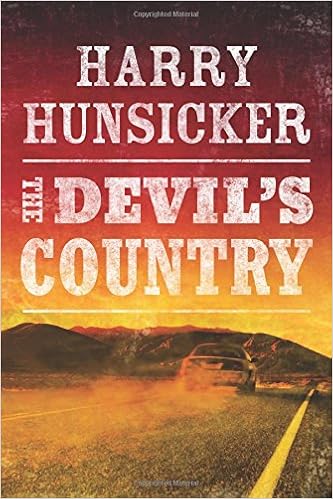
THE DEVIL’S COUNTRY (Thomas & Mercer) is a heart-stopping new thriller from award-winning author Harry Hunsicker, former executive vice president of the Mystery Writers of America. In the vein of True Detective, THE DEVIL’S COUNTRY features a troubling small-town murder and asks the haunting question: Does the devil live in your own backyard?


After losing his wife and child to a violent crime, ranger Arlo Baines wants nothing more than to disappear in the dusty badlands of West Texas. But when a young mother turns up murdered, Arlo becomes the primary suspect in the exact kind of crime he’s desperately trying to forget. Now, it’s up to him to clear his name and find the dead woman’s missing children, all before a corrupt local cult can exert its influence over the town and its residents.

Harry Hunsicker is a fourth-generation native of Texas and author of seven novels. His work has been shortlisted for both the Shamus and Thriller Awards.


Steve Weddle: Your publisher refers to THE DEVIL’S COUNTRY as a “21st-century western.” Other than being set in the southwest, what does that mean?

Harry Hunsicker: True story: I didn't realize until the publisher start working on ad copy that I had written a western. The story is set in the current day, so how can that be, right? Looking at the book after some time has passed, I realize now that the main character is cut from the same cloth as the rugged loners in all those Clint Eastwood movies. So in that sense the book is a western.

SW: Arlo Baines finds himself working with a newspaper reporter. What makes Hannah Byrne a good companion in this mystery?

HH: Hannah Byrne is a reporter for the New York Times who arrives in this small town in West Texas much like Arlo Baines does, with no connection to the area or clue about how things operate in that part of the world. In some sense, she's a wanderer much like Arlo is. But because she's reporter she's very inquisitive by nature, which proves to be a big asset for Arlo.

SW: What’s the town of Piedra Springs like, and why is it a good setting for this story?

HH: Piedra Springs is a fictionalized representation of what is going on in rural areas across Texas and the rest of the US. Short version: small towns everywhere are dying due to a lack of economic opportunity. People are leaving, and those that remain have a certain fatalistic outlook toward life.

SW: How is Arlo Baines different from Jon Cantrell?

HH: Arlo has a lot more baggage than Jon Cantrell. Arlo is a luggage store, he's got so much baggage.

SW: What is it that readers and writers find so interesting about characters with baggage, about damage and redemption?
Harry Hunsicker


HH: In regards to baggage, I think readers relate to characters who offer a glimpse into their own lives. I.e. everyone has some baggage.

SW:  You're working now with Thomas & Mercer after earlier books with more "traditional" publishing. How has that gone?

HH: Working with Thomas & Mercer has been a wonderful experience. They understand books and more importantly how to sell books.

SW: You're doing video promotion for this book?

HH: I'm very happy and honored that THE DEVIL'S COUNTRY was the only second mystery/thriller selected by Thomas & Mercer to be part of a program called Kindle in Motion, essentially a new format for consuming stories. Imagine a graphic novel where the graphics are moving images. So if the text reads "A guy walks into a bar" there's a short looping video of a man entering a bar. (Kindle in Motion is only available with the e-book version. No extra charge.) These videos and some stills are scattered throughout the book and are designed to make the reading experience more immersive. For THE DEVIL'S COUNTRY, the publisher created a short script based on my story, hired actors and a production team, and filmed in Nevada for a week last November. I was fortunate enough to be able to spend a couple days on set which was an incredible experience.

SW: And you're working with Alison (Janssen) Dasho? Does it get any better?

HH: Alison is a great editor. I loved working with her on the Cantrell series. She has transferred internally to Montlake so for THE DEVIL'S COUNTRY I was fortunate enough to work with another all-star editor, Jacque Ben-Zekry.


--

THE DEVIL'S COUNTRY published April 11, 2017.