There is a
homage to character and story and a great actor today in the New York Times. Michael
K. Williams, who played Omar Little on The Wire, died this week. And showrunner
David Simon remembers him through the lens of his commitment to the story they
were trying to tell.
“What are we
going to say this year?” Williams would ask Simon at the beginning of every
season, as the show shifted from the Baltimore streets to its port to its city
government, schools and newsrooms. And Simon had to answer Williams’s question,
had to articulate his vision and his reasoning. What a gift for a writer to
have a person like that in her or his corner—one who forces you to explain
yourself. I know my stories are better when I have to do that for someone. I can only
imagine if that person was someone of Williams’s exceptional talents.
It's hard to believe, but Omar Little (The Wire) may not have been played by Michael K. Williams. There was a real possibility that the role of Leonard (Hap and Leonard) could have gone to someone else.
It's easy for those of us who love his performances and (like Obama) agree that his character on The Wire is a memorable stand-out.
Omar's so popular he's got several supercuts of clips on Youtube that keep popping up, years after Omar and The Wire took their last bow.
Michael K. Williams isn't shy about crediting the role with altering the course of his life.
Imagine if he hadn't decided to give acting a final try.
Imagine if his mom hadn't given him a loan so that he could make that attempt.
The truth is, many artistic types suffer from self-doubt and rejection along the way. It's easy to get discouraged. No matter how nice and supportive a lot of people in your industry are on the surface there are always going to be those people who will try to bring you down. I just had a chance to chat with Dana King about his latest book and he talks about some of the issues female authors face as just one of a number of gender-related issues that inspired his story.
I got a lesson in perseverance from my 3rd cousin, Deric. Same age. Same home room in high school. Different paths in life. He quit college, packed his bags and moved to Nashville. And when his debut CD came out he wrote about spending 10 long years deciding whether to buy groceries or pay the electric bill while he struggled to get his break.
This would be the same guy who's had his own successful career as a Canadian recording artist and as a popular songwriter. If you've listened to popular country music on the radio then you've heard something that Deric penned.
I'd always wanted to write novels and I felt shamed that the only thing I had to do was invest my time and energy and I could write from the comfort of my own home. I didn't have to move to Nashville. I didn't have to struggle to pay the bills while trying to pursue my art.
Deric talked about seeing people come and go from Nashville. All he could say was to keep chasing your dream. You couldn't give up.
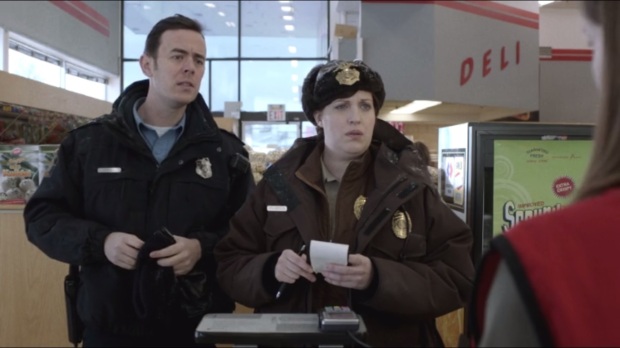
It will come as no surprise to anyone who knows me that I'm a fan of the Fargo TV series. There are few crime series that I think rival The Wire as best ever, and Fargo is a contender for the crown. The first two seasons of Fargo have been exceptionally tight, for viewers like myself, who love a series with a long overriding arc and strong characters, Fargo is top shelf.
We've recently been re-watching Fargo in preparation for the upcoming third season. It isn't necessary. Each season is a standalone season, with a different story. Most of the characters are different, and in the case of season 2, the few returning characters are much younger than they were in season one, and you're delving into a part of their history that informed them in season 1.
The real reason for the re-watch is simple. This is a great show that holds up to repeat viewing. As I told Brian yesterday, I think it's more enjoyable the second time around because there are so many things you pick up on that make more sense or have relevance that you may have missed in the first viewing. The attention to detail is phenomenal, and it's just that layered.
The series has been filmed in Calgary, Alberta, and the surrounding area. That's never bothered me at all, even as someone who lived in Calgary and the surrounding area for many years. In season one, a key part of the story includes Stavros Milos, who started Phoenix Foods.
The actual grocery store used? My grocery store, from when I was in college. I lived about a block and a half from it.
Parts of the show have been filmed in Beiseker, where my ex and I owned a house and lived for several years. And another filing location is the Beiseker library... A place that I worked at. Other locations included Bragg Creek, where North of 60 was filmed.
Personally, I'm really excited to see familiar sites and how they play out on the small screen. However, I also realize that this season will cut the closest to home. There may be flashes of stores I shopped in dozens of times, as well as restaurants I ate in. And part of the backdrop will be a place I worked in for a period of time.
While I don't think that will detract from my enjoyment of the show at all, I'm aware that when things cut close to home for some people it can be very distracting. How many cop shows follow police procedure to the letter? How many police procedures follow every detail precisely? They don't. Reality is almost always filtered to accommodate the needs of fiction.
The balancing act that writers must contend with is weighing the needs of the story versus the credibility of the content. When you can get a reader or viewer to completely embrace your work and dispense disbelief, or buy into your fiction, then you can successfully tell your story.
The setting may inform the story. There are things about specific places that, if gotten wrong, may make a local cringe or even abandon a story. I think as a Canadian, I'm accustomed to the distortion of Canada in story. One of my favorite slips was a reference to a town named Muskoka, when Muskoka is a district and not a town. Others might ignore than, but when you grew up in a town in Muskoka you can't deny they didn't do their homework. Did I stop watching the show? No. Canada is used as a fictional film backdrop for so many American shows it's just become something I think we overlook. Fargo isn't the first series to feature filming in Calgary or the surrounding area, and it won't be the last.
The authenticity of the experience informs the art. How many of you have had that moment, when something in the fiction spoke to you as being so real that you connected with it deeply? I had that reading Laura Lippman's To The Power of Three, because the description related to the foot injury was so real that I - as a person who had their foot partially severed as a child - knew Laura must have suffered a foot injury she drew inspiration from, which she confirmed in an interview I did with her over ten years ago. Or when I read the opening of The Murder Exchange, and knew - as someone who almost drowned as a child (I was a nightmare kid, okay?) - that the author must have had an experience where they thought they could die.
When a setting I know is utilized in a way that creates a new setting, that makes it really become the fictional universe, it enriches the story. Done wrong, it can be a black mark. It's easier to do this in film than it is in books, but if you feel daunted by writing about a setting that you haven't visited or lived in, consider this: most people determine whether a work feels authentic to a location based on their perception of the location, rather than their experience with it. Sometimes, being believable is more important than reality... And if you're really stuck, there are usually community associations where you might be able to get in touch with someone who is more than happy to answer your questions and help you create an accurate representation of their world.
Back to Fargo, I'm going to put this challenge out there. If you haven't experienced Lorne Malvo messing with the minds of those around him for his own amusement, if you haven't watched Mr. Wrench and Mr. Numbers in action, if you haven't experienced Mike Milligan and the Kitchen brothers, if you haven't watched at least one season start to finish and weighed it as a whole, then you cannot argue that there's a better crime fiction show currently on television. This is one of the best shows that writers can watch to study villains who are so damned entertaining, you almost hate to see them brought down.
Rewatching The Sopranos of late has got me thinking about crime fiction and television. Crime is a great source of drama, and crime shows are among some of the most popular scripted shows that people watch on the box. At their most basic, they are crime of the week shows, at their most complex they become stories as much about their time and place as they do about providing that vicarious thrill of watching bad things happen without the consequences affecting our lives. Here are my top 10 crime shows and the reasons they work.
10 - Crime Story
This was the show that really introduced the world to ex Chicago cop Dennis Farina. Made in the 80s, it was set in the 60s and faced off Farina's cop against an up and coming mobster first in Chicago and later in Vegas. The first season was stunning, with memorable guest stars (including a young David Caruso, Pam Grier and Miles Davis) and an ending that left the viewer slack jawed. The second season stumbled, but perhaps this was because no one thought they'd be back. Yes, its a little disjointed in an 80's way, but it was one of the first shows to really try and create an arc for its characters and for the most part that first season stands out as a trailblazing template for modern crime dramas.
9 -Life on Mars (UK)
John Simm was the lead, but the star of the show was Philip Glenister as DCI Gene Hunt. A TV show about a modern cop travelling back to the un-PC seventies sounded daft, but somehow everything about this series came together in exactly the right way. It only lasted for two seasons, and that ending resulted in a number of debates about what actually happened, and if the producers had been smart that's the way things would have stayed. Sadly they made a sequel set in the 80s which made Gene the lead and provided a few dissapointingly definitive answers that really negated the power of the original show. But LoM was one of the finest British dramas of its time, and the crime drama aspects of its scripts were rarely less than compelling, drawing great paralells between what Britain was and what it had become.
8 - OZ
This prison drama was frequently unsettling, massively melodramatic and never less than utterly compelling (although frequently, one would feel the need for a long shower after watching: this was one disturbing show, not for the easily offended). There were no good guys - the best you could find was amorality - and the violence was frequently shocking and unexpected. Adibissi ranks as one of the most memorably terrifying characters of all time, even if his little hat defied the laws of physics. Brave, bold, a show that tried to ask tough questions about the penal system and even if it all got a little surreal (the musical episode was both brilliant and head scratching), and occasionally too focussed on the horrific violence inside a max security pen, there's no denying that it was hugely powerful and often debate provoking television.
7 -Braquo
I love french crime dramas. The ones they make for the movies, anyway. Their TV has been more hit and miss until a little show called Spiral (Engrenages) came along and paved the way for a new way of looking at cop shows. Written by an ex cop, Braquo took the baton offered by Spiral and ran with it. Its a show about corrupt cops, about good people doing bad things, about how power can corrupt. Its a show with a spiky edge to it. And its utterly compelling. If you haven't seen it, seek it out, now. I'm just about to hit season 2 and I can't wait...
6- Homicide
Homicide at number 6? Oh someone's going to lynch me for this. Homicide was a brilliant, brilliant show. But it was interesting how its early grittiness (the first season was based quite closely on David Simon's brilliant Baltimore reportage) gave way to a cleaner cop drama that nevertheless retained its bite with some great central performances. I still think killing John Polito was a mistake, but luckily the show continued to impress with a career defining role for Richard Belzer (his character, John Munch, has now appeared on around a dozen other shows including, bizarrely, Sesame Street) and the constant presence of the brilliant Yahpett Koto as the squad commander. And of course, there was always A brilliant show, even
5 - Justified
Based on my favourite Elmore Leonard creations - US Marshall Raylan Givens - Justified had a strong first season that really grabbed me. Mostly it was the cool moments cribbed from Leonard's own writing, but it was also something in Timothy Oliphant's turn as Givens that grabbed me. Then Season 2 came along, turned everything on its head, ensured that this was a drama that was about more than just solving a crime. It became a show about families, about what they mean to us. And it quickly became one of the best goddamn shows I'd seen in a long time. Effortlessly cool, and unexpectedly smart, Justified is absolutely brilliant television.
4 - Spiral
The show that changed French TV for the better is a labarynthe, complex series that owes a huge debt to America's THE WIRE in the way that it mixes procedural machinations with a cynical examination of the justice system in modern Paris. The cops are flawed human beings, the judges are subject to their own failings and the criminals are often far more complex than we might at first assume. Every season works in its own story arc, but threads that you thought long gone soon re-emerge when you least expect them. This is appointment TV at its finest, and crime drama with a brilliant coating of true French cool.
3 - NYPD Blue
This is the one that might get me in trouble as a lot of people do prefer Homicide to Blue. But frankly Blue is the show that really got gritty first. Those first few seasons, where Andy Sipowicz was at his drop down drunk worst were compelling television as Blue presented cops who were every bit as human as the people on the mean streets they patrolled. And while, like Homicide, Blue got more comfortable in its later years, the creators acknowledged this by refocussing the show on Andy Sipowcz's evolution. And any show that can take the lead from early 90s sitcom Saved By The Bell and make him into a credible and - more importantly - a foil for Dennis Franz's powerhouse performance as Sipowicz deserves to be hailed as a classic.
2 - The Sopranos
The two and one slots are interchangeable in my book. The Sopranos is simply one of the greatest character studies ever committed to television. Tony Soprano is more than just a mob boss; he's a barometer of the times. He's all our worst instincts in one empathetic package, and even when he tries to do the right thing, its often in the wrong way. That any show can make us care for not only Tony but his wholly sociopathic crew is a minor miracle. But care we do, so much so that when that final shot aired, you could hear the collective gasps of nations of TV viewers who all took something different and personal from the meaning of those final moments.
1 - The Wire
After the dry run of Homicide and the HBO adaptation of The Corner, David Simons produced this incredible examination of the modern world wrapped up in the guise of a crime show. More than cops and robbers, The Wire was all about the evolution of a city, a microcosm of humanity on a larger scale. It was a show about injustices on small and grand scales. It was about how all our lives are determined by larger forces. It was about how we must recognise injustice to make any kind of chance. And it was about some of the most complex and most completely human cops ever put on television. The Wire was television as novel, and frankly, it reinvigorated the television cop show to remind us of the power of visual storytelling and how it can be as subtle and thought provoking as any straight prose.
For those wondering, there are shows I have missed. The Shield, for example, never really quite worked for me. Mostly down to Vic Mackey, a character who never really evolved over the show (although that may have been the point) and the fact that the show reveled a bit too much in its own over the top approach. I'm not denying its fans, but it never quite held together for me. Law and Order and CSI were all huge shows, but again they never worked for me in the same way that many of these shows did. And yes, I have a US bias, but its the same as in my reading that there's something about the US way with dialogue that always seems to work for me. Its a personal list, so feel free to disagree in the comments or remind me about the great goddamn TV crime shows I may have missed...
This week, I have finally been indulging properly in the first seaosn of Boardwalk Empire, over a year after everyone else managed to see it. But, hey, I've never been one for keeping up with the zeitgeist.
What initially impressed me - before anyone uttered a word - was the incredible opening sequence. There was a feeling for a while that opening titles were going the way of the dodo. And after years of generically bland "introduce the characters" titles, a-la CSI, you could see why. A spot of soft rock. A bunch of shots of the main cast with their name underneath. Job done.
But opening titles, when done well, are masterpieces unto themselves and introduce you completely to the tone of the show. Boardwalk Empire's music is perhaps a little anachronistic, but the great, sweeping shots of all those bottles of booze and Buscemi on that beach are just brilliant
The opening credits of a TV show have to put you in the right frame of mind. In the case of Dexter, the juxtaposition of such odd shots of everyday life put you right into the mind of a central character who doesn't see life in the same way that we do. And of course all that blood (and keptchup) reminds you of the basic tent of the show, with Dexter being a blood spatter analyst moonlighting as a serial killer (or is that the other way round?):
But its not just the most recent shows that had great opening sequences. The opening credits of Crime Story, from the 1980's were quite brilliant, but then that show still has, in many ways, a massive influence on modern TV:
And of course, I won't post them all here, but THE WIRE, went a great stage further with its opening credits, changing them from season to season to highlight the different themes involved. By changing the artists recording the main title track, they managed to ensure that each season felt utterly different from the last and yet somehow connected:
I guess you could say that the opening credits of a TV show are something like the cover of a book: they are the first thing the reader/viewer sees, and they sure as hell have to give an idea of what the books are about. And while many of them are generic, those that are unique or truly inventive, tend to stick in the mind.
I think it would be entirely fruitless to compare The Wire and Breaking Bad. It's the kind of pointless exercise that bloggers use to fill up their word counts. That said, I shall now be comparing The Wire and Breaking Bad for around 1800 words.
Firstly a quick warning. I've not seen all of Breaking Bad, today's piece will be assuming the show finishes with that final shot of season 3. If you've seen all of both shows, you're good to go. If you've seen anything less than all of The Wire and the the first three seasons of Breaking Bad, then stop now, there be spoilerybeasties here.
Secondly, this is written because I read this piece from Chuck Klosterman. I'm writing as much out of reaction to that than I am to the shows themselves. There are times when my blogs come with a required reading list. This is one of those times.
I'll wait right here.
Okay, why did this essay inspire me to write? Well, with all due respect to it's author, I think it's playing fast and loose. It singles out Wire fans for being obstinate, and effectively turning the subjective into the objective (I like the show, therefore it's the best show ever, and here are the facts why, and I don't care about your facts.) Before pretty much doing the same thing for Breaking Bad. Its also makes some points that I think are gross oversimplifications of both shows.
Can we draw a distinction between the two? Sure. It's one I may well contradict later, but here we go; The Wire is social fiction, Breaking Bad is a morality play. The Wire requires that you see the broad canvas, that you see the characters in context of the large machine. Breaking Bad (at least at the point I'm at) has remained a very tight and focused show, the cast hasn't expanded much past a couple of additions in three seasons, the locations tend to be the same select few on rotation. The Wire presents you with an ever expanding cast of people to follow, and it's down to us to debate if one or two of them represent the heart of the show. Breaking Bad would be just as effective if the morality play was pared down to it's two central characters, Walter and Jesse, in a dark room, debating ethics every week; the other characters are there to reflect changes in the central two, they are extensions of Walter and Jesse.
So there we go. That, I think, is the key difference between the two shows. Which is why my mind started to click and whir when Klosterman started talking about other differences.
His key argument seems to be this; Breaking Bad is the crime show that gives it's characters individual agency. To which I'd say; on the surface, sure. It is a morality play, after all. The appearances are that Breaking Bad is just about the choices these guys make, and the slippery slope that leads from good to bad. But every time people start talking about morality in fiction, they're really giving away more about themselves than the fiction (me included.) And I think simply stating that BB is the "only one where the characters have real control over how they choose to live," is an oversimplification, as well as revealing a set moral world view.
I find BB to be a very religious show. This is me as a total non-believer. I wasn't raised with god, and my views on morality come from human ideas of right and wrong, rather than any inbuilt wiring of commandments, hellfire and heaven. To watch the domino effect that leads from one choice made by a science teacher in the pilot episode, to two passenger planes having a head-on collision in the air space directly above that teachers garden at the end of season 2, is not to watch a show that is all about individual agency.
(Lets not mention the bullet that somehow falls from the hitman's pocket and lands exactly where Hank will need to find it)
You can call it contrived coincidence, call it cosmic coincidence, call it plot device, call it what you will; there is very definitely agod in the Breaking Bad machine. I'd go one further, and say there is something very old testament about the show. It's a show that needs to believe in wrath and punishment. Right from the start we were shown that everybody is a sinner in one way or another, from abusing their authority, to smoking illegal cigars, to infidelity and lying, almost everyone so far has transgressed, and every one of them has been punished. It even has it's biblical figures; the serpent trickster in the form of the very broad Saul Goodman -who pops up every time Walt's conscience is getting in the way to push him further astray- and the cold, calculating devilish Gus -who is waiting to suck you into his game and then destroy you. They are the two characters who seem most out of sync with the rest of the show when first introduced, as if plucked from another show and dropped into the narrative, yet both become important parts of the machine. Is it any coincidence that Saul was the gateway to Gus? I wouldn't be surprised if (in season 4, which I haven't seen yet, or season 5, which nobody has seen yet) we see the progression from old to new, and we begin to see Christ metaphors and symbolism, and if, indeed, one character has to choose to die for the sins of others.
None of that is said as criticism. I don't make these points to lessen the brilliance of the show. I simply make them because I think that to say Breaking Bad is the show about individual agency is to miss the point.
If I were to extend the above argument, I might say we're looking at a show that actually dislikes its people. It's waiting to sit in judgement, waiting to punish. By the same token, I always found The Wire to be a show that loved its characters, and worked to show you that love. It was the system or the game that the show hated, not the people.
For all it's talk of gods, and all David Simon's talk of classical Greek tragedy, the religion of the show was all man made. The system was the god. The game was the god. The drug was the god. Ultimately, the stats were the god. There was no cosmic coincidence, there was no hellfire, and there was no guarantees that doing the wrong thing would lead to punishment.
I find it bizarre that anyone would remove the concept of individual agency from The Wire, when so much of it's drama revolved around the tension between that concept and the game. The two notions were pulling at each other. Sure, the system chewed people up again and again. However, the characters who took the choice to remove themselves from the game, the characters who reached that level of almost spiritual self enlightenment, walked free and clear. I'm thinking of Poot, who chose to get out in time. I'm thinking of Bubbles (my favourite character) who is last seen earning a place at the family table after removing himself from the game. I'm thinking even of McNulty, who's personal demons are so at odds with the system that he realises he needs to engineer a way out of it, and finally looks at ease with himself once he's reached that point in the final episode. Even the most preternatural of the characters, Omar, was given the choice. He was given an out from the drama many times during the shows run, but chose his fate, he could not remove himself from the game because of his ego. Do we want to rob the shows amazing cast of characters of their small incremental choices over 5 seasons by saying that it's the show without individual agency?
Klosterman also argued that your liking of The Wire would come down to how much you agreed with the world view of it's creator. But if that premise is true, then surely it's true of both shows? David Simon has talked often about the messages he wanted to put forth in The Wire, and about his views on the end of empire. Vince Gilligan, creator of Breaking Bad, has also put his arguments forth. Here's an example;
I hate the idea of IdiAmin living in Saudi Arabia for the last 25 years of his life. That galls me to no end. I feel some sort of need for biblical atonement, or justice, or something. I like to believe there is some comeuppance, that karma kicks in at some point, even if it takes years or decades to happen. My girlfriend says this great thing that’s become my philosophy as well. 'I want to believe there's a heaven. But I can't not believe there's a hell.'
So Breaking Bad is just as much an authors statement as The Wire. It's an attempt to put some sense of order onto our world. As much fun as it may be, as much whimsy and invention as it shows along the way, it's very much boiling down to an author saying that, yes, drugs are bad and a fervent prayer that these bad people face some kind of punishment.
Breaking Bad is a morality play with a set moral view. It's a show that needs there to be a sound if there's nobody around when the tree falls in the woods. The Wire, by contrast, is a show with a more fluid moral compass. The sound of the tree falling is dictated by whoever is present to hear it.
I think both shows are fantastic achievements. I could even make the argument that they belong together, as book ends on any shelf full of crime fiction; different takes on similar questions. There's no reason to try to objectively place one above the other.
Subjectively I prefer The Wire. I don't think that comes as a surprise to anyone who reads this site. It ticks a few more of my boxes, and I prefer it for the same reason that I like Dickens (take a drink if you're playing at home) and Steinbeck. But if David Simon wanted to mine pre-Shakespearian drama for his story-telling, then there is definitely something of the bard in Breaking Bad, there are healthy doses of the up close and personal morality tales of Macbeth and Othello, and I love those plays, too.
Due to the fact that I'm working like hell at the moment today's post is neccesarily short and has pushed back my talk of three films of the eighties I loved. Hopefully next week we'll continues my SHADOWS RISING redux.
One of my favourite movies of the moment is TINKER, TAILOR, SOLDIER, SPY. Its a film that I know many people won't enjoy. Many people will, in fact, scratch their head and wonder how this movie is getting the acclaim it does. After all, its just a bunch of middle aged guys in suits talking cryptically for much of the movie, while the star, Gary Oldman, says as little as possible.
And yet its amazing film-making and an enthralling story. The story is tense, the threat palpable, the sense of realism absolute. This is spycraft at its most natural. Forget Bourne or Bond, the reality is that being a spy is a job like any other. And this movie - about the hunt for a mole in The Circus - captures that perfectly without resorting to the hystrionics or melodrama of most movies.
How?
By relying on character and treating the audience with respect.
The other week The Literary Critic and I watched ALL THE PRESIDENT'S MEN. Again, a thriller with very little in the way off kiss-kiss-bang-bang, it was all about people and wrapping the audience up in the conspiracy unfolding on screen. It was a film done through implication and character rather than punctuated by car chases and explosions. It was the perfect starter course before the main course TTSS.
Both films made you work to get the rewards, but that was what made them feel special and made their journey worthwhile. Yes, you had to pay attention. You couldn't drift off thinking about that text you needed to send or that email you had to reply to. You lost yourself in the minds and worlds of the characters on screen. You started - like Gary Oldman's Smiley - paying attention to the details, to what characters said and what they actually did, looking for the tells that would implicate the liars, and genuinely caring about who would and wouldn't be found to be wrapped up in the conspiracy that so perturbed our point of view characters.
With TV show THE WIRE, David Simon said he wanted to re-educate us on how to watch TV. He wanted us to start paying attention to each scene, to each detail. TINKER, TAILOR, SOLDIER, SPY does this for the movies, now. The movies that used to - in the 70's - be superior to television have started more and more to rely on the same cheap tricks and easy manipulations that used to define TV shows. Films like TINKER, TAILOR, SOLDIER, SPY that reward the audience for paying attention , that remind us of the joy of actual engagement with storytelling, are hopefully a marker that we are moving away from this again and back to solid, intelligent entertainment. Turn your brain on - after having it had switched off for so long - and you might find that entertainment is even more rewarding than you might think.
I had a dream the other night that Laura Lippman tried to kill me. That's about as noir as it gets, when someone as nice and warm as Laura could be a villain. I mean, if you can't trust Laura, you better live with your back to a wall.
At the time, it just seemed like one of those bizarre things, born out of a combination of odd thoughts that included driving through Federal Hill, talking to someone about The Wire, and the sobering reality we've had to deal with at school, with one of our students recently being shot and killed. Under normal circumstances, I'd prefer not to have my two lives collide on the blog here. But this will be relevant later, and that's why I am including the link.
Now, I wonder if the dream might have been a bit of a premonition, because days later, I find myself writing a blog post on a topic I hadn't even considered a week ago, and referencing a comment Laura made at Bouchercon Baltimore almost three years ago.
This is off of memory, from three years ago, but this is what I remember. Laura was on a panel, and someone in the audience asked why there aren't any black crime fiction authors. Laura was quick to point out that she was surprised the person hadn't seen Gary Phillips that weekend.
In no way do I intend to single Laura out or pick on her for a comment that, in the context it was made, was reasonable. The reality is, her panel wasn't on that subject in particular, nor was there time to dissect the issue in any way that would do credit to it... and unless I'm completely off my rocker, I believe Laura went on to say that. It was just one of those things that came up that someone needed to graciously sidestep, under the circumstances.
So, it is not that the issue wasn't discussed then and there that has me referencing the incident.
It's really, the fact that we never seem to go on to actually have that discussion as a community. In the context of the situation, Laura did what I do so often. She pulled out one random example to disprove an absolute.
But the reality is, attend Bouchercon, attend Harrogate, attend Bloody Words or any other mystery convention, and the overwhelming majority of those attending form a monochromatic crowd.
That being said, like Laura's panel at Bouchercon, the purpose of my post is also not to talk about where our black or Asian crime fiction authors are.
What's really on my mind is the issue of criticism and its validity within any given community, and the question of what responsibility we, as writers, have for the stories we tell.
I love it when Brian tells me he's done something on Spinetingler that's generated a huge controversy, and spawned blog posts and comments by the dozens. Specifically, I love that if there's any fall-out from the controversy, he gets to wear the egg and take the blame, and I can step in as editor-in-chief and appear reasonable and mature while I clean up his mess.
Or not. ;)
The other day when Brian told me that a post on Spinetingler had yielded dozens of comments, with no end in site, I suddenly became aware of the fact that a review of a short story was causing a huge controversy.
The review in question is Benjamin Whitmer's review of a James Reasoner story in DANGEROUS GROUND, a collection of Western Noir stories published by Cemetery Dance.
Whitmer explains, in a lengthy commentary, why he feels the story in question follows the format of an Indian-hater story, and why he takes issue with the story Reasoner wrote.
Now, many of us know James (if not in person, then online and through his writings and our interactions with him, and I'm a huge fan and have great admiration for James). And many of us also know of Ben Whitmer. He knocked my husband's socks off with Pike and won a Spinetingler Award. In fact, I do believe when Brian mentions Ben, there's a touch of reverence in his tone. At least, as much as is possible for a lapsed Catholic evolutionist to muster, but in the same way that I have a dedicated Rankin section in our library, I can imagine a future where Whitmer's works become top shelf works.
We love both authors, and I'm not interested in taking sides. Part of the reason is that I don't believe there are sides to take. Whitmer has acknowledged in the comments what Brian and I already knew - that James and Ben have been in touch. Nobody's asking for the post to be removed. The main people involved here have conducted themselves with class and everyone's fine.
While I have read Whitmer's lengthy analysis, I have not read the short story he's writing about, and that was deliberate. I did not want this blog post to be misconstrued as being about James, or his story. If it's about any part of the controversy, then it's about the comments that have appeared and the way some have reacted to Whitmer's review.
I do believe that we have a responsibility, as writers, to consider what we write. We can't dismiss everything as simply art. If I were to write a story today about an African-American president being caught in some sort of political scandal, it would almost certainly be interpreted as a political commentary on President Obama, even if that wasn't my intention. (I mean, I define courage in the county where I live.)
Whatever we write, however, it can be framed by its time and every single piece of art created is interpreted through pre-existing filters that people bring with them.
I feel fairly confident that people who are gay are more likely to pick up on homophobic slurs than I am. I actually tutor students taking writing diplomas, and one of the assignments in the business writing course involves re-writing various statements, to remove bias. One of these sentences refers to a 'Jewish fire'. I had to look up what that was, and I've had other students admit they had no idea what the term meant.
Jewish students know, though.
We all bring our own filters to what we read, and that affects how we interpret things. Sometimes, it greatly discolors and distorts everything, far beyond reasonable criticism.
Other times, we're dead on the money.
That's why I included the link to the story about the student at my school that was shot and killed. It makes me sick to read the comments people have posted. The blatant racism and discrimination that's reflected by those comments is disgusting.
But this is the world we live in. We afford people anonymity on the web, so they speak without censor or concern for respect, or evidence of their assertions. And it's too easy in a city like Baltimore to dismiss this type of crime because of the reputation the city has.
What kills me is that people don't see the wonderful city that I see. Sure, Baltimore has its faults. Every single place on earth does. But I have spent the majority of the last two years working with students in Cherry Hill. And although I work with special needs students who have unique challenges, the student body at large embraces and accepts them as their own. When I walk into Southside, students hold the door for me, talk to me, and I enter a community. When a boy put his hands on me elsewhere in the city and hurt me, it was the students from Cherry Hill who stepped up to send a message, that nobody was going to hurt me again. Protected. Cared for. One of the community.
A community where I've never been met with racism or discrimination. A community where people reach into their pockets and help others out. A community where people sat silent in the halls, after we learned of the shooting, and young men had tears in their eyes and young women wept.
Marcus always said hi to us when we walked by him in the halls. 'Hi' in Cherry Hill might sound more like, "S'up," but it's a greeting all the same.
There is never any joy to be found in the tragic, violent death of a young person, ever. Unless you're a racist. And I don't even need to qualify my statement with referencing the fact that he was an athlete. Someone who was working on making a better future for himself and his family.
Marcus was a human being. And anyone who thinks a 19-year-old is beyond redemption because of where they live or the color of their skin or who they're related to is a racist, and no better than an Indian-hater.
But I must admit, perhaps today, if I read a story about some young person being killed, with any kind of inference that they deserved it because they were born of a certain ethnicity, in a certain place, and maybe even were related to people who'd made some bad choices… Maybe if I read a story like that today, I'd be pretty offended.
I have a filter. And there are raw emotions at work. And the comments left on a news story about a student prove the existence of racism in our society.
As an author, I have to acknowledge that there should be a separation between myself and the characters that I write, and that the story needs to create that separation. That's part of my job, and that's why I'm not too fond the idea of authors creating protagonists that are thinly disguised incarnations of themselves. If you admit your protagonist is based off of yourself, and then your protagonist makes racist statements, readers have a right to connect those dots.
Authors also have a responsibility to justify the content of the story and make sure it's relevant to the story being told. If offhanded, racial remarks are made throughout and have nothing to do with the story being told whatsoever, then people are going to wonder about the author and the author's views.
Same if the author has women being mutilated for no reason that's even connected to the main story.
Can I write a story about a Native American who spurns acts of kindness and slaughters countless whites in his quest for revenge without being racist, or an Indian-hater? Absolutely. The key is in justifying within the story why it is that the character refused forgiveness and was unable to make a different choice, and it needs to center on the character rather than his ethnicity.
And that's the subtlety of it all. Sometimes, as authors, we intend to convey things that we don't actually put on the page. And sometimes, as authors, we have to own some responsibility for that.
Like I said, I'm not taking sides about who's right in the Whitmer-Reasoner debate. I wanted this post to be about something bigger than that, and that is our fundamental obligation to consider the impact of our story, how it may be interpreted, and whether we've done our job to ensure the story is interpreted in the way we intended it to be.
I want people to realize that racism and bias and sexism… discrimination in all forms... exists. To deny that reality is ridiculous. As writers, if our works are grounded in the "real" world in any respect, we have some degree of responsibility to acknowledge that and be sure our stories don't perpetuate stereotypes or biases we don't intend for them to convey.
As Brian once said on Twitter, "If all the women in your novel are a) hot b) fuckable c) in to the protag d) all or some of the above. Then your book has a woman problem."
And if every male character I write thinks with his dick and spends all his time trying to get into some woman's pants, I have a problem writing men.
You can't write and only ask for people to love you. You have to acknowledge that some may love you, and others may loathe you. If I'm driving in my car and Wintersleep comes on, I have the right to turn it up. And someone else has the right to turn the radio off.
I think racist attitudes are pretty dangerous, but when we circle the wagons defensively and refuse to even have the discussion about discrimination, racism, sexism, the biases of our society and how that may shape our fiction and our community… That's even worse.
At Dachau concentration camp, there's a twisted metal memorial outside. It isn't until you get closer that you realize the metal is in the shape of bones and bodies, piled on top of each other. And in multiple languages read the words, "Never Again."
I watched the Berlin Wall come down, and nobody I knew felt it more than my German friend, Susie, because she had lived with the repercussions of WWII in a way that none of us North Americans had.
As a Canadian, I never fully comprehended the depth of the scars of slavery on the United States and how they still affect generations of people until I married an American and spent time living south of the Mason Dixon line.
It's unfair of me to completely dismiss an intelligently and respectfully offered opinion with no consideration of the potential validity of the perspective offered. I may still come away believing the person wrong, but knee-jerk defensiveness is part of what prevents us as a society from moving past our prejudices.
As writers of crime fiction, I would expect us to be more aware of how the ills of society hurt us all.
Or are those that say people read crime as safe wish-fulfillment/fantasy because we're all just one blow-out away from going postal closer to the truth than I'd like to believe?
And, in other news...
Spinetingler expands in June with the launch of a press. More information to come at spinetinglermag.com