Showing posts with label Country Hardball. Show all posts

Thursday, December 10, 2020

Beau plays hardball


This week, Beau Johnson takes at look at Steve Weddle's Country Hardball, a novel-in-stories.

"Downright dazzling." -- New York Times Book Review


"This debut collection of 20 tales takes a close, respectful look at poor folks in contemporary rural Arkansas. Dark, noirish and worth a look." --Kirkus Reviews 

"Ex-con Roy Alison would like to go straight, but he can't seem to make up for past mistakes . . . Weddle's debut novel is a suspenseful series of interrelated stories . . . of people facing nothing but bad options, though Roy eventually manages to make something good come from his situation." --Publishers Weekly

Get your copy

Thursday, July 31, 2014

Noir at the Ballroom

By Steve Weddle

Thanks to the efforts of Ed Aymar and others, the inaugural DC Noir at the Bar was a fabulous success. People showed. Drinks were gedrunkened. Stories were read. People were met. Book were sold.

The event was held at the Wonderland Ballroom on Kenyon which, as it happens, is rather a steep hike from Dupont Circle.

I read "Purple Hulls," a short from COUNTRY HARDBALL.

Also reading were these talented folks:

Nik Korpon

Ed Aymar

Tara Laskowski

Alan Orloff

Art Taylor

Meredith Cole

Thomas Kauffman

Michael Underwood

Ben Sorenson did a fabulous job videoing the readings, and you can find the complete list here.

Here is Ed Aymar -- aka EA Aymar -- reading a delightful story in which the narrator encourages his mistress to kill herself. Ed is the author of I'LL SLEEP WHEN YOU'RE DEAD, available through Black Opal Books.


And here's the link for my reading of "Purple Hulls." This is the link.

Wednesday, April 30, 2014

Holly's Turn: My Writing Process

by Holly West

My esteemed colleague, Steve Weddle, asked me to participate in this meme about writing processes. He's the author of COUNTRY HARDBALL, the editor of Needle Magazine, and is, in general, someone I like a lot. So of course I said yes.

The thing is, I only recently realized I actually had writing process. It was borne of necessity, when I found myself under contract to write a novel with a deadline six months away. Given its origins were defined, at least somewhat, by sheer desperation, this process is subject to change, but for now, it seems to work.

1) What are you working on?

A standalone (with, as they say, "series potential"). The working title is NOSE DIVE and it's set in contemporary Venice Beach, featuring a female amateur sleuth who tends bar at the fictional Luca's Lounge. Luca's was inspired by the Townhouse, one of the longest "continually running" bars in Los Angeles. During prohibition, the top floor operated as a grocery store and the basement was a speakeasy; illegal shipments of beer and whiskey were smuggled into the bar through tunnels under the old Abbot Kinney Pier.

2) How does your work differ from others of its genre?

I'm not sure how to answer this question, other than to say that the themes I explore in my writing are unique to me, regardless of genre. Which isn't to say that some of the themes I'm interested in exploring aren't universal, but my take on a given subject is always going to be unique to me, and I'd say the same is true for other writers as well.

Does that make sense?

3) Why do you write what you do?

My chief goal as a writer is to entertain, and to me, crime fiction is entertaining. If I'm somehow able to engage a reader further by making them think more deeply about the human condition then so much the better, but it's never my main concern.

4) How does your writing process work?

It starts with a spark of inspiration. In the case of my current WIP, the Townhouse intrigued me because of its history as an illegal speakeasy. Something interesting could happen there, no?

From that spark, comes a whole lot of thinking. What is the story? Who is the best person to tell it? What is their backstory? Who and what do they care about? I write a short biography of my protagonist and briefer sketches of the supporting characters, along with basic timelines of their lives before my story took place.

I outline as much as I possibly can before I actually start writing. Act I--the set up and such--is easy. I usually know who the dead body is from the beginning, but figuring out exactly how he/she got that way is the hard part. My husband and I have at least one long brainstorming session to suss it out. I give him the bones of the story and then we bat ideas back and forth until something sticks for me.

Once the outline is finished, I write a synopsis, from which I try to smooth out any developmental issues in the plot. Then I write the first draft as fast as I can. If I've outlined everything in advance I can do this in 30 to 40 days. Then I do a revision, let my husband read it, then do a second revision or however many are needed to get the novel into shape.

Of course, I'm greatly oversimplifying my process. This doesn't take into consideration the many days and nights I spend fretting about not writing well enough or not writing at all. It doesn't take research into account (which includes drinking Buffalo Trace Old Fashioneds on Saturday afternoons at the Townhouse). But it gives you a glimpse of how I write a novel. It worked once, at least. I'm hoping it works again.


Thursday, October 31, 2013

Steve Weddle & Country Hardball - Part Two

By Jay Stringer

Earlier we dropped part one of a pretty lengthy-wise interview with Steve Weddle. Here's part two. 


Country Hardball, out now. 

“Country Hardball is a searing portrait of an America most people would rather forget, where life is cheap, grudges never die, and dinner is always in the microwave. Steve Weddle’s poignant, powerful prose brings it to life in all of its desperate passion and hopeless aggression. Once I started reading, there was no way I could look away.”
—Hilary Davidson, author of Evil in All its Disguises


Steve Weddle & Country Hardball; The DSD interview. Part Two.

-Do you think ‘voice’ is something writers should be conscious of?
I think writers can be conscious of voice, and I think that's a problem. Writing a story and thinking about voice is like crossing a canyon on a tightrope and looking down. You can get too conscious of that, and it can be crippling. I'd try to read what I'd done the day before to proof along and also to get back into the voice, to remember whose story I was telling. If I thought too much about it, I had to stop. I'd get to where I was writing a parody of myself and it was no good.
-How did Indy know to close his eyes when they opened the Ark?
Indy who? Is this from a comic book?
-Well, thanks for asking me to talk at length about RAIDERS OF THE LOST ARK, and how its climax works because it serves the characters emotional arc rather than the plot, and how everything that is great in fiction is influenced by this film (even the things that were written before it came out.) But, honestly, we're here to talk about you. You mentioned people who need to have their stories told. Is that where you find yourself now, looking to tell the stories that aren't being told?
I think what I so often find myself concerned with is the emotional arc of my characters' lives, while the plot is the thing that gets them there. Like this movie I was watching the other day about some old man with a whip trying to get a box away from the Nazis. What was more important, it seemed to me, was how the characters were developing, how being faced with adversity forced them to search for this thing they'd lost, and the thing wasn't just a MacGuffin box.

In the stories I want to tell, the writer and reader get invested in the characters, in the world. If I'm going to do justice to the characters and make something worth the reader's time, I'm going to develop the storyline, of course, but I'm going to work to understand the characters, to see how their choices create them, how they impact the world around them. As a writer, it's up to me to thoroughly understand a character, to see both sides of the coin. If I can do that, then I can delve deeply, hopefully digging in the right place.
- You're with TYRUS BOOKS. It's a real sign of quality writing to see their logo on a book. How's it feel to have Country Hardball join that family?
It's pretty cool, isn't it? Many years ago, I started paying close attention to Bleak House Books, which was Ben LeRoy and Alison Janssen (now Dasho). They had all kinds of great authors and wonderful books and clever ideas. They had the Evidence Collection, which put in a rap sheet and fingerprints for the author. I have one of Neil Smith's books like that. And they had a signature collection. And a subscription plan, too.
So I got together what money I could and sent off for some collection they were offering. I think it was three books from the signature collection for $50. Something like that. I got a huge box of books back with a note (pictured) from Alison -- someone I didn't know at all at the time -- that said they'd run out of some of the books and she'd pulled copies from her shelf and had to substitute some hardbacks even though I'd only paid for paperbacks. I thought that was amazingly nice. You know, personal and thoughtful and all. I know now that it was perfect Alison. Fast-forward years and years and my agent is texting me from a conference where she's talking to Ben LeRoy about Country Hardball. Ben is doing Tyrus Books now and Alison has taken a job with Amazon at that point.

Though we'd talked to other people about publishing Country Hardball, we knew Tyrus was the perfect fit -- personal and thoughtful, just as Alison had shown years ago. I have all those Bleak House books, along with the subsequent Tyrus titles, on a shelf in my library. Inside one of the Nathan Singer books is the note from Alison. 

How does it feel? It feels like it's the way it was supposed to happen, you know? It feels perfect and great. It feels, I don't know, it just feels all of it. Every bit of awesome.
-Okay. So Country Hardball is out right stinking now. Why the hell should people buy the book?
I'm told the print version is in stores, too. I think people who like a good read should buy the book. I've worked hard in trying to tell the stories of these people, from the teenage boy just trying to understand the world to middle-aged people who understand it too well. I'm not saying this is the one book you should buy this year. The Shining Girls is a great read, for example. But if people think they might be interested in reading about the working class in rural America, about people who just need that one push to do bad things, about people who keep pushing back trying to not do those bad things, about the brutality we level against each other from credit card debt and workplace furloughs to attacks of cancer and assault, this is a book they should consider. Especially if they want to read about people trying to fight against the bullshit in this world.

-What are you working on next?

If you've gotten to the end of Country Hardball, then you know that Mabel Murphy is abducted by aliens during a Los Angeles Lakers game. I'm working on the backstory to those aliens and why they are forced to share umbrellas.


Oh, Country Hardball? Sorry. Yeah. Well, in that book, Roy Alison is looking for answers about what happened to his grandfather. I've had to go back to 1933 Arkansas to find out. The next book follows some of the characters from Country Hardball into the next year, but also flashes back to 1933 and 1955. It's a difficult, layered story, but the first one took me 42 years, so I figure I've got time.

What are you working on, Mr. Stringer?

-Lost City, the third book in the Eoin Miller Trilogy (three books...I'm told that's how a trilogy works) comes out in January, and I would be mighty grateful if people would read it. Buy it first, then read it. As for the next project? I'm cooking it now. It's set in Glasgow, a move away from my usual stomping ground, and it's something akin to an episode of The Rockford Files if made by the Coen Brothers. 

I know i vanished from DSD without much of a word; I'd like to thank everyone who worked with me on the site over the years, and all the readers who came back to read my ramblings week after week. I'd also like to say that I haven't left completely, I just needed to focus on other things for awhile. I'm sure I'll be back to stink the place up at some point. 


Wednesday, October 30, 2013

Steve Weddle & Country Hardball - The DSD Interview.

By Jay Stringer

We pinned our resident evil genius Steve Weddle down to a board and pointed a fricking laser beam at his middle bits. He asked us if we expect him to talk and we said, uh, yeah. He said....okay.

The real reason we pointed a beam of hot light at his third favourite feature was to get him to open up and talk about himself. And his writing. And HIS BOOK. YES. BOOK. You won't find a harder working or more supportive person in the crime fiction community than Steve Weddle. But what's most annoying is that he writes bloody good stuff, too. Country Hardball is the kind of fiction I like to read, and the kind of fiction I wish I'd written.

Here's part one of the epic chat. Part two will follow in a few hours. As soon as I've cleared the content with our lawyers.

Steve Weddle & Country Hardball; The DSD Interview. 


-What's your favourite swear word?


I think I first encountered the word "cockchafer" in a David Lodge book, though it could have been Kinglsley Amis, I suppose. I thought it was a terrific insult, suggesting that perhaps the person in question had undergone only limited training as a prostitue and, therefore, was not terribly good at the profession. Turns out it's a type of bug, like some weird bee. Which makes me love the word even more. I called someone a "cockchafer" a couple weeks back in an Applebee's in Tennessee. True story. It went over about like you'd imagine. 
-They say 'those who can't do, teach'. You've done both. Do you think creative writing can be taught? 
You're confusing writing with speed, I think. You can't teach speed.
What you do if you're working in a creative writing class, I think, is teach various aspects of the writing life. You can look at examples of pacing. You can talk about whether this story of yours has an effective opening. Neil Gaiman said something about how when people tell you that your story didn't work for them, they're right. But when they tell you how to fix it, they're always wrong. To me, that seems something good that can come from a creative writing class. Having others read your work, getting their comments. You don't have to be in a classroom. You can have peer groups. And there are other options. I just finished teaching a seminar online for the smart folks at LitReactor, who seem to have this down to a science.

-Is there any particular quality that makes a good student? Is there any one trait that you can see in them that makes the difference between the ones who will finish a book and take it to the next level and the ones who don't?
I've worked with students writing fiction and reporters writing (presumably) nonfiction.  The trait that marks the successful writer, it seems to me, is curiosity, which is a kind of energy. You can fuel a day of writing the novel because you want to see what happens to these characters. You want to know why a member of the town council voted in a way against the interests of his constituents, so you dig a little deeper. You want to learn about your characters, your setting. I can teach commas and pacing, but I can't teach curiosity. 
-Is that curiosity what fuels your own writing? What is most important to you as you sit and start a story?
I'll start a story with character and action. Sometimes, I'll start with two people talking about A Thing. I'll work through this to get to what's going on and why. I don't recommend my process as an example for anyone, but this is how I usually work. Pen and paper, trying to track along as best I can. Sometimes I'll build around a line of dialogue, sometimes around a piece of action. There's this scene in a Nightwing comic book, of all places. He says to some bad guy, "I know a dozen ways to break your arm. Pick a number." So you can start with that, then write your way along either side to figure out how we got there. You figure it's taking place in a back alley, so you move it to a church and see what happens. You change things up from where you first think of them. You send this tough guy into a scene with a broken-down man and you have things turn, so that the tough guy is at the mercy of the old man. You start with a thing and just keep working through it, wondering "What happens if I do this?" and that's how you start a story. Or, you know, that's how I start a story. Maybe you do things differently.   
-I tend to start with 'which Daredevil story or Alan Moore comic haven't I ripped off yet?' Do you think about genre when you write?
I don't give a damn about genre. And I certainly don't try to paint by numbers or write to formula. Some people do, and when they're done, you can't see the numbers underneath. Some writers can use an outline beautifully, can put that rising action right on the page it's supposed to go when you're writing to such-and-such outline. But if I were to do that, you'd see lines between the 3 block that was supposed to be blue and the 4 block that was supposed to be green. With other writers, you just see a wonderful piece of writing and you can't notice how they got there.
I've worked on writing a real mystery novel. I've read through about what you're supposed to do and not do. And I've read novels where, when I go back later, I can see all these points where they followed the formula. But I didn't notice that when I was reading. I could be a lousy reader, I guess, but I think mostly I don't notice because those writers are good at what they do. If they're writing a YA dystopian novel, then they do these things at these points. I'm not that good at that, I guess.
There's a story in Country Hardball called "This Too Shall Pass" that opens with a couple of teenagers lying down in field, looking up at the stars. When the book was going around a while back, someone pointed that story out as a YA story. I didn't, and don't, think of it like that. It's a story. And there's another story in that book that someone has called a horror story. Again, that doesn't make sense to me. My pal Soren Kierkegaard equated labeling to negating, which makes sense to me.
I don't set out to write a noir story or a horror story or a love story. I just set out to write a good story, the one the characters deserve.

-Okay, but seriously, what label would you give to Country Hardball? (Ducks.) Actually I think you can tell a lot about someone by seeing what book they throw at your head when you get 'em angry.
Yeah, I don't know how that helps. Do you only read Grit Lit? Rural noir? Then you're doing it wrong. If you're looking for a book that's easily categorized, you probably don't want to read Country Hardball. Look, in all honesty, I've read a dozen Inspector Morse books and thoroughly enjoyed them. British mystery. You know what you're getting, like eating at McDonald's. But if you're trying to label Old Gold and you give it the term "British mystery" then you're doing the Morse fans a disservice because Miller is not Morse. Sure, Old Gold is a British mystery, but that's not all it is. And it really isn't that at all, is it?
I think what happens is that people work to label books because it's an easy shorthand to talk about a book you don't really understand or don't care about understanding. I could talk for an hour about Holly West's Diary of Bedlam and tell you all about the characters and the intrigue and the setting and you'd run out the door to grab it. Or I could tell you it's historical fiction and that would make your choice for you. Also, I think it's called Mistress of Fortune now. Bonnie Jo Campbell writes magnificent midwestern noir, which is great unless you only read northeastern noir.

-If you write like me, and I'm meaning in terms of following a character and seeing what happens, that can mean getting a few thousands words into a project before you really know if you have a story. Old Gold was a short story that turned into a novel by accident. So did Country Hardball grow out of a "write and see" approach, or did you sit down and think "I'm going to write this set thing."
I wrote a few Roy Alison stories and my agent -- our agent -- suggested writing a Roy Alison novel. I think the line was "This is so much better than that other stuff you're writing." So I started a novel, but it didn't quite come together. Then I realized that the book was really about the community, about the different people in that area and how their lives intersected. I started working on stories about these connections. So instead of having a character move about the UK midlands, for example, I worked on stories about the place itself and the people there, about how one family can be fighting against  this type of loss while another character sees this little shard of hope in the distance. Eventually, after a great deal of work, these stories came together in what I hope is a book that is coherent in its fragments.
-Something that I really remember about reading the early Alison stories was how strong and clear the voice was, that they felt like the kind of stories you should be writing at the moment.
Thanks. 

-Did you notice that as you were writing?

My pal Julie Summerell said something online a few years back about wanting to be better, wanting to do better. Maybe she was talking about a character in a show or a book or just a random fleeting thought. I don't remember the context, but I remember that idea and the line from that Squeeze song that goes "I want to be good/ Is that not enough?"
This concept of always wanting to be good meant that you were doing bad things to begin with, but that you had this hope, still. So you have a character with bad actions, which is the first level. Then you have that second level of desire mixed with regret. Once I started working on this, I had the Roy Alison character.
I wrote "The Ravine" first and then "Purple Hulls," which set Roy up with his grandmother and really opened up the setting for the stories. I did feel, as I was writing these stories, that I was firing on all cylinders, for once. These stories were the best I had in me, you know? When you're in the middle of this type of writing, everything folds into it. At the grocery store, a woman you go to church with tells you how her husband's cancer came back. A TV news story goes on about a local carnival and you remember the elephant that died in your town when you were a kid. All these people who need to have their stories told, everything you run across finds its way into the stories. Everything connects. That's when you know you're writing exactly what you should be writing at the moment.


Check back later for part two. 

And make sure you've ordered Country Hardball. 


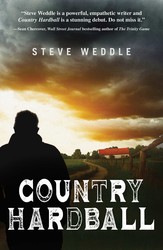
“In COUNTRY HARDBALL, Steve Weddle takes us deep inside a rural Louisiana long since abandoned by the American Dream. His characters carry the weight of their bad luck and sins through a landscape of economic devastation, where bad choices and worse choices seem the only available options. And still they search for something beautiful—love, faith, a moment of grace among the ruins—as they struggle to become better people than they were the day before. Steve Weddle is a powerful, empathetic writer and COUNTRY HARDBALL is a stunning debut. Do not miss it.”
—Sean Chercover, author of The Trinity Game
Thursday, August 22, 2013

Tuesdays With Tyrus


On Tuesday, I talked to Ben LeRoy of Tyrus Books -- publisher for my upcoming COUNTRY HARDBALL.


http://youtu.be/orHHBfu2wMc?t=1s


We talked about dead elephants, baseball, and steam shovels. Then I took the headphones off, shut the laptop, and thought about the clever things I'd meant to say which would have been totally impressive and sent everyone running to buy the book. 

--

KillerNashville is going on Aug. 22-25. If you're in the region, check it out.

--

Also, I'm posting pages from the sequel to COUNTRY HARDBALL. Spoiler Alert: They're all werewolves.

--

Also, as well, publishing isn't dead.

--

Bookshelves, via Bill Crider

Tuesday, May 21, 2013

I like libraries. Libraries are cool

By Steve Weddle

First, since I was here last week, I've signed the deal with Tyrus Books for COUNTRY HARDBALL. Also, they've made a cover. And there's a page. And stuff. Here, lemme get out of the way for a second so you can click this link. COUNTRY HARDBALL

OK.

There seems to be a popular conception that, with each day that goes by, more and more people have more and more access to everything on the internet.

This seems goofy.

I live in the country. Not like in a William Faulkner story or anything, but I'm in the country. The town is 15 minutes away and has a population close to 1,000. We can drive 45 minutes to see a movie, if we want. We have access to the internet through one of those little boxes that we pay too much for. Other people don't. Other people near me use the county/state services to get a bus to come near them, then deposit them places in town. Then they have to rely on the bus to come get them.

Whenever people start to talk about how everyone has access to the internet now, I'm reminded of the opening to GATSBY in which the father tells Nick to remember that not everyone has the same advantages he's had.

My mom would drop me off at the library when I was a kid. I was in summer reading clubs every year. I read books. I checked out books. I read books from my parents' shelves. I talked to the librarians about books I wanted to read. I talked to my parents about books. We lived in a papermill town when the papermill shut down, when everything was dying, and I still had access to the world.

When I was growing, libraries were indispensable. They still are.

Not everyone can afford $100 a month for smartphones or internet boxes.

And I'd prefer to live in a world in which everyone -- even those who can't afford Verizon FIOS and $25 hardbacks -- are able to access the internet, the newspapers, and books. Books. Books.

Heck, I was 12 years old and I was reading John Updike. I had no idea what the hell was going on in any of his Rabbit books, but I was reading them. And I read non-fiction about the Boer War. That was some weird stuff, I'll tell you. And, of course, I read all the Harry Harrison and Piers Anthony I could find. All the librarians could find for me. And I read. And read. Just like so many kids did then, and like so many kids still do.

Books and DVDs and internet access and meeting rooms and book clubs and newspaper archives and on and on. I can't imagine a world without libraries. It's super cool that many of us -- especially those reading this -- can access the internet at a whim. But not everyone can. Not everyone has the same advantages you and I have had.

Rita Meade (@ScrewyDecimal) has a great post up knocking down the anti-library argument.

Do yourself a favor and give it a read.