by
Scott D. Parker
It is rare that we constantly sustain the excitement of what we do. We writers can love the writing process, but after, say, you hit 50,000 words, sometimes the work is more like work than magic.
The same thing applies to the publishing side of things. When we’ve finished a manuscript, now comes the more mundane aspects of our jobs: editing, copy editing, proofing, cover design, and uploading files for publication and distribution. After you’ve done it enough times, it becomes routine. A little rote. You know you need to do it, but you might look forward to it the least.
That is until you get to talk to someone who is a little behind you on the journey.
This week, I had lunch with a former day job co-worker. I hadn’t seen him since February 2020, pre-Covid. We had conversed off and on via emails and texts. We’re both writers and we talked about our day jobs and the kinds of things we do. But then the conversation shifted to the fun writing. Fiction writing.
He was keen to learn the ins and outs and processes I use to write, edit, publish, distribute, and market my books. I have internalized all this information and actively keep learning new ways to streamline processes.
I’ll admit something: I was a little tired on Thursday morning, so I kept downing green tea all morning at the office and made a point not to order a heavy lunch that would have made me sleepy. Seeing my friend was a nice jolt to the system, but the more powerful jolt was talking shop.
Literally, I could feel myself becoming more and more energized about the tools, the processes, and all the resources I used to get where I am today. I was able to talk about going to “Indie Publishing School” with podcasts. I pointed out authors like Joanna Penn, who are farther along the path than I am that he should study. Also veterans like Dean Wesley Smith and Kristine Kathryn Rusch who have completely changed the way they get their stories to readers. I talked tools like Vellum and Draft2Digital.
It was so exciting.
I’m currently in the stages of readying my next book for publication next month so I’m in the thick of doing the mundane things. But you know what I told him? I said that I actually enjoy all the steps that takes a story from my brain to readers. It really is magic.
I was so jazzed that the rest of the day, I didn’t really need any more green tea. What I wanted was to get home and get back to fixing up my book.
It was good to have an unexpected recharge just by talking shop.
Y’all ever experience that kind of jolt?
Saturday, August 12, 2023
Recharging the Excitement by Talking Shop About Writing


Saturday, February 26, 2022
Writer, Know Thyself AKA Don’t Fight Who You Are
by
Scott D. Parker
The year 2022 has been rather productive even if that productivity hasn’t always generated new words. It has, apparently, yielded greater clarity as to the type of writer I am. It also meant I had to struggle through some thoughts that really got me down.
On New Year’s Day, I had the idea that I wanted to write every single day in 2022. That lasted 41 days, longer than some folks do with their resolutions but it still stopped. Part of the reason was that I was a bit haphazard in what I was writing, but I think I learned something about myself in the process.
I thought it would be fun to write some short stories. I also thought I could write 1,000 words per day. I busted out the first one in only three days. Then I jumped on a second one, knocking it out in about seven or so days. Then a third. I then shifted to writing chapter 29 of my current WIP and finished up that chapter. But I wasn’t sure where to go next with the story. With the 1,000-word-per-day goal hanging over my head—when I really wanted to stop, re-read the WIP, and determine where to take chapter 30–I left the WIP and started a fourth short story. The thing was it wasn’t as good as I thought it could be. I was literally stringing words along just to get to 1,000, and I wasn’t writing what I truly wanted to write (the novel).
Dissatisfied with my output, I ended the 1,000-word streak. Then I ended the writing streak. And, to date, haven’t started it back up. Why?
Well, because of burnout, I'm guessing. I looked back on my 2017 writing calendar. I wrote three Calvin Carter novels in three months. Each time, I finished the books with days in the month to spare and I took a break. In January, I had about 5 days. In February, it was only two. I finished the March book on 28 March, giving me a three-day break. As you can see, I built in breaks. They were my rewards for a completed novel.
Then, in April 2017, I quit Calvin Carter Book 4 on Day 15. Back in 2019, when I was using NaNoWriMo to write a different novel, I ended up coming to a dead end—no, not a dead end; a 'which way to go?'—and I never got back on track. But that was in early December, after I’d successfully reached the NaNoWriMo threshold in November of writing 50,000+ words in that month.
All this is to say that it looks like I'm the type of writer who needs to have breaks built into my schedule. All the more power to those old pulp writers and modern ones like James Reasoner who can just keep writing, but it appears that's not me. Which is kinda sad because I'd like to be that kind of writer, but I guess I'll have to fall back on the mantra of Writer, Know Thyself.
When I stopped my 2022 writing streak back on 10 February, my failure really got me down. Why bother writing? was a common thought that ran through my mind. Why indeed? One more voice in the cacophony of writers and all the other content vying for people’s attention. I started to write down my thoughts and instead of zeroing in on all the bad stuff, I turned it around and started to count my blessings.
I am in the enviable position where I have a day job that provides me and my family with monetary income, health benefits, and stability. That affords me the ability to write what I truly want to write and make it the best I possibly can. You know, as opposed to having to write something simply to put food on the table and keeping the roof over our heads even if those subjects are less than exciting. Again, major props to those pulp writers of all the decades who really did have to churn out the words in order to provide for their families, even if it was the fifty-eighth Shadow novel or sixty-fourth Doc Savage book or even the two hundred and sixteenth novel in the Longarm series. (Or Destroyer. Or Executioner. Or Trailsman.)
By slowing the pace down to a steady constant rather than the frenetic pace I was keeping earlier this year, I should be able to be like the tortoise in the old rabbit vs. tortoise fairy tale. Yeah, I’ll get to the finish line with the content I have the time to write. Yeah, other writers will do better [Pick your metaphor: they’ll reach more finish lines than I will or they’ll reach the finish lines with more books] but I can’t control them. They have different environments and situations (and genres?) than I do.
Which means what I do will be more difficult. Yay. It means I might not have the success of others. Sure. But it also means I’ll be able to carve out my own path that is uniquely my own. And that is good. Again, with a foundation of having a day job to provide stability, I can keep going at my own pace.
I still have the goal of completing twelve short stories by year’s end. I’m a quarter to that goal already. And I have my three novel WIPs that’ll keep me going. But I’ll build in breaks. Evidently, that’s the kind of writer I am. Better to acknowledge it and run with it as opposed to fighting it and getting depressed I’m not a different kind of writer.
I’ll be back on the writing wagon come Tuesday. It’ll be a new month and I’ll start up again. I’ll move forward, finish the next project, and then set everything aside. The break probably won’t be the two weeks I’ve given myself in February, but it will be a break.
So, fellow writers, have you had a heart-to-heart with yourself to help you realize who you are as a writer? What steps did you take? I’d love to know as writing—and all creative outputs—are a constant work in progress.
Saturday, February 12, 2022
It’s Okay to Adjust Your Goals
by
Scott D Parker
Remember a few weeks ago when I wrote a post about finding time to write? The thrust of the piece was that there are lots of little chunks of any given week to devote to writing. I stand by that assertion, but two things happened in the past week. I realized I wasn’t leaving time for all the other things an indie writer needs to do, and I was getting worn down.
When do I edit my stuff? When do I create covers for my stories? When do I do the website upkeep? These activities are crucial to being an indie writer/publisher in 2022 and I simply wasn’t giving myself time to do any of it. Why would I? Doing those things meant I would write less.
But, but, but I have a minimum word count of 1,000 words. How am I supposed to do all that other stuff and still get in my thousand?
I’ve been trying and doing reasonably well. Actually, that may not be entirely accurate. I have been working in the editing and the cover creation, but doing it by sacrificing sleep. The Olympics didn’t help because of the time zone difference, I’d be up watching live coverage prime time through 11pm yet still getting up at 5am. That, of course, wouldn’t last, but it crystalized just how much time in the day I had at my disposal. It is finite and there are things I need to do, and keeping myself healthy is high on the list.
But what about that minimum word count? What about hitting that thousand? Well, if the words are crap and you’re just writing to hit a number, then what’s the point? I intuitively recognized my internal self was stretching out scenes just to meet some arbitrary number. For example, the short story I’ve been working on is nearing 10,000 words. Are they all needed? A critical edit will tell me the truth, but there’s a sense I’ve been padding the story to reach that 1,000/day threshold.
But to do this, to accept that I’d be doing less in the given time allotted to me, I’d have to give myself permission to downshift and try something else. That’s a big mental hurtle for many of us, myself included. We want to be super productive, but if that productivity either ruins our health or delivers sub-par writing that you’re going to have to fix anyway, what’s the point?
Better to be efficient even at a slower pace than the opposite.
So I gave myself permission to drive the writing career at a slower speed. My goal is to create better content at a consistent pace without sacrificing my health, both the body kind and the mental kind.
What also helped me reach this conclusion was this week’s post from Kristine Kathryn Rusch. She links to an article ostensibly about “Covid Cloud” and how we can overcome our concentration issues, but the author, Jessi Gold, makes a point about doing less. “Normalizing doing less feels uncomfortable, vulnerable, and might even make us feel like a failure. This is because we often measure our success by our productivity.”
Yup, that was me. And it’ll still be there, truth be told, but I am trying something different. Still writing everyday, but allowing myself time to breathe and do the other things required of me, like re-reading a novel to determine next steps.
Do y’all ever have moments like this? What do you do?
Saturday, January 22, 2022
Carving Up Your Hours and Meat Loaf’s Example for Creatives
by
Scott D. Parker
You don’t find the time to write. You make time to write.
That’s an adage I’ve held onto for years. I firmly believe that if you truly want to write, you will make the time to write. Thus, the excuse of “I would love to write but I just don’t have the time” flies out the window.
But sometimes you have to carve up your time to find those pockets in which you can write. I did a little exercise this week that you might find instructive if you are wanting to find all those extra minutes in your week to get your fingers on the keyboard and your brain into its imagination.
I started a new day job this month and this is the end of week three. Naturally, I now have a new schedule, one that involves three days in the office and two at home. It felt like I had less time to write, so I broke down my days.
Every weekday, I wake at 5am. Yes, I am a proud member of the 5am Writing Club. Have been a morning writing for going on nine years now, and dedicated 5am-er for the past three or four. I find it liberating to have the house to myself, only a single light on over the kitchen table, and just a cup of coffee (two, actually) beside me as I write. Zero internet, zero TV, zero anything other than a psalm a day until the words are out of my head.
I work in the office Tuesday, Wednesday, and Thursday. That means I have a hard stop at 6am so I can get ready for work, jump in the car with the daily smoothie, and drive to work, usually listening to an audiobook (most recently finished Carol Burnett’s memoir).
So, accounting for the waking, exercising, Bible-reading time, I’m left with approximately 45 mins in the morning to write, give or take. Doing the math, 45 x 3 = 135 mins. Since I work from home on Mondays and Fridays, I allow myself an extra 30 minutes. 75 x 2 = 150 mins. That’s 285 mins, or 4.75 hours per week in the mornings to write. Not bad at all.
Side note: I don’t write during Family Time at night.
Then there are the lunch hours at the day job. Accounting for regular meetings going long and, you know, eating, I estimate I have 45 minutes I can spend writing on my Chromebook. That’s another 135 minutes, which bring us up to about 7 hours per week that I have to myself and I can write.
I have more time on Saturdays. I tend to wake at 7am, get the dogs, head out to Shipley’s for do-nuts, come home, cook and eat breakfast. Generally, I get to writing around 8am and the family leaves me alone. On Saturdays in which there are few things to do, I can get two hours easy. Then, it’s Family Time (or Chore Time) so the writing is off the table. Now I’m up to 9 hours, more or less.
Sundays are a tad different. I still wake at 7, but I have a hard stop around 9:30 or so to get ready for church. So let’s call it a good 90 minutes. Now I’m up to 10.5 hours of writing time per week.
All it took was for me to analyze my schedule and see what time I have available. There’s a lot I can do in 10.5 hours. I knocked out NaNoWriMo’s 1,667-word threshold in any of those given time frames, but if it’s slow going, I can get 800 words in any one of those writing sessions (although my daily goal is 1,000).
Here’s where the math is magical. If I can average a 1,000 words an hour, that means I can write approximately 10,000 new words of fiction per week. With a day job. With Family and Chore Time factored in.
And all I basically ever do is wake up earlier than my family and write. Makes me really happy, productive, and helps start the day on a good note.
Now, how does your week break down?
Meat Loaf’s Example and His Challenge
The news broke yesterday morning that Meat Loaf passed away. I have an unabashed love for his soaring, Broadway-like anthems. In particular, there is a late-career gem I wrote about back in 2016 that was the first song I went to upon hearing the news. Then I listened it again before playing all the songs I have on my Mac.
In the various comments from folks yesterday, more than one commented on Meat Loaf’s improbably resurgence in the early 1990s. In an era of grunge and rap and early hip-hop, here was Meat Loaf singing about the things he would and would not do for love. The song was over the top, the video was even more over the top, but people ate it up. I know I did. There he was, wearing makeup to give him the appearance of a beast, starring in a mini-movie. Were it anyone else, they would have been laughed at.
But not Meat Loaf. He knew who he was, what his talents were, what kind of music he liked and performed well, and just did all that. He was himself no matter what. Sure, he had some down times, but he kept to his talents. When it worked, it soared. When it didn’t, he kept going.
From the last part of the tweet that announced his death came this challenge: “From his heart to your souls…don’t ever stop rocking!”
That’s his challenge to every creative: Don’t ever stop [making your art].
Saturday, January 8, 2022
Writing Without Paper: Introduction
By
Scott D. Parker
Can you be a writer without using paper?
I’m a writer and I use a lot of paper. I make notes on yellow legal pads, I make lists of character names on a giant spreadsheet printed out on an 11x17 tabloid-sized piece of paper. In the past, I have used hundreds of note cards to map out a story. Those note cards would then be pinned to the cork board in my office. And don’t get me started on post-it notes that I’ll use to jot down random pieces of things for the story and post them on monitors, laptops, keyboards, or the desk.
Then there are the drafts. Yes, I know there are folks who write and edit within whatever word process they’re using. I can do that, too, but more often than not, I prefer to print it out and read it that way. Sure, I format the manuscript to be single spaced and I print on both sides of the paper, but still, if I have a 300-page manuscript, that’s 150 pieces of paper.
Suffice it to say, when I’m writing a novel, I simply use a lot of paper. This amount goes up and down depending on the length of the writing project. For shorter pieces, I usually don’t have all the background stuff, but I still have the various drafts with all my marks in green ink.
Late last year, I got to thinking if there was another way, a paperless way, to brainstorm, write, edit, format, and publish stories. I came up with a qualified answer: Yes, I think so, but certain equipment and apps would make this job easier.
Equipment and Apps
First off, I needed a new iPad. Mine was a second generation that basically did nothing for me other than allow me to read comics and ebooks. If this was going to work, I needed new tech.
I purchased a refurbished 2020 iPad Pro with a second generation Apple pencil. Wow. Is this thing amazing. Granted, when you’re coming from a 2012-era iPad, most anything is an upgrade, but I’m particularly impressed by the fact that I can get an entire ‘piece of paper’ on the screen at the same time.
The pencil is super cool and seamless. There is no visible lag at all. Among the coolest things: a simple double tap on the pencil changes the function to the eraser (while another double tap shifts it back to the pen). Thus, without even changing your hand position, you can write, make a mistake, erase, and start writing again in seconds. Tres cool.
I paired my Bluetooth Apple keyboard with the iPad and use the device as my primary means to write. But I do not plan to take the iPad to the office (yet) so I compose in Google Docs. That way, I can sync my Chromebook and bring it to the office. It’s rugged and a single unit so it’s been my preferred in-the-office personal device for over two years now.
When it comes time to edit the completed file, I use GoodNotes. Not only does it allow me to edit PDFs. It’s really neat to have the iPad in my lap, pencil in hand, and just read and edit the text. It’s pretty much paper-like, but still digital.
This app is good for general note taking. So far this week, I’ve worked on two short stories, completing one and more than halfway through the second. As such, I don’t necessarily need a notebook with character names, etc., but when I start a new novel, this will be the place where I store said notes. It syncs to my phone so when I’m out with my Chromebook, I’ll have my notes. Granted, I can’t use (nor would I have) the pencil with the iPhone, but that’s no big deal.
Here’s a screenshot of page one of the completed short story.
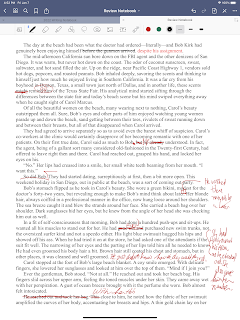
From there, I’ll be able to make those changes in the manuscript and nary a piece of paper will be needed.
Publishing
While I have not yet published anything, I already know how to do that part. I’ll spell it out in a future post.
I have an entire process flow, but I want to test it first, work out any kinks, before I share it.
So, am I the only one who is writing without paper? For you other paperless writers, what are some of your preferred tools and apps?
P.S., Happy Birthday, David Bowie. Still miss you.
Saturday, November 6, 2021
NaNoWriMo 2021 - End of Week 1 Encouragement: Get Some Sleep
by
Scott D. Parker
How’s the book coming along?
Today is Day 6 of NaNoWriMo (although for me, it’s still Day 5). If you’ve kept up the daily 1,667 words pace, Day 5 will have you at 8,335 words total.
I’m happy to report that, as of Day 5, I have reached 11,220 words. That's pretty remarkable considering I'm writing in a combined genre brand new to me. I’m actually 2,885 words ahead of schedule, which is fine by me. Remember we have a holiday here in the US on the last Thursday the month. Ideally, I want to be able not to write, although I probably will squeeze in some minutes and words.
The week went pretty well for me this week, writing-wise. I woke at 5am each workday. On Monday, Wednesday, and Friday, I work from home, so I had a nice 85-minute session each of those days.
Tuesday and Thursday was a different story. I go into the office and arrive at 7am. To do that, I have to stop writing at 5:55am. It’s a shorter session, but I bring my Chromebook and finish out the day during my lunch hour.
But I immediately noticed something on Tuesday: I cannot stay up late on Monday. I did, quite by accident, and I really felt it on Tuesday. Wednesday night was different as I went to bed early and made up the sleep time. By now, Friday afternoon, I can feel the lack of sleep. So looking forward to the end of daylight savings time this week. The extra hour of sleep arrives at the perfect time.
So I have two pieces of encouragement for you writers who are on this NaNoWriMo journey
Don’t get too bogged down in the daily weeds. Maintain the overall goal: 50,000. Some days, you’ll blow past the 1,667 mark. Others you may fall short. You can make it up. Don’t lose sight of the end goal: a completed story. In the end, it won’t matter if you didn’t reach your daily goal for a third of the days and exceeded it on the rest. All that matters is a 50,000-word completed novel.
And keep yourself healthy and maintain your sleep schedule. You can’t write if you’re sick or tired.
Until next week, keep writing!
Saturday, October 30, 2021
NaNoWriMo 2021: Yes, You Can Write a Novel in a Month
by
Scott D. Parker
Are you doing NaNoWriMo this year? I am, and I can’t wait until Monday.
For those of y’all who don’t know, November is National Novel Writing Month (NaNoWriMo), a fun event where writers are challenged to write a 50,000-word novel in the 30 days of November. I’ve done it multiple times, sometimes succeeding and other times failing.
What I enjoy about it is the virtual camaraderie. On any given day that I’m writing a book, I know that there are thousands (millions?) of other authors also writing. But it’s a little different when you’re doing NaNoWriMo. We’re all in this same boat together. We have to manage our writing time, our day jobs, our lives, and just when we plan to get our words in on Thanksgiving Day.
Throughout this month, I will be updating my progress and offering helpful tips and encouragement to keep going. Because every time you write “The End” on a novel is special, but it’s just a tad more special when you do it during NaNoWriMo.
Preparation
I’ve spent the better part of the past two weeks preparing. This will be my first murder/mystery that might lean cozy. As I’ve never written a murder/mystery, I took time to create characters (not named at first) and situations they will have to deal with. Who will be the victim? Who will be the killer? Who will discover the crucial clues?
It was this past Thursday when I knew I was ready to start. I mapped out the first few scenes because I wanted to hit the ground running come Monday at 5am (my writing time). During that little session, my imagination began veering and including little tidbits. I’m a hybrid pantser/plotter. I have just enough framework to give my imagination room to breathe, but breathing with focus. That my imagination was already chomping at the bit, I got even more excited about 1 November.
Typing Names
For the longest time—up until yesterday, in fact—I had no names for my characters. They were just Mom, Son #1, Son #1’s Wife, Girl, Guy, etc. I knew that wasn’t gonna fly come Monday, so I named my characters in a first-for-me manner: I typed them to see how they’d feel and to see if my typing speed and fingers misspelled them often. It’s all well and good to name a character Chrysanthemum Bannington, but can you imagine typing that over and over again? Sure, there’s autocorrect but I prefer to type the names.
So I took some names for a test drive and started filling in my list. I also paid attention to the first letter of those first names. I only repeat one letter one time: B. Every other character has a name that starts with a unique letter. Easier for me the writer and it’ll be easier for future readers to keep everyone straight.
Track Your Progress
The nuts and bolts of NaNoWriMo breaks down to 1,667 words per day. If you do that, you’ll hit your fifty thousand by 30 November.
Over the years, I’ve developed a spreadsheet I use to see where I am. Here’s a screenshot of the first couple of weeks.
You’ll see that I track the obvious stuff: date, the 1,667/day pace, Idea is the pace of 1,667/day, Actual is what I wrote that day, Total is obvious, Diff is how far under or over I am on the 1,667/day pace. I also like to track time spent doing the writing so all those other columns do that.
The “Diff” column is very helpful. Not only does it give you a daily reminder of where you are, but it also enables you to build in a buffer. Remember what I mentioned about Thanksgiving Day? Well, if you are, say, 1,000 words ahead, you can get by with fewer words on any given day.
But let me give what is perhaps the best piece of advice: do not skip a day. If you do, you will get behind, and there’s nothing more demoralizing that running behind.
There is still an even better piece of advice: Have Fun! If you do, it’ll be nothing to reach “The End” in a month.
Saturday, October 23, 2021
What’s It Like Co-Authoring a Book?

Scott D. Parker
A couple of weeks ago, I was talking to my cousin and he asked about any upcoming books I’ve written. I mentioned “Ghost Town Gambit,” the short story I had in the Six Gun Justice podcast anthology as well as Cash Laramie and the Sundown Express, the novel I co-wrote with David Cranmer that teams up our two western heroes, David’s Cash Laramie and my own Calvin Carter. My cousin was intrigued about the book, but more interested in how David and I wrote a book together.
To be honest, it was quite seamless.
The Beginning
Way back in January 2010, David sent me an email about a Cash Laramie story he was working on that drew some of its inspiration from the real-world west of the 1890s but also some steampunk elements. (I’m keeping the nature of the steampunk thing close the vest. You’ll just have to read the story to find out what it is.)
Knowing I had a fondness for steampunk, he suggested we team up our characters for this adventure. Soon thereafter, he sent about 3,000 words of the story. It included a historical note on when the story took place and the opening setup.
It quickly became apparent that his characters would need to get on the hijacked Sundown Express while Carter would already be on it when the outlaws took over the train. From that point forward, I took David’s text and inserted Carter into it, writing Carter’s scenes from scratch and layering in some text on the Cash side of things.
That’s pretty much how it went for a good stretch of 2010 and into 2011. We’d email back and forth, asking and answering questions, and tweaking the story as we went along. With Beat to a Pulp the publisher of record, David kept the main versions of the story while I maintained my copies as backup.
Recruiting Outside Help
The story just fell off our radar for about a decade or so. Every now and then, we’d bring it up, but little new work was done. In the intervening years, I had written more Calvin Carter stories and three novels. His style of story changed from a darker, more grittier version you see in his first short story to a more light-hearted, Maverick-style fun character in the novels.
Then, out of the blue, David emails me in August 2020 asking my opinion about reviving the story and completing it. I jumped at the chance, but let him know about Carter’s style change. I hadn’t thought of Sundown Express in years—although I had Carter reference it in one of the novels—but I remembered him being pretty tough. I would certainly have to re-read the story from scratch.
An invaluable stroke of good fortune was David asking Nik Morton to read the story and offer suggestions. Nik is a fantastic author, and his Write a Western in 30 Days book is a wonderful primer for writing your own western, even if it takes you longer than a month.
Nik had a read and then David sent me the updated file. I had already made a crucial decision: I would not go back and re-read what I had last written in 2011 or so, letting the 2020 draft serve as the new starting point.
I picked up the draft and read the story, with a notepad on the table and Word’s tracked changes turned on. Nik’s edits were good, but what was great for me was a couple of extra scenes featuring Carter I didn’t remember writing. I still have never gone back and re-read the old versions, but I was thrilled that Nik seemed to get Carter’s style. While David’s had multiple authors write about Cash and other characters he created—most recently The Drifter Detective featuring tales of Jack Laramie, Cash’s grandson—this was the first time another author wrote about a character I created.
The Homestretch
I worked on the draft rather slowly last fall, finally turning over my update in early January. From then, David and I went back and forth a time or two. During that time, David created the cover you see. I really like the painted effect he has on it, especially on the back cover of the paperback.
By way of marketing, David suggested we do an in-print “interview” where he and I go back and forth. I also suggested we try to get interviewed together for a podcast. I reached out to Paul Bishop and Richard Prosch of the Six Gun Justice podcast and they agreed. While the interview features just me, I do promote the collaboration, offering more insights than this.
Finally, a short twenty days ago, Cash Laramie and the Sundown Express was published for all the world to read.
I’m not sure if co-authoring a book is this seamless for other writers, but it was for David and I. We’re really proud of the finished story and hope you enjoy it.
Saturday, September 25, 2021
Processes and a Podcast

Scott D. Parker
There must be something in the air this week, because a good number of the writers I follow on Twitter had writing challenges. I did, too, but there is a solution.
On Thursday, Texan Jeff Abbott tweeted this:
“writing early this morning, i had been pondering since last night how to fix a chapter opening, had no good idea, sat down to the chapter, in desperation typed three sentences, character-driven solution presented itself to my weary brain, onward”
Later the same day, Bryon Quertermous had a short thread, the last of which contained this little nugget:
“Writing can cause so many problems, but almost every time, the solution to a writing problem is to write through it. 5/5”
As for me, I’d been suffering a lazy streak. Part of it certainly had to do with how to craft the beginning of my next chapter. I had struggled to end the previous chapter in a satisfactory way, so I just ended it. The subconscious must’ve festered on my dissatisfaction with that ending because it kept hindering my forward progress.
Until this week. As a writer with a day job, I’m time locked with my writing time. I also hadn’t been doing my exercises as often as I needed to and it’s lack was catching up to me. So I did the most basic thing in the world: Gave myself no excuses. I compelled myself to wake at 5am, get on the rowing machine within five minutes of waking, and after a brisk ten-minute session, sat at my computer and wrote.
Guess what? The words came, fast and furious, until I had to stop and get ready for work. I didn’t mind, really. I had accomplished something. Two things, in fact. I had cleared my mind of the block that hampered my writing as well as the exercise. That was a great day.
No matter the writer, no matter how many stories the writer has completed, there will always be days in which the stuff just doesn’t happen. The brain might be wonky or filled up with life’s clutter. It’s going to happen, so it’s best not to get upset about it.
But there is a way to mitigate the hangups: Rely on the process. Don’t wait for inspiration. For nearly all of us, that means getting in front of our screens and doing the work. When we’re there, inspiration will come. It always does.
My First Podcast Interview
This process of always being available is part of my writing life on which I constantly rely. It’s one of the things Paul Bishop and I discuss in my first-ever podcast interview. It dropped this week and I couldn’t be more thrilled.
Have a listen.
Or use this link to get the episode in your preferred podcast-listening app.
Saturday, September 11, 2021
Ignore the Scoreboard: A Writing Process
Scott D. Parker
The NFL season kicked off on Thursday of this week, but I was already prepared because of Peter King.
For many years now, a NFL weekend is not complete until I read King’s Monday column. And they are long. Wonderfully so. He covers the weekend’s action, what he’s reading, what beer he likes, tales from the road, and other non-sports pieces as well in a segment he dubs “10 Things I Think I Think.”
On Monday, King commented on a recent article with Nick Saban, the head football coach at Alabama.
“I think I learned something about Nick Saban in his enlightening interview with Alan Blinder of the New York Times. Saban’s a lot more malleable as a coach than I thought. Listen to him about how his approach to coaching has changed:
“The biggest thing that has changed for me — and you might be shocked when I say this — is that I’ve actually become, through the years and through the experiences, a lot less outcome-oriented and a lot more process-oriented. I think that approach carries over to the players because then they become less outcome-oriented, and they’re more focused on process, they’re more focused on one play at a time, exactly what do I have to do and how do I have to do it, what’s going to help me be successful here, and they’re not looking at the scoreboard like we’ve got to win the game. They’re focusing on one play at a time.”
King then continued:
“I think that reminds me so much of what Drew Brees told me a couple of years ago, when I asked him what advice he’d have for your quarterbacks. In effect, Brees said, Ignore the scoreboard. Think about making every play the best it can be. Worrying about the scoreboard distracts from the only thing you can control—the next play. Great advice for football, and for life.”
And great advice for us writers.
The scoreboard for us is when the book is published and some of us might obsess about Amazon reviews or how our book is doing with readers. All things we cannot control and over which we have zero power.
To keep the football analogy going, the next play for us writers could be something as small as the next chapter or as large as the next book. Keep your focus localized to your own work and let the scoreboard take care of itself.
Because every now and then, you’ll fumble the ball and produce a book folk won’t enjoy even if you loved it and poured your heart into it. But at the same time, there will be those days when you publish a story everyone loves and the confetti will cascade down from the rafters.
Be mindful of both moments.
Saturday, September 4, 2021
Reading Aloud to Improve Your Writing
by
Scott D. Parker
I read Jay's blog from yesterday and I thoroughly enjoyed his bonus content where he posted a video of him reading a chapter of his latest work in progress. (I really loved that one of the characters shared my name.)
Anyway, I loved it so much...that I did the same thing.
It's a fundamental truth in writing that if you read your prose and dialogue aloud, you will hear errors your eyes miss. It'll also help your character to sound more natural.
So, here you go: me reading a random chapter (actually the latest) of my current manuscript. And I'd like to challenge our fellow writers to do the same.
(Boy, did YouTube select an awkward image of me.)
Saturday, August 7, 2021
What Is Your MVWC?
by
Scott D. Parker
How do you keep going? On anything.
If you're a runner, you lace up the shoes, don your favorite running clothes, maybe grab your phone for some music, and head out the door. If you're a student, you keep studying. If you're lawyer or doctor or just about anything, you just keep doing the thing you either trained to do or are getting paid to do.
So why do we writers and other creative types fall off the wagon?
There are countless posts--like this one--talking about how we writers get thrown off our game. Sometimes the forces are external and uncontrollable. Often, however, they are self-inflicted. We sleep in and miss that 5am writing time. We might always write at night, but the day job took everything out of us and we'd rather just watch TV or do nothing. No brain use tonight, thank you very much.
It happens. It always happens. It's like Houston summers, New York winters, and rain in London. The thing you expect always, always happens.
What To Do About It?
Okay, so it happens. We writers lose our mojo for whatever reason. How do you get it back when you've been thrown off the horse. Get back on the horse.
Ah, but that's easier said than done. Why?
One reason might be that we remember how the mojo felt on our last project. Remember that feeling, when everything was aligned and your fingers could barely keep up with the images in your brain? I've had that feeling and it is like a drug. It's intoxicating. What we always forget about that project were the slow times, the beginning, the part where you had to pause and sort out plot points, and when you struggled with that one stupid chapter.
But you got your mojo back and sailed across the finish line to The End. And, most likely, we celebrated with something bubbly and decided to take a break.
That's not what I'm talking about today. I think breaks are a necessary part of the creative life. Angel said the same thing on Wednesday. What I'm talking about is getting back your mojo. And that brings me to MVWC.
What is MVWC?
I think we're all familiar with the concept of a Minimum Viable Product. It's the phase in the development of a product or service where the inventor can start selling the thing even though all the bugs are not yet ironed out. The MVP can also be called the 1.0 Version. Early adopters love this stuff because you can say "I was there when X was just out." Same is true for the early careers of actors, musicians, writers, and other creatives.
When it comes to us writers, we can use the same concept. What is the minimum word count I need to get back my mojo?
[Keep this bookmark right here in mind. You'll need it at the end of this post.]
The Minimum Viable Word Count, the MVWC, is the word count you can easily achieve without even breaking a sweat. The kind you can type in fifteen minutes or thirty or an hour each day you are working on a project. Because, as we all know, words on a page are words out of your head. We can fix them later, but forward progress was made and the momentum builds. When that happens, we have our mojo back and we can soar through the clouds and get to The End.
I think the MVWC is a key metric you'll need when you get back on the writing horse or after a break or when a project's really thrown you for a loop. You're irritated, you don't know where the story's going, you don't really know how to begin. So you reach for your MVWC and do the bare minimum. It is forward progress. You will feel better. And, soon, the MVWC will rise and grow and the mojo takes over and you hold on for the ride.
But the MVWC itself. That's what you have to find for yourself. For some, it might be 250 words. Maybe 500. If you do NaNoWriMo in November, that daily word count is 1,667 words per day to achieve 50,000 in a month.
A lot of times for me, it's 1,000 words per day. I often keep track of a story's progress by using a spreadsheet. I have it coded with a baseline number and it automatically color codes the numbers green (if I achieve my goal) or red (if I fall short).
That’s all well and good for when you are in the groove, however. What about getting started? Ah, that’s for you to determine. What’s your MVWC you need to reach each day you’re writing a story so that you’ll feel a sense of accomplishment?
Whatever that number is, make it reasonable, easily achievable, and sustainable. Some writers might up their MVWC to a higher number, a goal they can’t reach consistently unless everything goes right. And, come on: how many days do we live through that are perfect?
Keep the MVWC sustainable or you’ll burn out and then you’ll start back behind square one.
Remember that bookmark earlier in this post? I wrote the start of this post on my lunch break, in a conference room, with just me and my Chromebook. I was time-limited after eating so I set a stopwatch and timed myself. In 15 minutes, I wrote 477 words, give or take. So roughly 500 words in 15 minutes. One could extrapolate from there.
Now, when I’m getting back on the writing wagon, it’s always slow going. And I’m almost always time-limited be it part of the 5am writing session or the lunch hour one. I rarely have a long stretch of dedicated writing time so I have to adjust my MVWC.
Now that I’ve been writing this piece, I think my MVWC is around 500. That’s easily achievable in 30 minutes or less. I can blow way past it when I’m flying yet I can struggle to get there when the story’s mired in molasses. But it is consistently achievable and sustainable. When I log off at 5:55am or after lunch, I can always walk a little taller and with a smile on my face when I’ve hit my MVWC.
Saturday, May 15, 2021
The Value of a State-of-the-Business Examination
by
Scott D. Parker
It all started with a question and it ended up with a complete evaluation of my writing and publishing life.
One of my longtime book club friends--we're going on our twelfth year together--has a side business and it is not going as well as he envisioned. He explained why and then turned his attention to me. "How's the publishing game? It's been a few years now, are you encouraged by how it's proceeding?"
What began as a reply to his email turned into a 3,300-word (and counting) evaluation of my writing life, my publishing life, where I am now, and where I want to go. With the day job and the family stuff, I don't have a ton of free time on my hands so the exercise stretched out the entire week. Not coincidentally, 1 May is my Writer's New Year's Day, a commemoration of my decision back on 1 May 2013 to start writing with purpose.
What followed was a technique I've used for years: a written dialogue. This is one where I ask questions of myself and then I answer them. And, since I'm literally talking with myself, I get to be brutally honest. Who else is gonna read this, right?
Am I encouraged? That is an interesting way to ask how it's going. I've been pondering it for a few days and I have a two-part response: No, not really, but, at the same time, I have not been giving it the attention it deserves if I want to see results.
The Analysis Begins
Thus, by answering with a qualified 'no,' I started analyzing the parts of the business I can control. It goes back to one of my favorite phrases about publishing: Control the Controllables. I can control my writing, how much time I devote to it, and what I write. This is absent all talk of sales. I truly cannot control that. Neither can you. No one can. But we can control what we write. For me, it boiled down to time and speed. I can write fast and I can start a writing session on-the-run (so I don't have to build up speed) so the words the flow out usually are not a problem.
Time proved the key factor. Despite me working from home, I realized I began 'sleeping in' on weekdays. When I had a commute, I used to wake at 5am. I kept that routine at the start of the working-from-home phase, but over the past year, my wakeup time slid later and later. Throw in the morning Bible reading and the amount of time I have to write in the pre-day-job quiet of the house ended up being 30-45 minutes. Sure, those minutes and words add up, but they are not truly as productive as I used to be.
Thus, to rectify my writing time, to control the controllables, I started waking earlier. Consequently, I also went to bed earlier. Give and take, right? I’ll be continuing that next week and the week after.
What is the Roadmap?
That’s the simple part. The larger thing is publishing schedule. I examined my available manuscripts. Including my current WIP, I have a dozen books either completely finished or close enough for a thorough edit. Why are these books not already in the pipeline? To that question, I had no answer. Laziness? Chalk it up to ‘not enough time in the week’? Hogwash. If I’m an indie author, then I make the time to publish what I write. I haven’t been. But I will be.
Thus, I made a publishing schedule for the next 2.5 years. I’m still fine tuning it and allowing for me to slip in newly written manuscripts—I’m pretty jazzed on the current WIP and its sequels—but I have a roadmap. It’s what traditional publishers do, right? Same should be for me. And you, if you’re an indie. The next book I’ll publish is my Harry Truman book this summer.
Fixing the Online Stuff
Armed with a new publishing schedule, I examined my online life, specifically the websites. I have my blogspot blog which dates back over fourteen years and I don’t want to ditch it. I have my author website that needs a refresh. And I have my new project that’ll I’ll tease here for a summer launch, probably around the time of the Truman book’s publication. I’ve already stopped updating one website and will disband it this month. No need mentioning it here. It’s for the dustbin.
Another aspect of online life is engagement. While I’m decent at it, I’m not as engaged as I want to be. Expect to see a little bit more of myself online on Twitter and Facebook.
The biggest online challenge is to create an online store. It’’ll be a way to sell direct to readers that’ll be as seamless as other online stores, enable me to increase my outreach, and pocket a little extra cash. The tools for this are present, I just need to implement them.
So, after a week’s worth of reassessment and the creation of a new roadmap, I have a better handle on my writing and the business of writing. What began as an email response with a somewhat dour answer has turned into a happy exercise and a renewed sense of purpose. I’m now ready to reply to my friend, but I won’t be copying the entire 3,300-word piece. I’ll just tell him to read this post.
Do you have any of these State of the Business type things in your writing business?
Saturday, November 7, 2020
Do You Save Excised Text ?
by
Scott D. Parker
When it comes to deleting text from you work in progress, do you up and delete it or do you save it?
I’m revising the existing chapters of my current work in progress before I hit that mark where I’ll be crafting brand-new words. As of yesterday’s writing session, I realized that a chapter/scene I had written really isn’t necessary. Actually, I’ve already excised two scenes because I think they’ll slow the pace. I can get the same information across with a tweak to an earlier chapter.
So what to do with the now deleted text?
I am using Scrivener for this particular book. If you’ve never used this program, it’s a little like Windows Explorer (or Finder for Mac folks) with each scene/chapter its own unique folder. There is also a ‘research’ folder at the bottom of the file structure. Typically this is used to house whatever research a writer needs to craft the book.
I have a folder I call “Excised text” and I’m pretty sure you can guess what that is. It is the folder into which I place all the content I will not be using.
Sure, I could—and do—simply delete it from the main sections of the book, but I also want to keep a record of it. In my comp book, I note that I’ve removed certain scenes. On my notecards, I’ll note that I’ve remove the scene from the main flow—but I keep the card in its original spot. I guess that’s the historian part of me. I want the record to show that on such and such a day, I removed a scene. It’ll also act as a road map if, when I’m finished, I go back and reconsider if the excised text/chapter really does belong. I’ve got all that text at the ready.
It’s a pattern I’ve always adhered to, going back as far as my grad school days.
How about you? Do you merely delete text/scenes you don’t need, or do you save it…just in case? I’m a process guy and I’d love to know how other writers treat text they don’t want to use.
Saturday, March 14, 2020
Year 5 of an Indie Writer: Week 11
Scott D. Parker
Well, it's been a week.
I'm not going to spend much time about the COVID-19 virus because it's all over the news and sometimes, we need to step away from the news. Just for a little bit. It's good to put some distance between the constant news scrolling across our screens or the various tweets on Twitter.
This is Spring Break down here in Houston and my wife's birthday. I took two days off from the job. One day was spent here in town, having a nice brunch, catching a showing of "The Invisible Man," and ended with some excellent sushi. The other day involved us traveling to Alvin, Texas, to visit the antique mall, a lunch at Killen's BBQ in Pearland, Texas, and a Half Price Books stop. Found HELLBENT, the third Orphan X novel by Gregg Hurwitz. I love finding books you want out in the wild.
Both days had me away from the news and social media for large swaths of both days. It was a nice break, especially when we tuned back into the news and seeing our new reality set in. I'd recommend it from time to time. Remain vigilant, of course, but you don't have to be vigilant 24/7.
The two-day break wasn't the only good thing this week.
Between Stories
Over on his website, Steven Pressfield had a timely post. It stemmed from a question: What to do between books.
His answer: there should be no 'between books.'
Why? Because it kills your momentum. Pressfield paraphrases the bodybuilder Jack Lalanne: every day we miss, it is that much harder to start writing again.
Boy, ain't that the truth. I started writing a new story for an anthology this week. Yay! The opening scene was pretty easily penned in one session. Yay again. Chapter 2 not so much. I know what I am going to write--mostly--but the words didn't flow as smoothly as when I was writing every day.
But the good news was the words came. And it felt good to be writing again, especially this week.
I started on 11 March, which was my grandfather's birthday. I aim to keep the momentum going.
For both things: writing and in creating breaks from the news.
Saturday, November 9, 2019
Year of an Indie Writer: Week 45
Scott D. Parker
One thing dominated my non-day job time: NaNoWriMo.
Like I mentioned last week, I'm getting off my novel-writing snide by participating in NaNoWriMo 2019. But for every creative type, when you start doing your art again, you are rusty.
While I'm ahead of the overall pace for the 50,000-word month, not every day this week was easy. I bested the 1,667 daily average every day but one, but some days it was like pulling teeth.
But if there's one thing I've learned over my years of crafting stories, it's this: Trust the Process.
I have a day job and a family so my writing times are time-limited. An hour or so in the morning before work and around 55 minutes at lunch after a daily chat with my wife. But the other twenty-two hours of the day, story-wise, is time for the subconscious to mull over ideas and next scenes. Sometimes your subconscious hasn't figured out where to go next.
Then there are the days in which it does. Then, you just hold on because your fingers fly over the keyboard and you curse the end of writing time. It was a breakthrough, at least for the near term.
That's what happened yesterday.
Later on last night, when I read my new words to the wife, she guessed on where the story was going. "No, that's not what I wrote...but dang it I wish I had." Still, I'm going with what my subconscious came up with. We'll see how much fun it'll be.
Trust the process. Always.
Saturday, October 12, 2019
Year of an Indie Writer: Week 41 - Writer Up!
Scott D. Parker
For those of us in Houston, we are still in baseball season. Our Houston Astros are in the American League Championship Series with the New York Yankees. A trip to the World Series is on the line. Being a Houston sports fan, I am conditioned to expect the worst and be happily surprised when we win. Even two years ago, when the Astros won our first World Series title, it went seven games. Ditto for the Houston Rockets in 1994 because nothing is easy for Houston sports teams.
Now, our Astros got into a bit of a hitting slump during games 3 and 4 of the divisional series against the Tampa Bay Rays. But what does any hitter know in his head and try to do when he's in a slump? Just make contact. Good contact, and put the ball in play. Hopefully he'll get a single, maybe a double, but just make contact. Get on base, and then see what happens next.
[Here comes the transition from baseball to writing that you knew was coming.]
I've been in a writing slump for a few weeks. Tried a bit, didn't like what the fingers spit out, and grew frustrated. How the heck am I supposed to write the next novel when everything I write reads like crap?
One simple answer is: Write the next sentence. It is literally that simple. Just write the next sentence of a paragraph. Then the next one and the next one. Just keep going.
Easy to say. Really hard to follow. I know. You know. We all know because we've all been there.
But if "write the next sentence" is the writer equivalent of "make contact with the ball," then what's the equivalent of a single in baseball?
A short story.
In an effort to get outta the slump, on Monday, I started a short story. I gave myself few guidelines other than...have fun with it. Just write a story and finish a story by this coming Sunday. That's a week. Even with a day job, I often carve out an hour before I get ready for the day and another at lunch. With two hours per day plus some on the weekends, surely I can finish a short story in a week's time.
Well, as of today, I'm about 95% done. Had a little issue mid week that knifed into the writing time (both mental and physical) but I got back on track.
With no care as to the idea of selling it in the future (but I will), I just wrote with a funny grin on my face most times. It was a blast and it reminded me of two things. One, I'm pretty good at this. Two, I love telling stories.
Guess what happens this coming Monday? I start the next one. I plan on writing a few short stories in a row--one per week--to get my mojo back. Once I've hit a few singles, I'll be aiming for a double, a triple, and a home run in the form of my next novel.
Batter up! Er, actually...
Writer up!
Saturday, September 28, 2019
Year of an Indie Writer: Week 39
Scott D. Parker
Are you a monogamous writer?
So, as a fiction writer with a separate day job, I have the luxury of finding myself in writing slumps and not having to worry about paying the bills. The slumps are a pain, to be sure, but I've been able to wallow in them, diagnose why they started, and then finding ways out of the hole.
I've been in one for a little bit, probably late summer until now. I've given myself permission to not write, but I plan on getting back on the horse come Tuesday, AKA 1 October.
A few, I printed my three or four works in progress and I've been reading over them, figuring out which one I want to restart. One's a Ben Wade tale so that's 1940s. The other is a mystery set in the present day. Ditto for the non-mystery novel I began in the summer. Then there's the sequel to a short story I submitted to an anthology. It's an action tale, and I enjoyed writing it so much, I want to write more.
Thing is, each of them bring a certain vibe in my imagination. I like all the vibes, especially considering each of them are in different genres.
I had an idea just this week: why not work on multiple projects at the same time?
Up until now, I've always written on one project until completion. It's worked well. I've written novels in a month using this philosophy. All waking non-writing moments enable me to think about next scenes, working through plot points, etc.
But if I hit a wall for any reason, the writing gets derailed. And if I can't get back on track, then the writing grinds to a halt.
I know other writers have multiple projects going at the same time. Veteran writer Robert J. Randisi works on multiple books per day. James Patterson undoubtedly does the same thing. If one book ain't jiving, shift books.
It's an idea I'll be testing, just to see how it works. Why not? Trying something and failing is way better than not even trying in the first place, right?
How Did You Celebrate Batman Day?
Last Saturday, we celebrated the manufactured "holiday" known as Batman Day. Why? Marketing and selling. But it was still kinda cool to see all those Batman-related hashtags and images.
I started by watching the Batman episode of the new Scooby-Doo and Guess Who
. Later, with the wife taken ill, I watched the end of Batman 1989. As those credits rolled, Batman Returns began in split screen. Why not? Ditto for Batman Forever.
Later in the evening, I ended up watching the first of two direct-to-DVD movies featuring Adam West and Burt Ward, The Return of the Caped Crusaders. Really, really enjoyed it. I closed out the evening with Batman comic 321, the one written by Len Wein featuring the Joker throwing himself a morbid birthday party.
It was a fun day. What did you do?
Sting's Brand New Day is Twenty!
Yesterday was the twentieth anniversary of the release of Brand New Day, Sting's sixth studio album. I loved that era of Sting fandom and I wrote about it (because of course I did).
The next anniversary is this Friday when David Bowie's ...hours also turns twenty. That was a great week back in 1999: two veteran artists releasing new music.
Saturday, March 30, 2019
Year of an Indie Writer: Week 13
Scott D. Parker
Well, let's call this Bat-Week, shall we?
Yeah, I know I posted four blogs last week about a 1976 four-issue run called Batman's Underworld Olympics, but this was the true Bat-Week.
The Caped Crusader is now eighty years old, and man, if he doesn't look a day over twenty-nine. I wrote my Gen-X life with Batman and me, while I reviewed Detective Comics 1000 on Thursday.
A Podcast Worth Your Time
Not sure how many Generation Xers we have in the audience, but yesterday, I wrote a piece about one of my favorite podcasts. TechnoRetro Dads is a clean, positive ray of sunshine celebrating the glory days of our Gen-X childhood, a reminder of how good we had it back then, and how awesome we Earbuds have it today.
And they've inspired me to eat some sugary cereal. How? Read the review.
Book Descriptions
Back in Week 9, I discussed the challenges of writing the book description of HELL DRAGON, the second Calvin Carter adventure. Well, this coming week, I'll be publishing "Amber Alert," a short crime story set in the modern day, and it's just as difficult.
But I tried something different this time, and it proved to make the process just a little bit easier.
Without thinking too hard or too long, I let my fingers fly over the keyboard and, before I knew it, I had crafted five descriptions. Each were slightly different. With each new variation, new light began to shine. I started to hone in on the best words to convey the character and the plot.
Then, I started cherry picking sentences. A bit like the technique of writing songs using cut-up pieces of paper like David Bowie or Bob Dylan.
When you write a book description and the focus is on a character, one method is to show the character as he is, present the problem, and leave with a choice that should compel the reader to keep reading. That's the format I chose for this description.
I ended up with the "As He Is" from the third, the "Problem" from the fourth, and the "Choice" also from the fourth.
Thus, we ended up with the following:
Griffin Lynne had locked away his old life and thrown away the key. He used to be an enforcer, hurting people and enjoying it. Now, he holds down an honest job as a carpenter. He rides a motorcycle, reveling in its freedom. He even found God.
In short, Griffin's life is about as perfect as could be for an ex-con.
Until he sees the Amber Alert sign. Kidnapped child was bad. Worse, based on the license plate number, he knows the kidnapper and where to find him.
Griffin knows what he has to do. But to find the little girl, he'll have to find that old key and unlock the evil.
But when his old life reemerges and takes hold of him, will Griffin Lynne be strong enough to hold them back?
The title of this little tale is "Amber Alert" and I'll have an excerpt later next week.
New Month. New Story
Monday starts a new month and a new quarter. I plan on completing at least one novel and one novella this quarter. It might only take me one month, but I'll allow myself at least six weeks to get those things wrapped.What are your plans for the month of April?
Saturday, February 2, 2019
Year of an Indie Writer: Week 5
Scott D. Parker
Sometimes life throws a curveball.
HEALTH ISSUES REVEAL…
Ideally, when we write, we writers would like nothing more than to isolate ourselves in a room and have little of the outside world invade our minds. That never happens. In fact, most of the time, outside things are banging around in my head, even when I’m in the zone. True, when I’m in that writing flow state, very little of the outside world invades my imagination, but it’s not an impenetrable wall.
In the mornings when I write, one rule I adhere to is never to check the news before I’ve got my daily writing accomplished. I’ve done it before, and nothing will kill your creativity—to say nothing of a valuable chunk of writing time—than to “just check the headlines” only to get sucked in. That part is mostly easy.
What isn’t easy is when life intrudes.
I had a physical a little over a week ago. When I left the doctor’s office, her words echoed in my head: “You’re in really good health.” Works for me. She ordered an EKG and, since I’d never had one, it would be the baseline for the future. Even then, the worse was having the nurse rip off the monitors from my chest. Remind me again why waxing is a good idea?
Well, imagine my surprise when the EKG was returned as abnormal. Say what? Well, that put an initial damper on my mood. Natch. But I did a remarkable mental feat: I didn’t worry. Sure, the proposed problem was listed and I looked it up, but then I stopped myself. There’s nothing worse for us non-medical professionals than to go down various rabbit holes on the internet looking up medical info. Let the professionals do it. I did.
I met the cardiologist. We talked. He listened. He shrugged. Sometimes the machines return an “abnormal” when, in fact, everything is fine. Such was my case. If you thought the grin on my face after leaving my regular doctor was big, you should have seen the one after leaving the cardiologist. I even blasted KISS all the way home.
Why do I bring this up? Because while I didn’t necessarily worry about that meeting with the cardiologist, it affected my writing.
JANUARY WORD COUNT
I’m not sure where I first learned writers keep track of word count, but I’ve done it for years, dating back to 2013. I enjoy having legacy information to review and compare. Basically, I have a spreadsheet. The various pieces of information I keep are the following: Actual words per day, Actual time per day (in minutes and converted to hours), Average word count per day (and per hour), Total words per month, and a rolling Average per Week. I also have a column with a common number: 1369. That’s the number of words per day a writer would need to reach in order to write 500,000 words per year. It also adds up daily and I compare my actual numbers to what I think of as the 500K Standard.
I only count fiction. Probably should include non-fiction (or at least do a separate spreadsheet), but I don’t. [Now that I think of it, that might be interesting, too.] By the end of January, I’ve only written 16,791 new fiction words. Pitiful by standards I’ve previous set. But, and here’s the key thing for us writers who rarely have a “boss” telling us what to do, that’s okay. Those were words I didn’t have outside of my brain on New Year’s Day. Just nod and resolve to make February more productive.
NEW STORIES…AND A LIGHT BULB MOMENT
I mentioned last week about the agility of being an indie writer. As such, my February publication is a pair of short stories featuring Detective Anne Chambers of the Houston Police Department. The title story, “Katrina Standoff,” appeared on David Cranmer’s Beat to a Pulp blog under another title. I paired it with a second story and published it yesterday.

The lightbulb moment came to me while I was uploading the files to Kobo. Thinking ahead to the Calvin Carter series, I knew I needed to prep HELL DRAGON for 1 March...and if I knew that every odd-numbered month was going to be a Carter novel, why not just pre-publish them all? The benefits are many. I wouldn’t have to stop new writing every month to upload new files. The pre-orders would be live for months. When readers read the early books, they’ll be ready to immediately jump to the next book and pre-order. But most importantly: all the URLs would be live. No more opening up an old, published book, inserting the links, and then republishing them. I’ll have to do that for EMPTY COFFINS, but I aim to get the remaining five Carter novels ready for pre-order before 1 March. Why didn’t I think of that before?
LIKE BATMAN?
Forty years ago, Len Wein scripted a run on the Batman comic. They stand as among my favorites of all-time. So, I thought it would be fun to re-read and review them. This past Thursday, I posted the review of BATMAN 307. Here’s the link.
NEWSLETTER SECRET
I have a goal to increase my mailing list by at least 60 new members in 2019. That’s only 12 a month, but it’s a goal I think I can reach. Well, imagine my thrill when I counted up the new members...and the number was 24! Twenty-four new subscribers to my newsletter. As a thank-you gift, I sent them a secret link. At that link, I gave them the entire “Katrina Standoff” story. Again, the agility of being independent enables us writers to get creative in how we interact with each other and our readers.
Want to see the secret link? No problem. All you gotta do is subscribe. You never know what secret thing I’ll be offering in February.
Well, that’s about it for the week.
How did your week go?