by Dave White
"Where do your ideas come from?"
Every author gets this question. Most authors I talk to hate it.
I love it.
Why? Well first of all, I get to talk about myself... Let's be honest here. That's one of my favorite things.
But the main reason I love to talk about this is because I love thinking about how ideas grow. I talk about this a lot with my students. We talk about generating ideas, but at the same time letting those ideas mature and evolve.
Where do my ideas come from?
Not one place. Usually most of my novels start with an idea, and I keep adding to that idea picking things out from different areas of life or research.
Let's take my second novel THE EVIL THAT MEN DO. The basic plot of the novel is this: Jackson Donne is asked by his estranged sister to talk to his Alzheimer's ridden mother. The mother had been talking about the past and a murder that occurred there, and Donne's sister wants to know what went on. Meanwhile, someone has started to attack Donne's family with car bombs and hired assassins.
The seed for this novel took place somewhere in 2005. My grandmother had the disease and the more she declined, the more she would lapse into the past. As my grandma spoke to my mother, my mother start learn things about her own grandfather she'd never known. Basically, my mother's grandfather used to work on the docks of the Hackensack River during the Great Depression. During that time he'd get on a boat and drag the river for dead bodies. His work nickname was "Tugger."
Yeah.
I couldn't resist.
So there's my seed for the novel.
The Great Depression idea was great because I wanted to test new writing muscles by setting some of the book in the past.
Next step, the characters... I had Tugger, but needed Donne to have a family. I started to think about writing EVIL around the last draft of my first novel WHEN ONE MAN DIES, so I went back and added a passage about Donne's mother and sister. I also wanted to use some of my friends' names in the book, so I created Bryan Hackett, the villain.
At the same time, I was dating a girl who owned a restaurant. And then she dumped me, right when I started to write the book. So, I decided to blow up a restaurant in the book. (Not her restaurant, mind you. A, um, different, fictional restaurant that happened to be ... okay I'll move on.) Another seed I planted to use later on.
Now I have a bunch of threads to work with.
So I started to write and move the characters around. Finally, when I needed some motivation, I was out with a friend looking at tuxes for his wedding. We ended up in Bayonne, his home town, and he started telling me some cool Bayonne facts about the harbor area. I used those facts for motivation later.
The rest was simple plotting and building on what I already had planted.
I think thinking about where ideas come from is interesting. It shows you how a novel grows and it can help you with the next novel. You think about your own ideas and you realize that inspiration will come. And it will come when you're least looking for it.
I think talking about the seeds of ideas with other authors can give you insight into their writing process. You can learn from how they work and incorporate it into your own. I love hearing where ideas come from. I love talking about it. Often the stories behind the books become just as interesting as the books.
You learn to keep your eyes and ears open. Listen to what people are saying. Listen to the jokes you make... because you never know... a joke might turn into a great pitch for a book.
(That's how the idea for my third novel began. I made a joke to a friend of mine... An hour later I was thinking about if that joke could become a serious and believable novel... I hope it works out.)
So...
Where do you get your ideas?
Thursday, September 17, 2009


Wednesday, September 16, 2009
Conferences, part two
by
John McFetridge
Last week I talked about going to literary conferences, conventions and festivals and then on the weekend I was at the Books 2009 Festival in Dublin. I'm still in Dublin, or just outside the city in a beautiful part of the country called Wicklow, as the guest of Declan Burke - these are the rewards of writing for me.
Books 2009 Dublin was pretty much exactly what I was talking about last week. A great place to talk about books, to find new books and for me, to feel like a real writer.
The opening ceremonies to the festival on Thursday featured a reading and short interview with John Banville. I haven't read any of his books yet (I can say "yet" now because I certainly will soon) but I followed the whole kerfuffle with him and Ruth Dudley Edwards (more fun with her later). As expected, the guy was charming and gracious but he was also honest and strightforward - the way I like the books I read to be. He had what I think is a tremendous insight into the writing process when he said;
Writing is not self-expression.
For years I've heard people teaching writing talk about expressing yourself, people taking the "write what you know," too literally to mean the things and events that you know rather than the emotions and about getting your voice right and meaning "your" actual voice. Banville said when he was starting out writing short stories it wasn't until he wrote one that was its own story, removed from him, that he realized, yes, that's right.
Oh sure, there's some self-expression in writing and you're going to draw from some of your own experiences and some of the things you know, but you're going to draw on a lot more sources as well and it's going to all add up to its own story - not "your" story.
On Saturday the conference's crime fiction section started off with a workshop on crime writing by Declan Hughes. At Bouchercon last year Dana King told me that Declan Hughes gave a talk about writing PI stories that was inspirational. His workshop was full of very practical advice based on his experience but yes, it was also inspirational. Especially when he said, "Writing is fun. Well, it's not fun like going to the pub for a pint, or fun like, well, insert your favourite fun activity here ______, but it's fun when it's done." Yeah. A lot of people have told me they'd like to write a book and really what they're saying is that they would like to have written a book. Writing feels good when you're getting it right (though it's very hard to keep that feeling when you finish for the day) and feels awful when it's not working. Declan Hughes makes you feel like it'll be worth it to fight your way till the end.
My panel went very well, I got to meet Stuart Neville, Alan Glynn and Ava McCarthy. The moderator was a novelist and professor of Italian named Cormac Miller who was very good and gave us the questions he was going to ask ahead of time - I wish my professors had done that back when I was in school.
There's a lot of buzz around Stuart's debut novel, The Ghosts of Belfast (in the US - it's called The Twelve in the UK and Ireland and I don't know which title it'll have in Canada) and after Cormac had us read the first page of our books I understand why. A guy by himself in a bar, looking at the ghosts of the people he's killed. If someone was telling me about the book and they said, "And when the ghosts follow him home and scream at him to keep him from falling asleep he says, 'it was worst when the baby started crying,'" I would think there's was a real danger of that book getting too maudlin, too sappy - come on, the baby? But the first two page were so good I could only think, man, if the rest of the book is that good, it'll be fantastic.
Because if there's no danger, what's the point?
In some ways I had the same fears about Alan Glynn's Witerland. Two men with same name (a man and his sister's son) die on the same night. The nephew, a Dublin gang member, is executed in a bar - er, sorry, pub (have to remember where I am) and the uncle in a car accident. But was it an accident?
I'm now 157 pages into the book and thrilled to report the "coincidence" was dealt with early on (for the reader, at least) and the book is excellent. None of the characters are too far behind the curve. Now I feel silly for being worried that the book was going to rely on that coincidence all the way through. This is no one-trick pony.
And the thing about Ava McCarthy's book, The Insider, that I think makes it very cool is that it's a big fat thriller set in Dublin. Computer hacker, insider trading scheme, chases, action - everything you'd expect in a thriller - and with a solid female lead and Dublin.
The final panel was Declan Hughes interviewing John Connolly and Colin Bateman. Unfortunately for people reading this it was mostly a, "You had to be there event." Just to hear John Connolly's rant on Dan Brown (quite the flip-side to Steve's here on Monday ;) and rant on so many other topics and for the sheer joy of Colin Bateman's few, but perfectly timed, words.
It was really the kind of thing that makes going to conferences and festivals and conventions worth it.
At the end of the day we went to a pub (shocking, I know) and I got to hear John COnnelly and Declan Hughes rant some more, but this time they had Ruth Dudley Edwards to keep up with. Some great gossip, there (another good reason to attend a conference) and I also had a chance to talk to Brian McGilloway and I was happy to hear there are more Devlin books on the way.
Oh, and one more thing. Whenever I'm in a crowd I like to blend into the background and not be noticed. Whenever I'm at a comedy club and the person on stage asks questions to the audience, even stuff like, "Anyone from out of town?" I never say anything, I just sit there and hope he doesn't look at me.
And yet, somehow, in Dublin, I ended up in the middle of a street performer's act for half an hour in front of a huge crowd on Grafton Street that ended with the guy laying down on a bed of broken glass and me standing on his chest.
People who know me will think I'm making this up, but I have proof:

The whole story is on my blog.
Now, if that's not a good enough reason to go to a convention, I can't imagine what is.
John McFetridge
Last week I talked about going to literary conferences, conventions and festivals and then on the weekend I was at the Books 2009 Festival in Dublin. I'm still in Dublin, or just outside the city in a beautiful part of the country called Wicklow, as the guest of Declan Burke - these are the rewards of writing for me.
Books 2009 Dublin was pretty much exactly what I was talking about last week. A great place to talk about books, to find new books and for me, to feel like a real writer.
The opening ceremonies to the festival on Thursday featured a reading and short interview with John Banville. I haven't read any of his books yet (I can say "yet" now because I certainly will soon) but I followed the whole kerfuffle with him and Ruth Dudley Edwards (more fun with her later). As expected, the guy was charming and gracious but he was also honest and strightforward - the way I like the books I read to be. He had what I think is a tremendous insight into the writing process when he said;
Writing is not self-expression.
For years I've heard people teaching writing talk about expressing yourself, people taking the "write what you know," too literally to mean the things and events that you know rather than the emotions and about getting your voice right and meaning "your" actual voice. Banville said when he was starting out writing short stories it wasn't until he wrote one that was its own story, removed from him, that he realized, yes, that's right.
Oh sure, there's some self-expression in writing and you're going to draw from some of your own experiences and some of the things you know, but you're going to draw on a lot more sources as well and it's going to all add up to its own story - not "your" story.
On Saturday the conference's crime fiction section started off with a workshop on crime writing by Declan Hughes. At Bouchercon last year Dana King told me that Declan Hughes gave a talk about writing PI stories that was inspirational. His workshop was full of very practical advice based on his experience but yes, it was also inspirational. Especially when he said, "Writing is fun. Well, it's not fun like going to the pub for a pint, or fun like, well, insert your favourite fun activity here ______, but it's fun when it's done." Yeah. A lot of people have told me they'd like to write a book and really what they're saying is that they would like to have written a book. Writing feels good when you're getting it right (though it's very hard to keep that feeling when you finish for the day) and feels awful when it's not working. Declan Hughes makes you feel like it'll be worth it to fight your way till the end.
My panel went very well, I got to meet Stuart Neville, Alan Glynn and Ava McCarthy. The moderator was a novelist and professor of Italian named Cormac Miller who was very good and gave us the questions he was going to ask ahead of time - I wish my professors had done that back when I was in school.
There's a lot of buzz around Stuart's debut novel, The Ghosts of Belfast (in the US - it's called The Twelve in the UK and Ireland and I don't know which title it'll have in Canada) and after Cormac had us read the first page of our books I understand why. A guy by himself in a bar, looking at the ghosts of the people he's killed. If someone was telling me about the book and they said, "And when the ghosts follow him home and scream at him to keep him from falling asleep he says, 'it was worst when the baby started crying,'" I would think there's was a real danger of that book getting too maudlin, too sappy - come on, the baby? But the first two page were so good I could only think, man, if the rest of the book is that good, it'll be fantastic.
Because if there's no danger, what's the point?
In some ways I had the same fears about Alan Glynn's Witerland. Two men with same name (a man and his sister's son) die on the same night. The nephew, a Dublin gang member, is executed in a bar - er, sorry, pub (have to remember where I am) and the uncle in a car accident. But was it an accident?
I'm now 157 pages into the book and thrilled to report the "coincidence" was dealt with early on (for the reader, at least) and the book is excellent. None of the characters are too far behind the curve. Now I feel silly for being worried that the book was going to rely on that coincidence all the way through. This is no one-trick pony.
And the thing about Ava McCarthy's book, The Insider, that I think makes it very cool is that it's a big fat thriller set in Dublin. Computer hacker, insider trading scheme, chases, action - everything you'd expect in a thriller - and with a solid female lead and Dublin.
The final panel was Declan Hughes interviewing John Connolly and Colin Bateman. Unfortunately for people reading this it was mostly a, "You had to be there event." Just to hear John Connolly's rant on Dan Brown (quite the flip-side to Steve's here on Monday ;) and rant on so many other topics and for the sheer joy of Colin Bateman's few, but perfectly timed, words.
It was really the kind of thing that makes going to conferences and festivals and conventions worth it.
At the end of the day we went to a pub (shocking, I know) and I got to hear John COnnelly and Declan Hughes rant some more, but this time they had Ruth Dudley Edwards to keep up with. Some great gossip, there (another good reason to attend a conference) and I also had a chance to talk to Brian McGilloway and I was happy to hear there are more Devlin books on the way.
Oh, and one more thing. Whenever I'm in a crowd I like to blend into the background and not be noticed. Whenever I'm at a comedy club and the person on stage asks questions to the audience, even stuff like, "Anyone from out of town?" I never say anything, I just sit there and hope he doesn't look at me.
And yet, somehow, in Dublin, I ended up in the middle of a street performer's act for half an hour in front of a huge crowd on Grafton Street that ended with the guy laying down on a bed of broken glass and me standing on his chest.
People who know me will think I'm making this up, but I have proof:

The whole story is on my blog.
Now, if that's not a good enough reason to go to a convention, I can't imagine what is.
Tuesday, September 15, 2009
Scalped - No capes allowed
By Jay Stringer
I continue to be blown away by SCALPED.
 It’s a shining example of great comics, of what can be done with the medium that can’t be done with film, television or books.
And that’s a key concept, an important one. There’s a dirty secret in comic books, folks. The industry looks down on itself. It has self esteem problems, always wanting to be more like movies and TV, always wanting to hang with the cool kids. In truth comic books are at their best when they’re allowed to be what they are; a distinct art form. A language of story telling that can do some thing far better than any other medium.
Comics are at their best when they’re not redefining themselves as graphic novels, or sequential fiction, or any of the other bullshit titles that get used to make them seem worthy of having a section in a bookshop.
And Scalped is possibly the best example out there right now.
But I’ll get to that in a minute. First it’s worth noting that I came relatively late to the party. I actually flicked through the first couple of issues and….it didn’t grab me. I wasn’t in the right frame of mind, I guess. After I heard the growing praise, I picked up the first trade, Indian Country, and it hooked me a little. I wasn’t fully sold on this being the best thing since sliced bread, but I enjoyed it and kept going. It’s now up to its fourth trade, The Gravel In Your Guts, and I’m hooked. I need it. Each time i think i have it figured out, it adds another layer or takes a new turn.
What’s the plot? Well like all good things its both very simple and very complex. The basic set up is that it takes place on a Native American reservation. It covers the inhabitants of the towns, the local law enforcement, the corruption, and the building of a brand new casino. It’s every noir tale of corruption and greed that you’ve ever read, but in a new setting that’s so perfect you can’t believe it’s taken this long.
 The story starts when Dashiell Bad Horse returns to the rez. He’s angry, he’s strong and he’s trouble. He picks fights with an entire bar full of people and comes to the attention of Chief Red Crow; the godfather of the reservation. Red Crow controls the drugs, the liquor and the sex. He’s the corrupt mind behind the new casino. His main adversary, a woman who is leading the protests against the casino, also happens to be Bad Horse’s mother. She and Red Crow were the love of each others lives until they started hating each other.
Dashiell is working undercover for the FBI to uncover the corruption of Red Crow and the bad guys. So far, so simple.
Well…..no.
There are no good guys and bad guys on show here. Soon you start to think that Dash is doing the right thing for the right reasons, and that Red Crow is doing the wrong thing for the right reasons. Except that theory unravels too. Dash is a bit of an asshole. He's not in this for any noble intentions, rather a mix of entrapment, self hatred and self discovery.
And Red Crow himself soon grows to be the best thing about the book. In fact, he’s just about the most complex character I’ve come across in years, in any medium. He’s both a crime lord and a freedom fighter. He’s a flawed hero and a noble villain. As he himself says at one point;
In the latest collection we see him trying to reform. He is given the soul pouch of a dead friend to guard over. What that means is that he must live a peaceful and noble life for a year so that the soul of his friend can find peace. If he fails he is condemning that soul to remain restless.
And boy, does he try. But a mans gotta do, you know? I never thought a scene where a middle-aged man says, “I’m sorry.” To a piece of cloth would have me in pieces.
The narrative cuts between the large and the small scale, to show supporting characters becoming entangled in the larger web of the plot. Much like The Wire, we see that the characters are trapped in a much larger game, just as in the old tales where the Greek gods would move the humans around like pawns. You know it’s going to end badly, and they know it’s going to end badly. But they can’t break out.
Dash and Red Crow are caught in a dance, they know one day it’s going to come down between the two of them, but they’re also locked in like family, both defined by the love of the same woman.
So what can this series do that a novel, film or TV series can’t? Why was I so bold with my opening statement?
Could this be a film? Yes. It could be a rushed and violent spectacle. It could cram the whole thing into two or three hours and barely scratch the surface of what this series has achieved so far.
Could it be a television show? Sure. The Wire has proved that this sort of thing is doable. But it would take the very best writers and directors, to say nothing of a cast who would be willing to sit out whole episodes at a time as the focus shifts.
What a comic book can do that doesn’t work on screen is to really get us into the heads of the characters. It can show and tell. And because of that, it only needs to do a little of each to hit home very powerfully.
 I’m reminded of a scene in issue 19, The Boudoir Stomp.
Dash Bad Horse and his lover are sharing a bed. We see them have wild passionate sex, sharing part of each other in the most intimate way.
Then afterward we see them lying in silence. They’re both lost and alone, and desperate for company. We get too see both what they actually say to each other, and what they want to say to each other. And the fact that they can’t say the words is heartbreaking.
Could this be done on screen? Yes. With a really clunky voice over. In fact, it would need two separate clunky voice overs; one for each character. Who wants that?
Could this be a novel? Sure. Absolutely. But to do the story and characters justice, it would need to be a seven hundred page epic, it would need to have about ten different points of view, and it wouldn’t be able to show us the simple despair that one panel of art can get across.
And that’s where the real strength of the medium lies, as I’ve already said, in its ability to show and tell. A little bit of both goes a long way. It combines the strengths of cinematic storytelling with the strengths of prose. In the right hands it can become something that neither form can match.
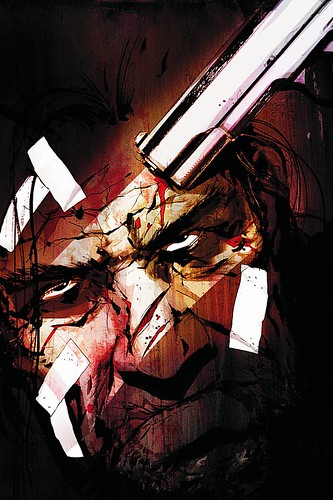 And Scalped is in the right hands. Written by Jason Aaron and (usually) drawn by R.M. Guera, this is a masterpiece in the making.
I don't gush like this often, folks. But you know those books that people look back on? WATCHMEN, PREACHER, MAUS.....wouldn't it be great to have front frow seats as one of those legendary stories was happening?
Well, you can. Volume 5, HIGH LONESOME is due out in November. That gives you plenty of time to catch up.
If you don't, the guy to the right gets it. And a puppy.
I continue to be blown away by SCALPED.
It’s a shining example of great comics, of what can be done with the medium that can’t be done with film, television or books.And that’s a key concept, an important one. There’s a dirty secret in comic books, folks. The industry looks down on itself. It has self esteem problems, always wanting to be more like movies and TV, always wanting to hang with the cool kids. In truth comic books are at their best when they’re allowed to be what they are; a distinct art form. A language of story telling that can do some thing far better than any other medium.
Comics are at their best when they’re not redefining themselves as graphic novels, or sequential fiction, or any of the other bullshit titles that get used to make them seem worthy of having a section in a bookshop.
And Scalped is possibly the best example out there right now.
But I’ll get to that in a minute. First it’s worth noting that I came relatively late to the party. I actually flicked through the first couple of issues and….it didn’t grab me. I wasn’t in the right frame of mind, I guess. After I heard the growing praise, I picked up the first trade, Indian Country, and it hooked me a little. I wasn’t fully sold on this being the best thing since sliced bread, but I enjoyed it and kept going. It’s now up to its fourth trade, The Gravel In Your Guts, and I’m hooked. I need it. Each time i think i have it figured out, it adds another layer or takes a new turn.
What’s the plot? Well like all good things its both very simple and very complex. The basic set up is that it takes place on a Native American reservation. It covers the inhabitants of the towns, the local law enforcement, the corruption, and the building of a brand new casino. It’s every noir tale of corruption and greed that you’ve ever read, but in a new setting that’s so perfect you can’t believe it’s taken this long.
The story starts when Dashiell Bad Horse returns to the rez. He’s angry, he’s strong and he’s trouble. He picks fights with an entire bar full of people and comes to the attention of Chief Red Crow; the godfather of the reservation. Red Crow controls the drugs, the liquor and the sex. He’s the corrupt mind behind the new casino. His main adversary, a woman who is leading the protests against the casino, also happens to be Bad Horse’s mother. She and Red Crow were the love of each others lives until they started hating each other.Dashiell is working undercover for the FBI to uncover the corruption of Red Crow and the bad guys. So far, so simple.
Well…..no.
There are no good guys and bad guys on show here. Soon you start to think that Dash is doing the right thing for the right reasons, and that Red Crow is doing the wrong thing for the right reasons. Except that theory unravels too. Dash is a bit of an asshole. He's not in this for any noble intentions, rather a mix of entrapment, self hatred and self discovery.
And Red Crow himself soon grows to be the best thing about the book. In fact, he’s just about the most complex character I’ve come across in years, in any medium. He’s both a crime lord and a freedom fighter. He’s a flawed hero and a noble villain. As he himself says at one point;
“I’ve killed many men. Women too. And I’ll kill a hundred more, if that’s what it takes to see my vision through. To carve a better place in this world for my people."
In the latest collection we see him trying to reform. He is given the soul pouch of a dead friend to guard over. What that means is that he must live a peaceful and noble life for a year so that the soul of his friend can find peace. If he fails he is condemning that soul to remain restless.
And boy, does he try. But a mans gotta do, you know? I never thought a scene where a middle-aged man says, “I’m sorry.” To a piece of cloth would have me in pieces.
The narrative cuts between the large and the small scale, to show supporting characters becoming entangled in the larger web of the plot. Much like The Wire, we see that the characters are trapped in a much larger game, just as in the old tales where the Greek gods would move the humans around like pawns. You know it’s going to end badly, and they know it’s going to end badly. But they can’t break out.
Dash and Red Crow are caught in a dance, they know one day it’s going to come down between the two of them, but they’re also locked in like family, both defined by the love of the same woman.
So what can this series do that a novel, film or TV series can’t? Why was I so bold with my opening statement?
Could this be a film? Yes. It could be a rushed and violent spectacle. It could cram the whole thing into two or three hours and barely scratch the surface of what this series has achieved so far.
Could it be a television show? Sure. The Wire has proved that this sort of thing is doable. But it would take the very best writers and directors, to say nothing of a cast who would be willing to sit out whole episodes at a time as the focus shifts.
What a comic book can do that doesn’t work on screen is to really get us into the heads of the characters. It can show and tell. And because of that, it only needs to do a little of each to hit home very powerfully.
I’m reminded of a scene in issue 19, The Boudoir Stomp.Dash Bad Horse and his lover are sharing a bed. We see them have wild passionate sex, sharing part of each other in the most intimate way.
Then afterward we see them lying in silence. They’re both lost and alone, and desperate for company. We get too see both what they actually say to each other, and what they want to say to each other. And the fact that they can’t say the words is heartbreaking.
Could this be done on screen? Yes. With a really clunky voice over. In fact, it would need two separate clunky voice overs; one for each character. Who wants that?
Could this be a novel? Sure. Absolutely. But to do the story and characters justice, it would need to be a seven hundred page epic, it would need to have about ten different points of view, and it wouldn’t be able to show us the simple despair that one panel of art can get across.
And that’s where the real strength of the medium lies, as I’ve already said, in its ability to show and tell. A little bit of both goes a long way. It combines the strengths of cinematic storytelling with the strengths of prose. In the right hands it can become something that neither form can match.
And Scalped is in the right hands. Written by Jason Aaron and (usually) drawn by R.M. Guera, this is a masterpiece in the making.I don't gush like this often, folks. But you know those books that people look back on? WATCHMEN, PREACHER, MAUS.....wouldn't it be great to have front frow seats as one of those legendary stories was happening?
Well, you can. Volume 5, HIGH LONESOME is due out in November. That gives you plenty of time to catch up.
If you don't, the guy to the right gets it. And a puppy.
Subscribe to:
Posts (Atom)