Showing posts with label Stringer. Show all posts

Tuesday, March 16, 2010

"Crime Is King," Says The New Guy

By Chuck Wendig

“I’ve got to go and kill a man,” Jay Stringer said in that accent of his (what is it? French? I don’t even know). He thumbed bullets into a rusty snubnose.

“Cool,” I said, just glad he wasn’t going to kill me. I’ve seen what he can do. I’ve seen how his enemies fared. Missing fingers. Lips burned to a char with cheap cigarette lighters. Chair legs shoved in various orifices, some new, some standard.

“I need you to handle some business while I’m gone.”

“Whatever you need, String.”

“You need to right some wrongs. Steer the ship straight.”

I wasn’t following.

He continued: “It’s Do Some Damage, man. It’s Weddle. It’s always goddamn Weddle. He gets drunk on his fruity drinks and then posts about Harry Potter and Twilight and My Little Pony and shit.” (Except, he pronounced it shite, instead. French people with their French pronunciations.)

I just shook my head. I should’ve known.

“You get in there. You do what needs doing. You can talk about Harvey Keitel’s wang if you want. Or the sexual habits of dinosaurs. But above all else, crime fiction. Talk about crime fiction, for Chrissakes.”

He spun the cylinder, snapped it shut.

“You think you can do that for me?” he asked.

I nodded.

He handed me a Taser. I gave him a look.

“For Weddle,” he said. “He comes at you, you give him a dose of this.”

* * *

Crime fiction is king. Let me tell you why – after all, seems like a good introduction to the site, right? Me, showing up here, seems like I should start at the beginning, and the beginning is that crime is king.

One of my recent mini-crusades in writing is how to make the story and the characters more active. Right? People do shit. A lot of stories end up the opposite, though: People respond to shit. Love? Love can be passive. Falling in love is unwilling. Romance can be born unaware. Horror? Horror is often reactionary. Evil comes. It chops down your door with an axe. You evacuate your bowels. You run. You scream. You respond. Fantasy? Sci-fi? Mythic patterns. Be forced on a hero’s journey. Respond to new technology and changing conditions and future nonsense.

To be clear, I’m not saying those other genres are automatically genres of passivity. Not at all. I love those genres. But you could, if you were so inclined, fall into a somewhat easy pattern of passive stories and passive characters. Those genres allow that.

Crime, though? Crime doesn’t put up with that kind of bullshit.

Crime is like a agar dish of awesome: active elements growing aggressively. Character commits a crime, he does so actively. He is full of want and need. The stories are sodden with possibilities. Guy kills his wife’s lover? Jealousy. Rage. Sure, he’s responding to it, but his response is wholly active. He chases the cheating fuck across the lawn. He pops shut the shotgun’s breach and pushes two shells deep. He pulls the trigger and blows the cheating fuck’s guts out his belly and onto the lawn gnomes (intestines draped upon them like a feather boa on a Vegas dancer).
Boom.

Bunch of assholes rob a bank?

Girl gets revenge on some sick prick by hanging him from a tree and, er, “pruning his man-branch?”

Cop goes off the reservation to make a side deal on the sly so he can feed his family?

Car bomb? Axe killing? Confidence game?

It’s all active. It’s all about people doing things. As a writer, you conjure the circumstances surrounding a single crime, and it’s like a series of dominoes starts to tumble forth into shadow. Who are these people? Why are they doing it? Motivations abound. Desires rise, triumphant. Fear and vice hold hands and jump. You’ve no idea where this trail of breadcrumbs may lead.

Crime is a transgression. It is a violation of social norms. Transgressions, deceptions, violations, violence: these elements serve as a wild source of conflict, and conflict is what we want. Conflict is the food that feeds the reader. An old writing professor said it best: in life we try to avoid conflict, but in fiction, we must head toward conflict. Or, like Tim O’Brien said in a recent interview: “When I hit plateaus, I head for the mountains. By that, I mean (or think I mean) that I do all I can to point a story or a novel toward its central human drama, toward its essential human mystery.” Goddamn right. Crime, then, is the ultimate expression of those mountains -- or, perhaps, as it represents a nadir, we might say it represents the valleys, pits and canyons, and the character must descend, must transgress, must cross the borders and boundaries that Should Not Be Crossed. The characters in crime fiction leave the plateau. They abandon the status quo. They choose that path.

It’s that choice that’s so compelling. The decision to transgress, to pull the trigger or take the money or crack some dude’s head open with a statue of the Buddha, that’s why we read it – or, at least, that’s why I read it. Why do you read it? Why, for you, is crime king?

Ooh. Dang. I gotta go. Weddle’s coming at me, and I want to get this Taser shot juuuust right.

Monday, January 4, 2010

Flash, Holmes, Podcast

By Steve Weddle

Jay Stringer and I just hung up -- or 'clicked off' (What do we say anymore? And why do we still say 'dial' a phone number when we just press buttons in the post-rotary days?) -- from the Skypes for our second DSD podcast.

The iTunes shoppe page for the podcast is here. You can download individual episodes or subscribe to the whole run. The second show will be up mid-week after Jay works his evil magic to make me sound like an over-caffeinated lemur.

Future episodes will include publishing news of the week, interviews, reviews, and audio stories.

In this second episode, John McFetridge reads his short story "Santa in a Red Dress."

Jay and I discuss blogs worth reading, the Sherlock Holmes movie (along with a review from Scott D. Parker), and flash fiction. I have a few thoughts about flash fiction and I'd like to know what you think.

1. Flash Fiction owes its popularity to the fact that most people can't follow a single thought for more than thirty seconds. Or eight seconds. Like in that movie where the dude is a rodeo rider and rapper. Or maybe that was EIGHT MILES. Something. Eight something. Eight Days a Week. Beatles. Rock Band. Hey, the Wii is open. Time for a quick bike ride around Wii island.

2. Flash Fiction works much better on the Innerwebs than it does in print. As Jay and I were discussing on the podcast, when his grandpa and I were growing up, we read ink-on-paper magazines. You might have heard about a shepherd boy who threw a rock and cracked open jars full of old copies of LIFE and US WEEKLY. Now flash fiction challenges such as this one and this one and this one allow readers and writers to get glimpses of talent they didn't know existed. When we relied on print mags for our fiction, the flash fiction might have gotten lost between stories, if you could find it at all. A 400-page collection of 200 flash pieces? Not likely.

3. Flash Fiction is much easier to find now. I remember some collections of flash fiction that I used when I taught literature. You could give it to the college students and start a good discussion on character and setting and so forth. Very helpful, since you could read the piece in class and not have to rely on college students actually having done the work. We only had a few choices back when I was teaching. The monks took a long time to illustrate the scrolls scrolls we used. Now, using the community I mentioned above in Idiotic Point The First, finding flash fiction is easier.

4. OK. Let's think about this one for a second. You put a story up on the Innerwebs, chances are you aren't going to get paid $10,000 for it. I remember reading something Garrison Keillor wrote about a story he'd done in The New Yorker, a story had gotten him $10,000 or so. Most online magazines now are run by folks who love what they do and love the stories they work with. They're not doing this for the money, because, well, there ain't none. And the print mags? Did another one die today? I didn't check. So we rely on the online magazines to provide us with great fiction. The writers don't get paid. The editors don't get paid. So, from a writer's point of view, if you're trying to get noticed and share some of your work, does it make sense to spend your time writing a 7,000-word story for one magazine or writing 10 stories of 700 words for various sites? Personally, it depends on what the story is. I've got longer stuff out there because that what it takes to tell the story. I've got shorter stuff out there because I wanted to have fun with something and maybe try out something new. A new character. A wacky idea. Take a chance, you know? But do you think writers are spending more time writing flash because they don't want to spend their "free time" -- time off from paid jobs, doing something for which they don't get paid -- writing for free? Dunno. Maybe some folks work like this.

5. Flash Fiction is great for writers because you can focus on a particular scene or character in something under 1,000 words. You get that done, maybe it's a chapter in a novel. Maybe it's a character study for a novella. Flash Fiction helps writers test out a new voice or fresh idea, as I mentioned a second ago (I remind you because the TV news tells me you have a short attention span. Remember? I already mentioned that.) and, wait, where was I? Oh, yeah. So you take this little, tight piece you've worked on and build it into something more, something bigger. Like you've made an appetizer and want to work it into a larger meal. Or you've painted your study and now want to carry that color scheme throughout the rest of the house.

So what do you think about Flash Fiction? What purpose does it serve? Do you think writers waste their time on these smaller pieces? Or do you think this helps readers and writers?

Tuesday, September 15, 2009

Scalped - No capes allowed

By Jay Stringer


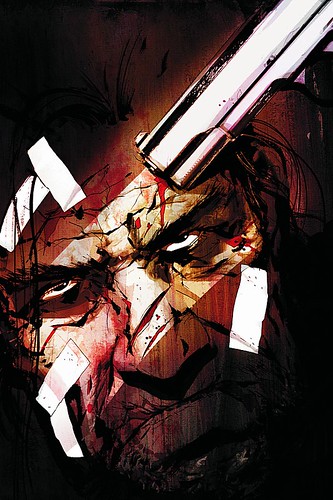
I continue to be blown away by SCALPED.

It’s a shining example of great comics, of what can be done with the medium that can’t be done with film, television or books.

And that’s a key concept, an important one. There’s a dirty secret in comic books, folks. The industry looks down on itself. It has self esteem problems, always wanting to be more like movies and TV, always wanting to hang with the cool kids. In truth comic books are at their best when they’re allowed to be what they are; a distinct art form. A language of story telling that can do some thing far better than any other medium.

Comics are at their best when they’re not redefining themselves as graphic novels, or sequential fiction, or any of the other bullshit titles that get used to make them seem worthy of having a section in a bookshop.

And Scalped is possibly the best example out there right now.

But I’ll get to that in a minute. First it’s worth noting that I came relatively late to the party. I actually flicked through the first couple of issues and….it didn’t grab me. I wasn’t in the right frame of mind, I guess. After I heard the growing praise, I picked up the first trade, Indian Country, and it hooked me a little. I wasn’t fully sold on this being the best thing since sliced bread, but I enjoyed it and kept going. It’s now up to its fourth trade, The Gravel In Your Guts, and I’m hooked. I need it. Each time i think i have it figured out, it adds another layer or takes a new turn.

What’s the plot? Well like all good things its both very simple and very complex. The basic set up is that it takes place on a Native American reservation. It covers the inhabitants of the towns, the local law enforcement, the corruption, and the building of a brand new casino. It’s every noir tale of corruption and greed that you’ve ever read, but in a new setting that’s so perfect you can’t believe it’s taken this long.

The story starts when Dashiell Bad Horse returns to the rez. He’s angry, he’s strong and he’s trouble. He picks fights with an entire bar full of people and comes to the attention of Chief Red Crow; the godfather of the reservation. Red Crow controls the drugs, the liquor and the sex. He’s the corrupt mind behind the new casino. His main adversary, a woman who is leading the protests against the casino, also happens to be Bad Horse’s mother. She and Red Crow were the love of each others lives until they started hating each other.

Dashiell is working undercover for the FBI to uncover the corruption of Red Crow and the bad guys. So far, so simple.

Well…..no.


There are no good guys and bad guys on show here. Soon you start to think that Dash is doing the right thing for the right reasons, and that Red Crow is doing the wrong thing for the right reasons. Except that theory unravels too. Dash is a bit of an asshole. He's not in this for any noble intentions, rather a mix of entrapment, self hatred and self discovery.

And Red Crow himself soon grows to be the best thing about the book. In fact, he’s just about the most complex character I’ve come across in years, in any medium. He’s both a crime lord and a freedom fighter. He’s a flawed hero and a noble villain. As he himself says at one point;

“I’ve killed many men. Women too. And I’ll kill a hundred more, if that’s what it takes to see my vision through. To carve a better place in this world for my people."

In the latest collection we see him trying to reform. He is given the soul pouch of a dead friend to guard over. What that means is that he must live a peaceful and noble life for a year so that the soul of his friend can find peace. If he fails he is condemning that soul to remain restless.

And boy, does he try. But a mans gotta do, you know? I never thought a scene where a middle-aged man says, “I’m sorry.” To a piece of cloth would have me in pieces.

The narrative cuts between the large and the small scale, to show supporting characters becoming entangled in the larger web of the plot. Much like The Wire, we see that the characters are trapped in a much larger game, just as in the old tales where the Greek gods would move the humans around like pawns. You know it’s going to end badly, and they know it’s going to end badly. But they can’t break out.

Dash and Red Crow are caught in a dance, they know one day it’s going to come down between the two of them, but they’re also locked in like family, both defined by the love of the same woman.

So what can this series do that a novel, film or TV series can’t? Why was I so bold with my opening statement?

Could this be a film? Yes. It could be a rushed and violent spectacle. It could cram the whole thing into two or three hours and barely scratch the surface of what this series has achieved so far.
Could it be a television show? Sure. The Wire has proved that this sort of thing is doable. But it would take the very best writers and directors, to say nothing of a cast who would be willing to sit out whole episodes at a time as the focus shifts.
What a comic book can do that doesn’t work on screen is to really get us into the heads of the characters. It can show and tell. And because of that, it only needs to do a little of each to hit home very powerfully.

I’m reminded of a scene in issue 19, The Boudoir Stomp.

Dash Bad Horse and his lover are sharing a bed. We see them have wild passionate sex, sharing part of each other in the most intimate way.

Then afterward we see them lying in silence. They’re both lost and alone, and desperate for company. We get too see both what they actually say to each other, and what they want to say to each other. And the fact that they can’t say the words is heartbreaking.

Could this be done on screen? Yes. With a really clunky voice over. In fact, it would need two separate clunky voice overs; one for each character. Who wants that?

Could this be a novel? Sure. Absolutely. But to do the story and characters justice, it would need to be a seven hundred page epic, it would need to have about ten different points of view, and it wouldn’t be able to show us the simple despair that one panel of art can get across.

And that’s where the real strength of the medium lies, as I’ve already said, in its ability to show and tell. A little bit of both goes a long way. It combines the strengths of cinematic storytelling with the strengths of prose. In the right hands it can become something that neither form can match.

And Scalped is in the right hands. Written by Jason Aaron and (usually) drawn by R.M. Guera, this is a masterpiece in the making.

I don't gush like this often, folks. But you know those books that people look back on? WATCHMEN, PREACHER, MAUS.....wouldn't it be great to have front frow seats as one of those legendary stories was happening?

Well, you can. Volume 5, HIGH LONESOME is due out in November. That gives you plenty of time to catch up.

If you don't, the guy to the right gets it. And a puppy.