By Russel D McLean
The other week, I was out at Literary Death Match (where, by the way, I won the evening...). Its an odd mash up of literary event and game show where four writers read in front of three judges who choose the two "best" to go into a head to head competition tangentially linked to literature. Hosted by the effervesent mass of energy that is Adrian Todd Zunga, LDM is a fantastic night and well worth attending. The mix of standard literary stuff (the readings) with more fun additions (the standoff, the occasionally insane judging commentary) makes for great entertainment, and its no surprise the show has been optioned for television.
But it got me thinking about authors and reading. Generally I don't do much reading at my events. The main reason being I can barely concentrate on the whole thing as a listener. I admit I drift off during most author readings, because most authors aren't trained performers. There are exceptions, of course. Stuart MacBride is a great reader. But he really plays the parts he's reading. However, most authors tend to lose any traction they've built up prior to reader by mumbling the words off their books. Sometimes this is down to ability, but often I think it's lack of preparation. I admit I read by the seat of my pants. I will change my mind about what I'm reading at the last moment, but I am confident in the fact that I'm two steps ahead of the words that I'm speaking in my ability to edit as I read, to change words and tones to suit the drama of the moment (ie, I edit my own work as I'm reading it). But as one writer told me on the night of LDM, they cannot read without knowing exactly what they are going to say. And I suspect many writers are similar, and yet I get the feeling they don't practice over and over again with their readings. Because they are never told how to.
Writers are expected to perform their books. Where the truth is that most writers don't know how to perform expect on the page. They can create stunning words, but reading those words is not enough. Our brains perform for us when we read words on the page, but its the rare untrained reader who can then perform in a way that brings that to life.
And while I claim to be a seat of the pants reader (when I do read; most of the time I talk about things that interest me, or about the stories behind the books or that time I got chucked out of an internet cafe while doing research for a novel when I was a teenager), the truth is that I always practice my voice and intonation. I may not read what I expect to read when I go up there, but I have always prepared myself with a tone of voice and feeling I want to convey. When appearing with other writers, I make sure I have a few topics we can both talk about just in case we dry up. I have spent hours thinking about how I want to appear and the kind of mood I want to create.
Because an author event is an event. You can't just show up. No other business in the world would allow a performer to show up and not have prepared to engage with the audience. And yet so often in the world of literary events, writers are let loose with little to no idea of what kind of structure or tone they are supposed to be shooting for with an evening.
LDM sets its tone nicely with the pre-event communication. It lets writers know what they need to do. But I do think that writers (none of those I appeared with at LDM, by the way; its just that this is the event that got me thinking) need to understand more about presentation and showmanship. We are writers, but if we insist on turning up to meet and greet our readers we need to give them something more. We need to give them a show. We need to give them a good time (by which I mean interesting; you can be serious, and it can be equally as much fun as someone who is laugh a minute if you are passionate and interested in the subjects about which you talk).
Showing posts with label rambling. Show all posts
Showing posts with label rambling. Show all posts
Friday, December 13, 2013


Friday, August 30, 2013
Eliminate the Unnecessary (or.... Axe those Adverbs)
By Russel D McLean
Last week, talking about Elmore Leonard, one of his ten rules - my favourite - reared its head. You know, the one about not using adverbs.
Adverbs.
Why do we hate them?
I think it comes back to the essence of show and don’t tell. Adverbs tell. Used sparingly, of course, they can be effective, but most of the time we use them unneccesarily. Let’s take a basic example:
“Go to hell,” he said, angrily.
“Angrily”. There’s no need for the word to be there. And yet time and again I read books where this happens, where what is obvious from dialogue is unnecesarily reinforced by an adverb. Let’s overlook the fact that “go to hell” is a cliche, and think about why we would use the word angrily.
Its a first draft problem. The use of the adverb is usually a sign that the writer is talking to themselves and not to the reader. For me adverbs become placeholders until I can work out how to make the scene “pop”. But when overused in final or published drafts, they become the equivalent of a movie director walking on stage and saying, “this is how I mean to convey this moment” because they don’t have faith that the audience will understand their intent. Adverbs kill the moment. They make what is usually already obvious even more so. And they remind us that we are reading. The act of reading - the merging of an author’s words and reader’s imagination - should create an illusion of reality. The more that a writer does to remove the reader from the “reality” of their story, the more likely the reader is not to care.
Make the audience understand. Show them what you mean, Don’t tell them.”
“Okay, smartarse,” I hear you say, “What if you intend for your dialogue to do something other than the obvious?”
Like,
“Go to hell,” he said, regretfully.
Okay, okay. I see what you’re talking about. But you still don’t need the adverb.
“Go to hell,” he said. His voice was soft, a whisper, really. There was no punch to his tone, no fire burning behind his eyes.
Yes, it uses more words (and is probably not the finest piece of writing in the world) but it is more of a direct appeal to the reader to use their brains. They are not being directly told what to think. Yes, there are hints and a tone that implies but the reader is less removed than if simply told, “regretfully”.
And yes, I know some people talk about “escapist” fiction as though sometimes we just read to turn off our brains, but its simply not true. Our brains do not turn off. And dumb fiction does not have to be dumbly written.
If you ask me, adverbs (mostly) take away the fun of fiction. When we watch a film, we need to guess what the characters are feeling through gesture and expression. Prose has a shortcut through that process in that it can tell us directly. But by telling us directly it takes away the emotional impact of a dramatic moment. By using, “angrily,”, “sadly”, “madly,” etc etc, we alienate the reader from the reality of the situation. Adverbs distance us from emotion. They provide a barrier between what we want to communicate at an emotional level. They are, in a word, a cheat. We experience the world through sensory impressions. Our brains interpret these. Adverbs bypass those impressions but in doing so lessen the impact on the reader. They are a cheat. And not a good one.
All of which is not to say that they should be avoided completely. Fiction is not a precise art, and sometimes cheating is the only thing to do. But what really annoys me is when adverbs are overused. Yes, all fiction should skip the occasional corner and occasionally adverbs can provide a nice and simple escape from a moment that never ends, but when used all the time they render prose and action soulless.
So, he said. empathetically, avoid the adverb. Use it judiciously. Use it correctly. Just don’t use it in a place where you can appeal directly to the reader’s emotions. Don’t use it as a stand in. Trust your readers. Make them work just a little. Bring them closer to your world. And if you do have to use them; use them wisely. Use them well.
Next week marks the beginning of a series of 11 geeky geeky blogs by Russel leading up to a certain fiftieth anniversary. Just to warn you...
Friday, July 26, 2013
Exit Stage Left, Pursued by a Reader
By Russel D McLean
One of the things I love most in this business is meeting readers.
I've talked about this time and again but its true. I love getting out in the trenches and seeing people in action, figuring out who buys the books. Sometimes they're insane. Sometimes they're wonderful. Sometimes they're determined to prove they're smarter than the author. Sometimes all they want is to be entertained.
Whatever, I love meeting them.
I was thinking about this again after doing a book and beer evening with Stuart MacBride in Crail. Its the third me and Stuart have worked together. The first time we did an event together, things were a little awkward awkward. Neither of us knew the other's rhythms too well and we both floundered a little (although thankfully we pulled it back in the end and everyone had a good time) but now we seem to be getting a handle on each other, working out how to come across well on stage.
And that's something you're never prepared for as a writer:
The Event.
You know, where people come out to meet the flesh behind the pages. Where they want to see in action the mind that created a whole fictional narrative.
The people who come out want to be informed. They want to be entertained. They want to feel like they've seen something behind the books.
And that's odd.
Because writers are naturally insular people. One of the reasons I have loved working with MacBride (God only knows how he feels working with me) is that he is a born entertainer. I can play the straight man to his Polish Swearing routine or field a serious answer to which he can then create a punchline (and then still tack on a serious answer that outflanks my own). But he knows when to pull it in, when the audience aren't reacting or when they need him to be the writer, not just the beardy Sex God.
But its strange being on that stage. Knowing that these people have come to see you.
I've seen it go wrong so many times. From the writer who talked for five minutes then announced that not enough people were here and walked off to the author who read from their book in a dull monotone for an hour straight. I've seen writers paired together who clearly had no common ground. I've seen panels collapse due to a overbearing host.
But the problem is that we're not trained how to speak in public. We're just expected to know how to do it naturally. We're also often expected just to show up with no advance contact and bounce off other writers we've never met... (I'm not going to mention the pay situation)
I've done a lot of events now. I'm starting to get a personality that I play up. Mostly its a befuddled one, but then its just an extension of who I am naturally. I've learned how to project, how to vamp when I don't know what I'm talking about, but all the same I've had little in the way of formal training (in terms of talking about writing; I did some stage work in my younger days) and just had to make it up as I went along. I still envy writers like John Connolly who can talk so eloquently, or Christopher Brookmyre who can naturally make a room crack up with laughter. Or Megan Abbott who just seems to always know exactly what she's saying. Or James Ellroy who just puts on the greatest motherfucking show that any pervert with a brain will appreciate. Dig the demon dog, hep-cats, he's got the greatest show in history.
The pressure of events on writers is fantastic. We're expected just to show up and be interesting, but unlike stand ups or actors, we got into our line of work so we wouldn't have to deal with people. Now, I've discovered I love doing events, and more importantly love meeting readers, but I know every time that I have to give them something whether its a few good punchlines or perhaps a few insights into something they didn't expect (I've started to talk more and more about the style and lives of writers who influenced me; my life revolves around books, so why shouldn't I talk about them?). It can't just be about plugging the new book or reading page after page (unless you're good at that). The audience are there to be entertained. Which means that any writer who agrees to do an event should be aware of what they are getting into. As I have seen (especially with the writer who talked for a few minutes before walking off due to low turnout) some are doing only because it is expected of them, not because they want to. A bad event can be worse than no event at all in a reader's eyes, especially if they are not entertained. Because we have to remember, its all about the readers. The audience. And its certainly not about feeding our own egos. I certainly hope that anyone who sees me comes away with some sense of value for money. Even if the event was free...
Friday, July 19, 2013
Cuckoo in the Nest
Updated 19/07/13 - It has now been revealed that the tweeter was connected to a lawyer who was aware of the pseudonym. So even though it did look suspicious, the publishers are actually innocent in the unveiling. Which I do find rather heartening.
Unless you’ve been living with your head in a sound-proof box this week you’ll know that JK Rowling was revealed as the real author of a crime novel called The Cuckoo’s Calling. The book - depending on who you listen to - sold between 450 - 1500 copies. I’m inclined to believe the lower numbers given the distribution of the book in the UK. A number of well known authors including Mark Billingham and Val McDermid blurbed the novel* and it got a couple (but not that many) of good press reviews.
Then JK Rowling was revealed as the author. The publishers deny leaking this information, but I still have to wonder how anyone noticed the “similarity to Rowling” when the book sold so few copies. And yes, she did share a publisher and agent with her pseudonym, but again that isn’t an unusual situation for an agent to build up a good rapport with a publisher and sell more than a few of their clients to them. When this happened, of course, sales increased by a staggering amounts and bookstores that had ignored the book ordered in droves.
What does this tell us?
It tells us that debut authors have a tough time. It tells us that names and platforms shift books and while good writing may rise to the top, it takes time. A lot of time. Ian Rankin didn’t sell too well until the seventh or eighth book. James Lee Burke won critical acclaim and then got lost in the publishing deserts for years until he rose like a Pheonix from the ashes. Most debut authors don’t sell.
Because readers are often afraid to take the chance.
That’s the basic truth of it. Working in bookselling for years, I know how hard it is to move a debut author. James Oswald is one of the biggest exceptions I have ever seen, but even he had a great platform to lift off from (as well as having talent), and a marketing campaign that you would rarely see for a new author. Most of the time, you can tell everyone about a debut author until you’re blue in the face but readers are still wary. And its no surprise. With crime writers in particular, readers like to have long affairs with authors. They like to come to authors with big backlists that they can read from the beginning or authors that come with the seal of approval of multiple publications (must mean that they have staying power). They don’t like it when debut authors come along, steal their hearts and then vanish without a trace.
But all of this makes it tougher for debut authors. After all, all a debut author often has to go on is their words. The lucky few have a great platform, but most are just plying their trade. The book should speak for itself, but in the modern world. its the people who shout loudest get the most attention. There are several reasons I can think of that Galbraith didn’t get attention until he took off that Scooby Doo mask and revealed himself to be JK Rowling. the most important of which is that the book wasn’t really pushed that hard. Working in the trade, I was aware of its existence, but the buzz was quiet. Nothing pushed it above the crowd, least of all the frankly rather dull cover**. It was another police procedural in an already overcrowded market. And while Galbraith’s pseudonym may have had a background in this according to the blurb, that’s not unusual these days, Matt Hilton and Luke Delaney both spring to mind as former police officers, so its not that unusual a background for a crime writer to have, necessarily. Certainly its not guaranteed to get them instant attention. And as The Literary Critic herself (Lesley McDowell) pointed out, having an author who can’t do the publicity trail may also have an effect upon the book itself (was there even a fake Galbraith twitter feed or fb presence?)
The fact is that, even though it should be, good writing isn’t always the first thing people look for when buying a book. They want assurances about what they’re reading whether through testimonials they trust or an assurance of the author’s pedigree. To create a brand from a good writer takes time. Its no wonder that Galbraith’s sales were so apparently low (but as lots of people have said, not bad for an unknown debut in hb) even when the writing might have been brilliant. There wasn’t enough volume to convince reader’s to listen. And the same is true of so many debuts. The fact is that a debut shouldn’t be about selling millions in one go. It should be about entering the market and starting to build something. One book’s sales are not enough to judge an author’s worth. Even Rowling didn’t start shifting until book 3. And who can forget that Raymond Chandler didn’t really shift that well for three or four books (part of that being to do with the fact he was published in hardcover only for those books)?
I would love the publishers to have been able to leave Galbraith alone for a few books and see how he did, same as King did with his Bachman persona. It would have been an interesting experiment to see how difficult it really is for a debut author to make it, especially when everyone knows the sales potential of that author's talent already. But at the same time I’m happy for Rowling that people who have read the book have enjoyed it. And I hope she is still able to exploit this second persona. After all, there is little more fun in this world than writing gruesome violence and dark deeds, as we at Do Some Damage can attest.
In the meantime, can Mr Stephen King please step forward and announce that he’s really me? Oh, what do you mean that isn’t how this works?
*cynics claim they must have known the truth as all three share a publisher. Yeah, it looks odd, but frankly I can see why publishers would do interhouse blurbs/reviews and it doesn’t mean that a) McDermid/Billingham were just being nice or that b) they knew who they were blurbing. I’ve met both McDermid and Billingham on several occasions and my instincts tell me that they are essentially honest types, so let’s just leave that particular conspiracy to one side, shall we?
**And yes, perhaps I’m one to talk - - this is not about targetting Galbraith/Rowling, however
Friday, April 26, 2013
Less is More (some thoughts on the legends of Villainy)
“You’d like to quantify me, Officer Starling. You’re so ambitious, aren’t you?” – The Silence of the Lambs
Its
fair to say that Hannibal Lecter is one of the greatest and most
terrifying villains in modern entertainment. From his appearances in
Harris’s novels RED DRAGON and THE SILENCE OF THE LAMBS to his
recurrence in MANHUNTER and later SILENCE OF THE LAMBS (the movie) he
was the ultimate in chilling evil. We saw just enough of him to know he
made the hairs stand up on the back of our neck. He was revealed in slow
moments, in pieces, stepping out of the shadows just far enough for us
to see his teeth and to know that we needed to steer clear of him.
He was a shadow.
A monster.
A bogey-man.
“Dr
Hannibal Lecter himself reclined on his bunk, perusing the Italian
edition of Vogue. He held the loose pages in his right hand and put them
beside him one by one with his left. Dr Lecter has six fingers on his
left hand.” – the Silence of the Lambs
We wanted more of him, this strange, unknowable and terrifying figure.
But
when we got more of him, something strange happened. He lost his power.
That uncertainty, that unquantifiability suddenly became quantifiable.
Because we learned too much and too fast. By the time Hannibal rolled
around, Lecter was no longer this creature in the shadows, but suddenly
he had a backstory (a sister lost in terrible circumstances, eaten in
front of his eyes, because, you know, that explains his obsession with
canibalism) and even an enemy who was more brutal than he was (the
ludicrously over the top Mason Verger, who happens to be a paedophile,
just so we get the message that he’s more morally reprehensible than our
favourite psychopathic doctor). He became more than a supporting
character in a larger tale and instead the focus of the story. He became
the “hero” instead of the villain. And he lost his edge; became a
parody of himself.
And I won’t even talk about Hannibal Rising.
It’s
the same story as with Darth Vader. A mysterious black clad figure,
Vader was given just enough backstory (spoiler – he’s the hero’s father)
to grant him life, but then we were given his backstory which fleshed
out his character to the point of pointlessness. All those beats that
one could easily have filled in as an intelligent consumer of stories
were made explicit. And suddenly Vader was no longer this omnipresent
threat, but rather a lovelorn idiot who was once an extremely annoying
kid with a talent for driving race-cars. All the threat and menace he
once exuded was gone. And it didn’t help that he was given one of the
most painfully hamfisted origin scenes in the history of the movies:
The
great villains – and by villains, I mean the ones who speak to the
blackness of the world, the ones who are truly monsters and bogey-men - do not need backstory beyond what is neccesary. They work at their finest when we know them in the moment, when we know only that we need to be afraid of them, that in this moment they make us feel something at back of our neck.
But
the problem comes when those villains start to step out of the shadows;
when they become so popular that their creators feel the need to give
the audience more, to expand upon their creations, to give these creations more depth than they were every created to handle.
And to do that, they have to let the bogey-men step out of the shadows.
Thus,
Hannibal Lecter becomes less a manifestation of our fears regarding the
intelligent, thinking monster, and more of a strange sad-luck story.
Darth Vader becomes a weak parody of power; a lost little boy carried by a destiny beyond his own control.
They
lose the effect they once had. In the harsh light of over-exposure they
become less powerful and consequently lose the effect that they once
had on audiences. We know them too well for them to have the same effect upon us they once had. They have become quanitifiable. Understandable. Predictable.
There is such a thing as knowing a character too deeply.
The legends become too thin. The increased knowledge on the part of the audience weakens the power of the character.
Think
about it: would Jaws be so powerful if we knew the Shark’s backstory?
If we learned that the shark were angry at the residents of Amity Bay
because Quint had killed its mother?*
Would
Max Cady have benefited from a sequel to The Executioners/Cape Fear in
which we learned about the childhood trauma that created the monster?
“He
kept grinning at me. I can’t remember ever seeing a more disconcerting
grin. Or whiter, more artificial looking teeth. He knew damn well he was
making me uncomfortable.” – The Executioners.
Certain
villains are iconic in and of a moment and only within a certain
fictional framework. Certain heroes work in the same way, too**. They
are legends more than they are characters. They do not need to step
beyond the confines of the stories that gave them power in the first
place. They do not need continual expansion or mythologizing. Because
instead of adding the depth that the creators – and the audience who
have demanded this – crave, all that happens is that the characters
become lesser. They lose their impact. They become something else
entirely; something weaker and altogether less appetising.
I
always think about The Joker. He is the Batman’s most appealing
villain, and yet for every attempt to explain who he is, we only wind up
with more questions and indeed even today we know as much about him as
we did in the early days; he is a homicidal maniac with no (definite)
name and no agenda beyond spreading chaos across the Gotham city
landscape. We may get glimpses of other parts of him, but never more
than is necessary and never anything to take away the most powerful
aspects of that character. Think about Christopher Nolan and Heath
Ledger’s take on the character in The Dark Knight: constantly telling
different versions of his origin, never letting anyone close to what he
really is or how came to be. The very uncertainty of the character gave
him his power.
Wanna
know how I got these scars? My father was… a drinker. And a fiend. And
one night he goes off crazier than usual. Mommy gets the kitchen knife
to defend herself. He doesn’t like that. Not one bit. So – me watching –
he takes the knife to her, laughing while he does it! Turns to me, and
he says, “why so serious, son?” Comes at me with the knife… “Why so
serious?” He sticks the blade in my mouth… “Let’s put a smile on that
face!” And…Why so serious? - The Dark Knight.
Less is more. The less we know, the more the legend has its power.
The
best villains – the best legends – do not need to come into the light,
do not need to let us see more of them than we do in the moment of the
story.
This is why they are effective.
And
that is not to say that some villains do not deserve depth, do not
deserve to come into the light. But when you’re dealing with iconic
figures, with characters whose very existence is dependent more on the
effect they have on the reader than on their depth, then you have to
walk a very fine line between psychological acuity and oversharing.
Or
else you run the risk of destroying everything that made that character
work in the first place. By giving the audience more, you wind up
giving them less.
*Actually
I have a sick feeling this may have been hinted at – or something
similar – in one of the sequels. In which case, given how bad the
sequels were, point proven.
**Although, as with everyone, I find its more fun to talk about the villains; they get all the best lines.
Friday, March 1, 2013
Books Like People.
By Russel D McLean
Last week I spoke at a school as part of their Book Week, being held right before National Book Day hits here in the UK. National Book Day is all about getting kids reading, because we should all be concerned about literacy rates.
One of the things I talked to them about (and I covered a massive variety of topics, so all of the stuff that follows is an expansion or exploration of some off the cuff comments) was the fact that we don't have to read books to "better" ourselves. Yes, we should talk about books. We should talk about issues raised in books. But in the same way that we do that with movies and computer games and other forms of narrative entertainment. Books are always being touted as being somehow "better" than other narrative forms, but I sometimes think this translates into books not working as hard as they could, as though by the very nature of being prose they've earned some slack.
Not true.
Look, books (we're talking fiction here) are about entertainment. Like movies, they can be about deep, provoking entertainment or they can be about relaxing us in some way, helping us escape reality. Sometimes, on rare occasions, they can do both. One of the reasons I love crime fiction is that I can at once thrill to the excitment of what I'm reading, but I can also talk about issues raised, whether its about the nature of crime, the culpability of criminals, the society that creates certain types of crime, or whatever. But the fact is that I seek out books I enjoy and that speak to me.
I see no shame in not enjoying a book.
And just because I don't enjoy it doesn't mean its bad. This was one of my other points: that we should not be afraid to say we didn't enjoy a book. It just means that, as with people, we suffer from a kind of personality clash. There are some people out there who are perfectly nice that we just don't get along with. And its the same with books.
Me and Agatha Christie don't get along too well. I appreciate her intelligence, her influence and the way she so cleverly creates these perfect little plots where the guilty are caught, but the fact is that we don't have anything in common. Me and Raymond Chandler on the other hand, have a little magic on every page and care about atmosphere and character over plot, which is why we get on so well (and why neither of us really care who killed the Sternwood Chauffeur).
You shouldn't be afraid to dislike a book. But you should be able to say why that is beyond "I didn't like it." By examining the reasons certain books don't appeal to you, you start to discover more about yourself and who you are.
I think we need to talk about books. But not just about how they better us. We need to talk about them on the same level as movies and other narratives. We need to talk about them not as special objects but simply as things that are. They're another delivery method for stories and fictions both good and bad. They're not innately special compared to these other methods, but they are different and unique in their own way, capable of delivering a certain kind of experience in a way that movies cannot in the same way that movies deliver a certain experience books cannot.
A good story is a good story.
A bad story is a bad story.
And there are millions of good stories between paper covers or glowing out at us from the screens of our e-readers.
Let's talk about them.
Let's agree about them.
Let's disagree about them.
Let's discover them.
Let's read them.
Friday, December 7, 2012
Identity
By Russel D McLean
Apologies for the late post today - I was rather caught up in paid writing work!
About eight or nine years ago, I got a call from my friend
John (whom I haven’t seen in ages – hey, buddy, promise I’ll be in touch soon).
John was recently out as a gay man and rather enjoying things from what I could
tell. Anyway, after all the usual preamble you get with a friendly phone call,
John said, “Look, is there something you want to talk about?”
I didn’t have anything I wanted to talk about that I could
think of. But he insisted. Like this was something serious. And we played that
game people do, where neither of them really wants to say anything in case
they’re wrong. It took John to finally say: “I saw the profile.”
The profile in question was on a gay dating website. He sent
me the link. And I saw that there – under a pseudonym (oh how I wish I could
remember it) was me. I knew it was me and not just someone who looked like me
because the profile pic was taken in a bar I frequented at the time. And, in
fact, I had a copy of the very same photo. It had been taken on a night out
with the English Literature Society of Dundee University. I should add, it wasn’t
an incriminating photo, although my eyes were a little glazed. This wasn’t a
photo already on the net. This was one you’d have had to scan in.
“Is there something you want to talk about?”
I was confused at first. My sexuality is pretty comfortably
heterosexual. And if I did come out, I probably wouldn’t use a gay dating site, just as I never used a straight dating site (which might explain
why I spent eight years single). So what was my image doing there? And what
were some of these activities I apparently enjoyed? And why did I describe
myself as a bear?*
After the conversation got less awkward, when I realised
what he was talking about, I explained to John that I hadn’t posted the
profile. I had no access to it. I couldn’t imagine why anyone would post an
image of me there. But it had to be someone we both knew because there were
only a select number of people would have access to those particular photographs.
What nagged at me even more was the fact that whoever had
posted it there hadn’t tipped me off to the fact that they had done so. They
hadn’t linked to anything personal about me, they hadn’t posted my email
address or forwarded messages of interest (maybe the profile got none) or used
it in some way to spread rumours about me.
They had just posted the profile.
And let it sit there for over a year until John stumbled
over it while looking for a date.**
I still don’t know who did it or why. Was there an end game?
Was it a practical joke that never reached a punchline? Was it some weird kind
of revenge? Was it someone so shy they thought that posting an image of me
would give them more chance at getting a date than posting their own features?
I contacted the site and told them that my image was being
used without my consent. Proving this got a little complex and I wound up
posting a photograph of myself to my then blog holding a newspaper so that the
site’s operators could determine I was who I said I was. The profile was
deleted with no further incident. But the site knew very little about the
details of who had set up the profile. I was intrigued, however, to learn that
it had been dormant for six months, almost as though whoever had set it up had
forgotten about it or got bored. Or maybe had been unable to achieve whatever
end game they were looking to (I still don’t know what it could have been - - but
I was rather proud to learn I’d got a lot of views, at least)
Or perhaps they had achieved their goal. Perhaps it had
nothing to do with me, and all they had needed was an image that was not them.
Because they didn’t want anyone who knew them to find them or because they
somehow thought I might be a more attractive proposition (believe me, the
likelihood is that I wasn’t). Maybe they met someone and forgot about the
profile. Or maybe…
Or maybe…
I was thinking about this again recently when a writer
friend of mine discovered someone trying to set up a facebook account in their
name. In this case, the fakester was befriending actual friends of the original
but again there seemed no real gameplan, no attempt to spread real malice. It
was just someone co-opting someone else’s identity and… well… sitting there,
online. Doing nothing.
So why?
Why do it?
The internet is an odd place, where identity is fluid and
where you can gain a fresh start merely by tapping in a few letters on a
keyboard. You can become someone or something utterly unknown to those who
would recognise you in day to day life. You can become someone else. Someone you
create. Or, in odd cases like these, someone you co-opt.
For crime writers, it’s a creepy (and inspiring in fictional terms) thing to think that the
people we’re talking to may not be the people we’re talking to. What if John had, rather than calling me, private messaged the profile? Would he have worked out that it wasn't me?
And what if the profile wasn't expecting someone who knew their image to get in touch?
I still think about the person who put my picture online.
I still wonder why they did it.
But this isn’t a novel. Its not a movie. Resolutions in life
are never near, and the fact is I’ll probably never know who they were, or why
they put my picture on their profile. And in some ways its more intriguing that I don't...
*For those not in the know, I discovered it meant a hirsute
and usually large man. I don’t mind that at all. If I was on the scene I think I’d be
comfortable with that description.
**Let’s quickly point out this was a fairly tame dating
site, so it wasn’t like my image was being posted around the seedier corners of
the internet – this was men looking for companionship with men and little else.
Friday, September 28, 2012
Its all relative...
By Russel D McLean
Its not spoiling anything about my novels to say my protagonist, J McNee, has killed a man. After all, the first book opens with a line that tells us as much.
But McNee has his reasons for doing so. Whether or not you agree with his actions, he is justified within his own mind as to what he did. I'm not sure even I agree with him entirely, but then that's not my job as an author.
Too many crime novelists inject a kind of judgement on their characters. The authorial voice present within the novel judges and condemns certain actions, layers a certain morality on top of the work that more often than not is of a very traditional kind.
But one of the joys of crime fiction is that it allows us to ask questions. Moral questions. Ethical questions. Questions of relativity. And while it is tempting to raise these questions in order to answer them, I think that its a poor novelist who does so absolutely. After all, fiction is a conversation between the work and the reader, and while the author may have certain goals in mind, if they start whacking the reader over the head with their own assumptions it weakens the novel.
That's not to say that its easy to allow your characters to develop their own moral compass. In early drafts of THE GOOD SON, McNee was far more liberal than he is in the final drafts. In fact he went so far as to refuse to carry a gun when one was offered to him. He rose above the level of the men he was going up against and went to that fatal confrontation unarmed.
Until one of my early readers pointed out that McNee was bringing "a cricket bat to a gun fight" and that McNee would be dead within a moment.
So how to get round it?
The answer was easy: stop imposing my own morality on McNee. After all, I would not carry a gun. Yes, I have fired a gun before, but I remain in favour of strict gun control.
And McNee might feel the same on one level, but on another it made sense for him to accept the gun and take it to this confrontation. And, in the end, to use it.
It opened up a whole side to the character I had never seen before. It made him more complex. More importantly, it made the narrative more complete in terms of morality, because McNee's actions were no longer simply moral in the traditional sense, but were situationally so. He made a decision that may have been best for getting him out of one situation, but which would bring more complexity to his life and his own conscience.
Morality in crime fiction novels is up for debate. What is the right thing to do in a situation that is utterly removed from the everyday? Will your decisions have unforseen consequences? How do you live with those decisions?
I don't like to offer answers in my fiction, or to impose any sense of my own judgements onto my narrative. I have my own personal ones, but I like to use characters to explore issues of moral relativity. To show how morality and ethical behaviour can be fluid within people, can be truly situational. This is easier to do when you have a protagonist who is not in a position of moral authority (such as an appointed investigator or policeman) but someone who can act outside of protocols and ideals of others, who can form their own morality and whose behaviour can be fluidly affected by the situations in which they find themselves.
McNee does not reflect my own morality. But he helps me to explore it. I would no longer impose my own sense of ethics upon him. Because to do so would be cheating. But he helps me to see other points of view, to understand another way of seeing the world. This is something that I think all fictional characters do to a degree, to both readers and writers. To read or write about a character is not to read or write about ourselves, but to see how others act and react, to try and understand them. Of course, fiction should be entertaining as well, but entertainment also allows us to gain new perspectives on the world in ways we might not even always consciously realise.
Friday, July 20, 2012
Five Paragraphs of Russel
Russel D McLean
The more things change, the more they stay the same.
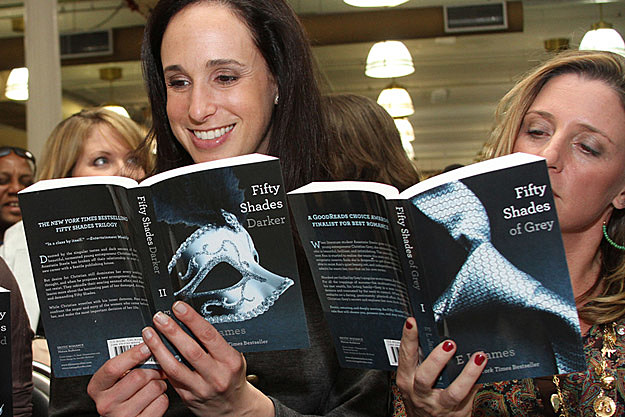 FIFTY SHADES OF GRAY is the book of the moment. Love it or hate it, its there and its not going anywhere very soon. People will talk about what it means in the cultural zeitgeist and try to make more of it than it really is (its a naughty book - there have always been and will always be naughty books, and most of them will be written with the same regard for the English language as SHADES, and that's fine) and others will decry or mock it. But the fact is that people are reading it so let's have a genuine cheer for Ms James and her success. Its what we all want and its what very few of us will get, so let's feel good for those that it happens to.
No, my problem with SHADES is the inevitable bandwagon. Publishing always does this. Something becomes an unexpected phenomenon (ie, THE DA VINCI CODE or Steig Larrson in general) and publishers scarmble to find something "the same" but "different". They rejacket books with tangential similarities so that readers will be confused. They retitle books so that they sound the same (SIXTY DAYS OF YELLOW or THE SCHOPENHAUER SECRET*). They struggle to find the initial spark, but they don't realise that the books in question are lone freaks of nature. They exceptions. They are popular because they are the right book in the right place at the right time. And sure there might be a long tail for some of the imitators, but the fact is that the buying public don't really want the imitations. Sure they want "the same" so they claim, but what they really want is the same *feeling* they had when they read the book. They don't actually know the specifics of what they want. They only know the emotional connection or the feeling of surprise that they had reading that particular book and that's what they want to rediscover, even if they can only artticulate that feeling in terms of the one particular book that sparked that emotion.
Books (and yes I include ebooks here - they are now another delivery format, so get over it and shut up) and entertainment cannot be driven by markets in the same way as other products. They connect with readers on a very different level, on an individual level. The minute they are marketted according to what other books are doing, that sense of surprise and connection gets lost. Publishing is a risky business. It always has been. But its being shortchanged every time it tries to grab the maximum number of readers rather than simply the most passionate readers (which is always the smaller number).
FIFTY SHADES is an incredible success story and one worth learning lessons from. But the lesson here is not that "we should all be writing erotica". Its that "you should write book you want to write and maybe, just maybe, other people will love it, too". The more publishers who jump on the erotica badnwagon, the more of them (and consequently the more authors) are going to get burned when readers cotton onto the fact that what made them love FIFTY SHADES wasn't simply the erotica or the underlying story or even Mr Gray himself, but merely an odd and unknowable moment of connection with a work of fiction that cannot be mass replicated or reproduced by going through the same motions over and over again.** Publishing is at its finest when it is about passion and not money, and sometimes I wonder if the modern world is making us forget that, is letting us slip in the real business of books and entertainment.
*I don't know if these titles are real, but it wouldn't surprise me if they were.
**Go on, insert your own dirty joke here
The more things change, the more they stay the same.
No, my problem with SHADES is the inevitable bandwagon. Publishing always does this. Something becomes an unexpected phenomenon (ie, THE DA VINCI CODE or Steig Larrson in general) and publishers scarmble to find something "the same" but "different". They rejacket books with tangential similarities so that readers will be confused. They retitle books so that they sound the same (SIXTY DAYS OF YELLOW or THE SCHOPENHAUER SECRET*). They struggle to find the initial spark, but they don't realise that the books in question are lone freaks of nature. They exceptions. They are popular because they are the right book in the right place at the right time. And sure there might be a long tail for some of the imitators, but the fact is that the buying public don't really want the imitations. Sure they want "the same" so they claim, but what they really want is the same *feeling* they had when they read the book. They don't actually know the specifics of what they want. They only know the emotional connection or the feeling of surprise that they had reading that particular book and that's what they want to rediscover, even if they can only artticulate that feeling in terms of the one particular book that sparked that emotion.
Books (and yes I include ebooks here - they are now another delivery format, so get over it and shut up) and entertainment cannot be driven by markets in the same way as other products. They connect with readers on a very different level, on an individual level. The minute they are marketted according to what other books are doing, that sense of surprise and connection gets lost. Publishing is a risky business. It always has been. But its being shortchanged every time it tries to grab the maximum number of readers rather than simply the most passionate readers (which is always the smaller number).
FIFTY SHADES is an incredible success story and one worth learning lessons from. But the lesson here is not that "we should all be writing erotica". Its that "you should write book you want to write and maybe, just maybe, other people will love it, too". The more publishers who jump on the erotica badnwagon, the more of them (and consequently the more authors) are going to get burned when readers cotton onto the fact that what made them love FIFTY SHADES wasn't simply the erotica or the underlying story or even Mr Gray himself, but merely an odd and unknowable moment of connection with a work of fiction that cannot be mass replicated or reproduced by going through the same motions over and over again.** Publishing is at its finest when it is about passion and not money, and sometimes I wonder if the modern world is making us forget that, is letting us slip in the real business of books and entertainment.
*I don't know if these titles are real, but it wouldn't surprise me if they were.
**Go on, insert your own dirty joke here
Monday, April 23, 2012
Entertain me..
By Russel D McLean
Today is World Book Night.
Yeah, who knew?
I’ll be out there hosting a pub quiz on behalf of Million for a Morgue, while other book events will be happening up and down the country (I think its happening in the US as well although I am not aware of the penetration to the public consciousness there), as people give out free copies of 25 publicly voted books.
It’s a great idea, although some might say its one with a few flaws. Not that I’m here to talk about those today, because I’d rather we had a flawed idea to get people reading than none at all. And having already seen changes in the approach from last year, I can see that the organisers are looking to adapt and try to improve year upon year. This can only be a good thing.
My major concern with people who talk about reading is that it is often seen as “self-improving” or “a good thing to do” rather than a fun thing to do. People who will readily discuss movies and TV shows in depth are afraid of discussing books in case they somehow seem stupid. Which is odd given that a great many books currently published are dumber than TV shows like THE WIRE or DEADWOOD or JUSTIFIED*.
Here’s the thing: you should read because you love stories. Its just another delivery method. There’s nothing challenging about it. Sure, you might need to change the way you use your senses, but in the end, the mechanics of storytelling are exactly what you’re used to with TV or film. The stories are still good. You don’t need to worry about what other people think about what you’re reading in the same you generally don’t worry about what people think about the films or TV shows you watch. Believe me, there’s a book – and generally more than one – out there for everyone. Find the ones you enjoy. Search in the same way you would for films or TV. You don’t like a book, you put it down and find something else that’s more up your alley.
The people who do the most harm to books are the people who talk about reading like it’s a duty. This usually starts in childhood, of course, when we’re told to “stop watching TV and do something smarter like read a book”. The idea of reading being harder than other forms of storytelling is as much about societal attitudes as anything else.
Waterstones right now have a leaflet out for parents talking about reading to their kids. The booklet is written in part by Julia Donaldson. In one part that struck me, she talks about how you shouldn’t make out that books are improving or in some way more “valuable” than other kinds of entertainment. And that’s right. Because books – fiction books, at any rate – are just another delivery method for stories and entertainment. Whether we read them on a screen or on paper, they’re no more challenging than any other form of entertainment. And the more we read, the less challenging books will seem, the more we’ll come to welcome the more complex works, because our brains will not be resistant to the preconceived ideas.
World Book Night is a great idea. If you’re a Giver, one of those handing out free books, I applaud you. But please don’t tell those you talk to that the book will “improve” them. Just tell them its entertaining, that it’ll make them laugh, it’ll make them cry, and they’re going to have a ball reading it. Because I’m pretty sure that one of the reasons you’re giving that book away is because it did exactly that to you.
*Yes, that one’s based on a series of books. But its it’s own beast.
Subscribe to:
Posts (Atom)