Showing posts with label jumping the shark. Show all posts

Saturday, April 17, 2021

What Are Some Literary “Jumping the Shark” Moments?

by

Scott D. Parker

Sometimes old things trigger new questions.

For the longest time, our front living room was television-less. That’s where the library is, it’s where we set up our Christmas tree, and it serves as the guest bedroom. We didn’t mind not having a TV in the front room, but during last year’s NFL season, I pulled out an old TV we had and one of those digital antennas and converter box and set up the TV. I’m the only one in the house who enjoys football and I didn’t want to hog up one of the good TVs just to watch a game.

It’s been kind of fun having that old TV available. I plugged one of our VCRs (yes, really) and a portable DVD player so I could watch the occasional show on it. In terms of live television, however, when it’s not being used for football, it’s on MeTV.

Imagine my surprise, a couple of weeks ago, when suddenly MeTV was not where it usually was. The network recently purchased a station here in Houston and started broadcasting from that new channel. A channel my old converter box/antenna combo did not receive. Cue a drive to Target to purchase a new combo setup. Viola! They work perfectly and I now can get MeTV.

But this new converter box also has a recording feature. It’s like a DVR but only for over-the-air channels. No problem for me. So one afternoon I pulled out the instruction manual to figure out how to record things.

And I received a happy surprise.

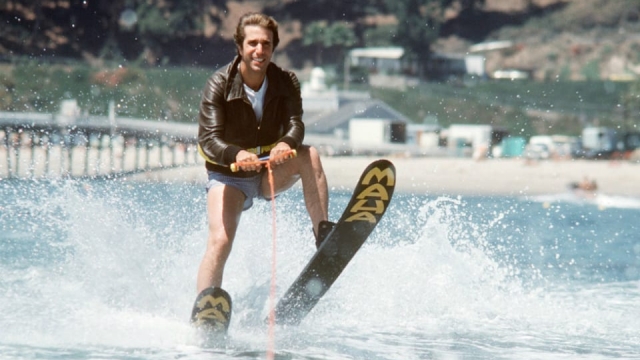
“Happy Days” was airing at that time and wouldn’t you know it, the episode in question was “Hollywood, Part 3.” What? You don’t know that episode by title? Well, it’s the exact fifth episode where Fonzie jumps the shark.

Naturally, I ended up watching the rest of the episode.* Yeah, it’s as cheesy as you remember it to be, but I reckon my nine-year-old self was glued to the TV in suspense, just like the Cunninghams were.

The term “jumping the shark” has been used to define when a TV show went off the rails. That is, when it stopped being the original thing it was and became something else, usually a shell of its former self. Just me writing this brings to mind many a show to your minds. That time when Bruce Willis and Cybil Shepherd got together in “Moonlighting.” That time when Victoria Principal discovered Patrick Duffy’s Bobby Ewing in the shower and they told you the entire season you had just watched…was a dream. That time when David Duchovny left “The X-Files.” Those are just off the top of my head.

Then I got to thinking: Are there literary “jumping the shark” moments? Are there books in long-running series that jump the shark? I know there must be, but I’m not coming up with any. Granted, I’ve not read many long-running series. There are 52 In Death books by J.D. Robb (Nora Roberts). John Sandford has written 31 in the Prey series. Twenty-five Jack Reacher books exist and I don’t even want to start counting the number of series James Patterson has written. Erle Stanley Gardner wrote 80 Perry Mason novels (and 30 Cool and Lam novels). The old pulp writers Lester Dent (Doc Savage) and Walter Gibson (The Shadow) wrote a novel a month for years.

The point is, there are many a long-running series in the book world. Have (or did) any of them jump the shark?

Follow-up Question


By the way, Happy Days went on for another six years, eleven seasons in total. Were all those post-shark episodes bad? Probably not. The TV show Dallas recovered from the Bobby-in-the-Shower moment, but The X-Files and Moonlight didn’t.

So if there is a book series that jumped the shark, did that series recover?
 

*Side note: The other plot for this episode (and probably parts 1 and 2) was Richie mulling over a choice of whether or not to attend college or head out to Hollywood and sign a film contract. I had completely forgotten this since I probably saw the episode on the date of its airing and then never again since. But there’s a nice scene between Richie and his dad. Howard Cunningham gives his son a nice pep talk, ending with a reminder: no matter what Richie choose, his father will support him and be proud of him. Now that I’m a dad myself, this scene got to me in a way my nine-year-old self couldn’t possibly have imagined.

Friday, October 19, 2012

Outstaying Your Welcom

By Russel D McLean

I’ve often talked about how, in a perfect world, I’m bringing the J McNee novels to a close after five books.

Why?

All good things should come to an end, and I’ve never been a fans of series that outstayed their welcome. What’s got me thinking about it recently has of course been the return to UK screens of 90s sitcom, Red Dwarf. I loved Red Dwarf for six series and then it vanished. For three years it was off our screen and then it returned. And something was missing. The jokes. The humour. The characters. I could never point to what it was explicitly, but something felt off from the delayed seventh season and the show never quite recovered*.

It happens a lot with long running series. Unless the series attempts to evolve like say, Doctor Who, a show that truly changed with the times right down to rewriting the central character on several occasions, then a staleness can settle in after a while. Its known as “jumping the shark”, a phrase that entered popular culture when Happy Days suddenly became irrelevant to its audience after a strained episode where Fonzie, literally, jumped over a shark.

The point is that some series can run on beyond the point of their own relevance. And its often because an audience or readership demands that the series stay, but the creative spark has been extinguished or else has burned to almost nothing. It doesn’t happen in TV shows, but also in novels. Some long running series characters encounter the problem of stories that no longer feel relevant or characters who no longer have anything to say. Yet readers demand the return of these characters.

Its one of the reasons I admire George Pelecanos. He writes about the same characters for two, three or four novels, and then lets it go. He allows his characters to sya what they have to say and then moves on. Its admirable. And its the reason his writing is so powerful.

Coming back to TV, I love seeing TV shows with a gameplan. The Wire may have warranted a sixth series, but I’m glad it never got one. Babylon 5 completed its five year plan, and then fell apart completely when it tried to expand its own universe. Life on Mars never needed any expansion beyond two series because, frankly, it said everything relevant to itself in twelve episodes (Yes, I know about Ashes to Ashes, but that was an entirely different show in many ways). All of these shows set out too say something, said it and then (in general and discounting spin offs) got the hell out. Part of their appeal was that they stayed around as long as they needed to. But then you look at a TV show like The X Files; a show that outstayed its welcome by several years. It never reached a real climax, but it was soon apparent that it was lost for new and refreshing ideas, falling back on recycled ideas and falling behind the very TV shows that its helped to influence. And the less said about a TV show like Lost, that tried to keep itself going for as long as possible with no real game plan (you can’t tell me they knew where they were going; none of the plot holds up as having been planned from the start) the better.

Sometimes, its worth getting out before an idea gets too old, before a series loses itself in the race to remain on the go. With McNee, I only want to write about this character as long as I have something relevant to say with him, as long as I can allow him and the supporting cast to continue changing (albeit iin some ways subtly) from book to book. And even if I decide I have more to say about book 5, there is a game plan and certain elements that have been building since THE GOOD SON are going to be wrapped up by book 5 in a very definitive way.

I’d rather be The Wire than The X Files. I’d even rather be DeadWood - a show cancelled before it could say all it had to, but that left on a real high note before it lost the lustre of its early promise - than continue to expand an idea long past its sell by date, Or maybe I can create a property like Doctor Who; a series that manages to reinvent itself as something completely different every few years, that pre-empts the need to end by changing itself with the times and with the needs of its audience. But such an invention is rare, tough to craft and tougher to maintain. In general, the best rule is to let go of a character when the time comes naturally, rather than expand and continue past the point of no return.

*although to be fair, it seems to have regained a little something with the new series, perhaps through lessons learned from what went before - - maybe because the long, long rest (and the near disaster of its last attempted ressurection) has allowed the creators to rediscover something of what they had before.