Showing posts with label agatha christie. Show all posts

Saturday, January 27, 2024

You Would Never Know The Mysterious Affair at Styles Was a Debut Novel

by

Scott D. Parker

For the past four years, I’ve tried to read along with the reading plans hatched by the folks behind AgathaChristie.com. Each year I’ve not completed all twelve books but I’m always game for a themed list like this that carries a reader throughout the year so I'm giving this year’s list a try. Unlike past lists that were, say, arranged by styles of murders, this year is simply chronological, and it begins at the beginning.

The Time Period

The Mysterious Affair at Styles is not only the first time we’re introduced to famed detective, Hercule Poirot, and his friend, Arthur Hastings, but it also is the first book Christie ever wrote. Talk about coming out of the gate at full speed. I’m still a freshman when it comes to Christie’s works—as best as I can tell, this is about the fourth or fifth book of hers I’ve read—but how she weaves this plot through the entire book is very impressive.

I’ve been doing some reading on Christie and I learned that Styles was written to win a bet. Christie’s sister didn’t believe the new writer could come up with a story where the reader cannot guess the actual culprit in the novel. Like many of the then-contemporary reviews stated in late 1920 and early 1921, the bet was won. 

Christie started the novel in 1916, which is why the setting is still during wartime. We get a good sense of what it is like on the homefront, at least in terms of a large country manor. Hastings is on leave from the war and ends up at Styles manor to recuperate. Poirot is a part of a group of Belgian refugees living near Styles and he knew the rich owner, Emily Inglethorp. I particularly appreciated Poirot as a refugee and not some famous detective who has an office and solves crimes. 

The Plot

Well, let’s be honest: the plot is wonderfully convoluted. As a listener (I heard the audiobook) in 2024, I was keen to see if I could figure out the killer, what threads were red herrings, and who had motive. Turns out I couldn’t, I kinda did, and everyone.

Much like Sherlock Holmes, Poirot keeps Hastings and other characters in the dark as the investigation progresses. There is always a legitimate reason why this happens (after Poirot explains it all) but it’s also Christie using her skill as a writer to tease just enough to entice readers to keep turning pages. 

The murder in question is that of Emily Inglethorp. She is poisoned. Now the only question is who did it and why. 

Christie tosses eight people in the mix. Alfred Inglethrop, the younger man recently married to Emily. John and Lawrence Cavendish, stepsons from Emily’s first marriage. Mary Cavendish, John’s wife. Evelyn Howard, a companion of Emily’s. Cynthia Murdoch, a friend of the family who works at a hospital dispensary. Dr. Bauerstein, a toxicologist who lives nearby. Dorcas, the loyal maid at Styles.

There are moments in the book where Christie (via Poirot) purposely keep things away from readers (and Hastings). To be honest, it reminded me of the middle section of The Hound of the Baskervilles where Holmes has Watson accompany Henry Baskerville to that manor while the detective does his own thing. Every writer is a reader and we absorb so many moments from other stories so things like this are bound to happen. 

What this does, of course, is let Poirot have that final last chapter where he sums up everything, and it is immensely satisfying. While I don’t think Poirot is as smart as Holmes, there were still a few moments when I heard the explanation and I realized I should have caught a clue. Shrug. I’m too busy enjoying the story. 

I borrowed my mom’s edition of the novel and it includes a different version of the final chapter. Christie originally had Poirot deliver the summation as part of a trial. Her editors encouraged her to change it up and just have Poirot relate all the details in the manor house. Much more effective because the Belgian detective can deliver all the clues with the flourish that reader have now enjoyed for over a century.

Sunday, August 27, 2023

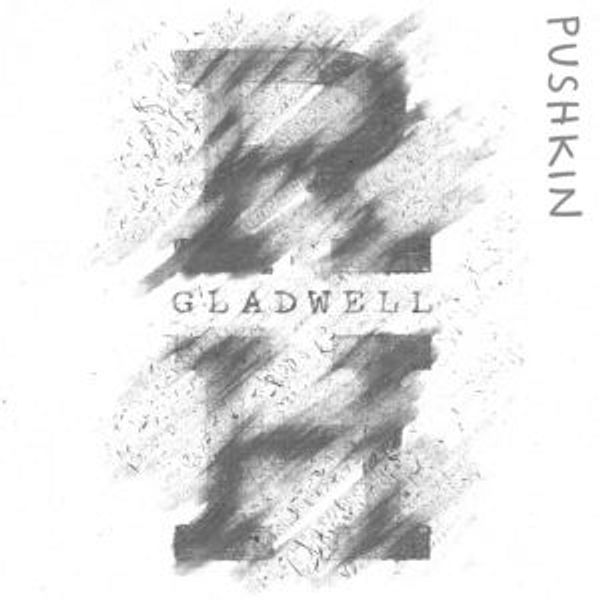
Review: Malcolm Gladwell Takes on Police Fiction--Good Points, Wrong Conclusion


By Claire Booth

Malcolm Gladwell takes on all sorts of subjects with his Revisionist History podcast, which I’ve listened to for years. Everything from college endowment funds to McDonald’s French fries has gone under his Gladwellian microscope.

Last month, listeners learned he’s a crime fiction fan. A huge fan, and he spent an episode on the modern murder mystery novel. It’s a lecture he gave during the New Orleans Book Festival, where he introduced his classification system for the mystery story.

His thesis was to see it through the lens of policing and how it then affects the public’s view of real-world law enforcement. No other profession gets so much space in books, television and movies. Professions like teachers and nurses don’t have to contend with perceptions created by screenwriters and authors. Law enforcement does.

“The stereotypes put forth in popular culture matter. They are the raw material people use to form their attitudes and perspectives. And I really worry that police narratives are doing the same thing. They’re doing an injustice to our understanding of the police.”

Police aren’t all good or all bad, Gladwell says bluntly, but the mystery story can portray them that way. In his view, the fiction that portrays them can be lumped into four categories:

He starts with the 1950s TV show Dragnet, which he calls one of the top five most influential shows of all time because it introduced to a mass audience the notion that police were good at what they did. That becomes “Eastern” on the four compass points of his “Taxonomy of the Modern Mystery Story.”

“Northern” stories are ones with incompetent police, where civilians have to step in and solve the crimes; here he lists detectives such as Hercule Poirot and Philip Marlowe.

Swing down to “Southern” and those are stories with corrupt authorities, where others have to come in and clean things up. He uses John Grisham as an example for this one.

Then of course, there’s “Western,” the only one that truly fits its namesake compass point. Those are stories with an absence of authority/police, just like the lawless frontier towns. He highlights Lee Child’s Jack Reacher books, because Reacher rides into a town, “kills scores of people, and never gets caught—so, Westerns.”

He tends to lump many subgenres together. This is, I know, a much more normal way to view things than the thin sub-sub-genres that crime fiction writers (like me) often find themselves slicing. But I like how I divide things, so I’ll do some quibbling here. His “Northern” classification isn’t police procedural at all, but rather amateur detective. And any modern mystery worth its salt will use more than one East/West/North/South in its plot and character development. “Modern” is what we do now—mixing all of these in a single work, as an acknowledgement that the world is not just four points on a compass.

Gladwell says he knows his categories are reductive, and that’s his point. That over the years, the genre has made it easy for two things to happen: for real police to be unjustly reduced to stereotypes, to less than what they really are; and to create fertile ground for a certain kind of narcissism to develop that moves away from the people they serve. “These are not novels and shows about solving crimes. They’re novels and shows about crime solvers … and where is the public in there?”

I think that good crime fiction—much current crime fiction—tries to address these questions and problems. I know I do. And I don’t think we’ve in any way exhausted the possibilities of the form.  

One other note:

There was a big lack of diversity in his name-checking. There’s only one direct mention of a woman—Murder She Wrote’s Jessica Fletcher, whom he lists when counting TV civilian detectives. In that same part of the discussion, he mentions Hercule Poirot, although he never does name Agatha Christie—or for that matter, her other, equally adroit (but female) amateur detective, Miss Marple.

He also doesn’t include any writers of color. Ed McBain, Raymond Chandler, John Grisham, Lee Child, Joseph Wambaugh, Daniel Silva. Dragnet, The Untouchables, Columbo, Slow Horses. All white male authors or cast with almost all white male actors. He makes good points with many of them. But there are plenty of non-straight white male writers who could have reinforced his ideas, too. Walter Mosley, Naomi Hirahara, Kellye Garrett, Sujata Massey, Kwei Quartey. Sara Paretsky, Patricia Cornwell, Joseph Hansen, Sue Grafton.

You clearly read deep, Malcolm. I look forward to hearing what you think when you read wide.

"Taxonomy of the Modern Mystery Story" was released July 26, 2023, as Season 8, Episode 12 of Revisionist History. You can listen to it here, or wherever you download your podcasts.

Saturday, February 5, 2022

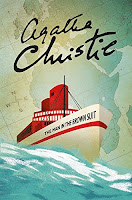
Setting Off For Adventure with Agatha Christie's The Man in the Brown Suit

by
Scott D. Parker

Well, I’ve finally read my second Agatha Christie novel.

The Man in the Brown Suit (1924) was the January 2022 selection from the good folks over at AgathaChristie.com. It’s part of the Read Christie 2022 project. For the past two years, they’ve done something similar. This year, they’re focusing on Christie’ love of travel and selecting books with that theme.

I didn’t do the challenges the last two years, but opted to read this novel, Christie’s fourth book. Our lead heroine is Anne Beddingfeld, a young woman, on her own after her father passed away. With her whole life in front of her and with her mind swirling with the drive for adventure, young Anne finds all that and then some.

In a London subway station, Anne sees a man look at her in shock right before he plunges over the edge of the platform and dies. An odd-looking man swoops in to examine the body, claiming to be a doctor. But Anne questions the newcomer’s intentions. Couple that with a piece of paper dropped by the supposed doctor and Anne starts to see a mystery.

The mystery leads her to a ship bound for South Africa. On the ship, strange things occur and she’s introduced to a number of other characters. One is Sir Eustace Pedler, a member of Parliament, who brings with him a pair of secretaries, Guy Pagett and Harry Rayburn. Also of note is Colonel Race, supposedly of the British Secret Service, and Suzanne Blair, a married woman who befriends Anne on the voyage.

Lots of things happen on the boat and they continue when they get down to South Africa. It’s fascinating to read what was dubbed a thriller circa 1924 and compare it to what we think of as a thriller nowadays. Like many a mystery story set between the two world wars, there’s a quaintness to this novel. There’s the tendency of the bad guys to expostulate to the heroine, laying out the bad guy plan in detail. There’s the somewhat coincidental nature of some of the plot points, like what happens on the boat at night that just so happens to have Anne present.

Then there’s how the story itself is presented. A prologue shows us a few characters basically told from the author’s point of view. Then the novel switches to the narrative Anne writes herself. Spliced amid Anne’s reminiscences are those of Sir Eustace himself. It’s a clever trick because it enables Christie to show the reader certain things Anne and the others don’t know.

I’ll admit there was a time or two I’d have to think and remind myself which character Anne was referring to. I listened to a well-done narration by Emilia Fox and it wasn’t her fault. It was my own disjointed listening schedule. But by the time I was on the final homestretch, I was deeply into the story and barreled ahead until its conclusion.

And I rather enjoyed learning the identity of the mysterious antagonist nicknamed “The Colonel.” [No, it’s not Colonel Race. Christie obviously didn’t read all those how-to-write-a-mystery books in which you’re not supposed to name characters with similar names or titles.]

I enjoyed it, but it’s certainly not what I think of when I think of Agatha Christie. No Poirot, no Marple. But that’s likely the point of a reading adventure like the one planned for 2022. It looks like they’ll feature books that aren’t always on the top of people’s mind when they list favorites from the Queen of Mystery Fiction. Granted, the February book is Death on the Nile (to coincide with the new movie), a title I do know, but I’m looking forward to the rest of the selections throughout the year.

Sunday, December 1, 2019

Review: Knives Out


I went to the movies yesterday and saw Knives Out, the new Agatha Christie-ish murder mystery. It was Thanksgiving dinner for mystery fans—time-honored favorites and those one or two surprises that someone insists on bringing even though you think there’s enough of the traditional stuff.
Let’s start with the favorites. There’s a creaky old manor house, an extended, animosity-soaked family gathered for a special occasion, a famous detective, and a dead patriarch. I’m not giving anything away; the body is shown about 60 seconds into the film. It’s director Rian Johnson saying, “This is what we’re all here for; let’s get right to it, shall we?”
Knives Out: Rated PG-13 for Daniel Craig’s Southern accent, a mask-free Captain America, and an always bad-ass Jamie Lee Curtis.
The surprises to the traditional include Marta Cabrera, a young Latinx nurse hired to help care for Harlan Thrombey, the aforementioned patriarch and an aged mystery novelist. Marta (Ana de Armas) is more than just the help; everyone insists she’s “family.” But she’s not. There’s a scene where family members fall into arguing over politics, pulling Marta into the room so she can self-consciously stand there as they make their points about immigration policy. She’s a human face only when they need her to be. 
I couldn’t help but compare Knives Out with Gosford Park, the Robert Altman’s 2001 masterpiece that had all the same standard elements. The manor house (this time in England), the extended family, the dead patriarch. In that movie, the wine glasses clink gently, the help are ignored (except when they’re being seduced), the accents are proper, and there’s a measured pace to everything.
There’s nothing refined about Knives Out. No time is wasted getting to the death, relatives swear at one another, there’s a fistfight (kind of), and everyone is proudly “self-made.” It is, in a word, American. And it’s a twisty puzzle of a mystery that takes the right things seriously, creates the right hero, and has a hell of a lot of fun with everything else.
*One final thought, without spoilers—the patriarch says something to one of the characters in a flashback midway through the movie. It casts an entirely different light on the ending, something that didn’t occur to me until I was writing this review. If you’ve seen the movie, DM me on Twitter @clairebooth10. I’d love to talk about it. 
 A more refined Knives Out poster and its spiritual twin, the one for Gosford Park.


Sunday, December 10, 2017

A Train, a Murder, and a Mustache


I finally had the chance to see the new Murder on the Orient Express yesterday, and I was, well, flat-out nervous about it. On the one hand, I was eager to erase any last memories of the horrible Albert Finney version. On the other, David Suchet is incomparable and every television episode in which he played Poirot is a jewel in Agatha Christie’s detective crown. 
Mustache v. Mustache: A Face-Off
I read my first Agatha Christie in middle school. She is the reason I love crime fiction, the reason I love a book that is a puzzle, and the reason I know that a finely drawn protagonist is something that will last the ages.
This movie version is directed by and stars Kenneth Branagh, who chooses to make the meticulous Belgian less finicky and more a prisoner of his own “little gray cells.” He can’t abide anything crooked or off-balance, and at one point says that this way of seeing the world is what compels him to be a detective.
Branagh chooses an almost James Bond-ian opening, with the film’s first ten minutes going to a completely unrelated criminal case, much like 007 makes it through a fantastical stunt chase that has nothing to do with the rest of the movie. Branagh uses it as an opportunity to familiarize newcomers with a few of the detective’s personality quirks, which I think is absolutely key to any hope of bringing new Poirot devotees on board.
After that prologue, the movie slows way down. I thought it took too long to get to the murder. There are many shots of train passengers walking around. Some of them talk to Poirot, some of them don’t. It’s inconsistent and possibly confusing for someone with no prior knowledge of the mystery. Once the victim is found dead, however, the momentum picks up and the suspects start to differentiate themselves.
Branagh chooses to inject several modern conventions into the plot. Poirot dwells on a lost love, and he suffers much more of a moral dilemma at the end than Christie put him through in the book. Branagh also ups the action quotient with several chase scenes not in the book. They would’ve been absurd for Suchet’s Poirot, but Branagh makes it work for his.
The most disappointing – and to me, heretical – change was the location of the climactic scene. It doesn’t take place on the train. It’s at the mouth of a snowy train tunnel, with the suspects spread out behind a table like some sort of Last Supper tableau. In the book, it occurs in the restaurant car. You know, on the train. The movie location loses the claustrophobia of a narrow train car, where the suspects are forced to sit looking at one another because there literally is no where else to turn. Instead they all face outward in such a way that no two characters can be in the frame at the same time. (And if you know who done it in this mystery, you know why that wasn’t the way to go.)
A newbie might sniff and call a group of suspects voluntarily sitting together for the unveiling of a killer nothing but a cliché. But every cliché starts somewhere, and this one started with Christie. It’s an absolute hallmark of the Golden Age of detective fiction, the decades between world wars when crime fiction authors, mostly British, perfected the art form.
As a movie standing alone, it was good. Not great. But for me, I still can’t get away from the Suchet comparison. For me, he is Poirot. Branagh is an interpretation. But maybe somewhere, some young teenagers are seeing this movie and its detective for the first time. And Branagh’s Poirot will become their entry into a world of clues and killers and puzzles and idiosyncrasies, and a lifetime of reading crime fiction. And that would be fine with me. Any Christie is better than no Christie at all.