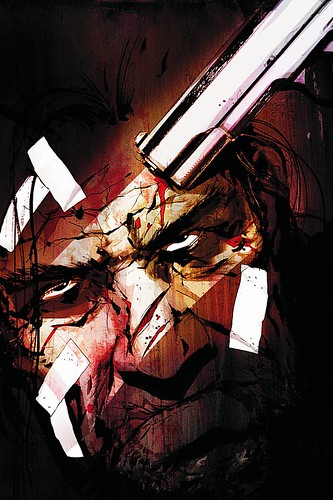
Showing posts with label Scalped. Show all posts

Tuesday, March 29, 2011

Scalped -Hells Yeah.

By Jay Stringer

It's been awhile since I preached to you about Scalped. It was way back in 2009. Except that's a big fat lie. I also did it in 2010. And in The DSD podcast. But apart from 2009, 2010 and a 90 minute podcast, I've never raved about Scalped. Except for on the twitters and the facebooks. Maybe a few message boards....

Where was I.....

Oh yeah, Shut up laughing.

I just read volume 7 of the collected editions, Rez Blues, and dammit if it didn't punch a hole in my gut. I really believe we're in the middle of something special here. In 20 years time people will be talking about SCALPED in the same way they talk about WATCHMEN.

And I don't just mean by comparing the beards of the writers.

I've recapped the basic premise many times. But just to remind you of the gist; It's set on a fictional Native American reservation in South Dakota. The reservation is under the control of Chef Red Crow, who operates both above and below the table. The secret fly in his ointment is Dashiell Bad Horse, a prodigal son who returns to the reservation with a lot of baggage and a few new secrets.


Dash kinda sorta loves Red crows daughter, Carol. And Carol kinda sorta loves dope. And Red Crow....well...it's never quite clear who or what he loves, but whatever it is he'll kill for it. The other other thing thats clear is that they all hate themselves in some way, and they can't out run that grasp of self loathing.
There is an overall story here, writer Jason Aaron is heading towards a set end point and we're heading into the closing stages of act 2. At this point the book is entering the realms of being a masterclass in serial crime fiction.

You want complex characters and shifting morals? Check. You want sex? Check. You want racial tension, corrupt politicians and some righteous violence? Check check check.

But as all of you already know, those details are nothing if they're not held together by talent, craft and a lot of heart. And that's where Aaron's writing is elevating the book. Between the cracks of all those big plot points is a lot of character and story.

Rez Blues is a perfect example of how this is being achieved. Despite the fact that the book has a huge over arcing story, the latest volume opens with a small character piece that is (so far) unrelated. It tells the tale of an elderly couple, Mance and Hazel. They've fashioned a life together on their farm, each depending on the love and strength of the other. But as age and finances catch up, their lives are falling apart. Mance worries that he has failed his wife, that his farming skills have faded and that he can't provide like a man should. Hazel worries that her illness is a burden on her husband. Neither one ever quite opens up the other, and yet we see the small (and huge) acts of devotion that keep them going. It's a touching and fragile story that shows that love and obligation can sometimes be the same things, and it really tugged on my cold cynical heart.

One of the best scenes has Mance drive into town to ask for food welfare supplies. It's free. He doesn't have to lay down any physical cost to carry out a box full of food for him and his wife. All he has to do is sign his name to a form that says he took the hand out.

"All I gotta do is sign.
I've fasted for eight days and hung by hooks from a sun dance pole until my flesh tore.
I've killed snakes big enough to eat a baby and reeled in paddlefish the size of small cows. I killed a coyote once with nothing but a pocket knife. I buried my only son and I didn't cry.
But I aint never done anything as hard as this."


And there's a great trick here. Plot wise the story of Mance and Hazel isn't tied into the rest of the book. But if you look at it as a tone poem, it's clear that it's themes and messages are laying the groundwork for what is to follow. The secrets we keep. The small acts of devotion. The obligations that can both bind us together and tear us apart.

Next up we get a nasty little two part story following Shunka, the cruellest, baddest bagman of the series. We see that he has a huge secret in his closet, one that makes him hate himself, and one that makes his every act of daily life a betrayal of who he is. For one brief moment we get to see inside his head, and come away with a shred of empathy for him. Aaron has done this throughout the series; we get to see a character one way, make a judgement, then get a glimpse inside their head that challenges our judgement.

Next up is a look at Bad Horse's father, and the run of bizarre luck that sets up the whole of the series. This is a bold move, adding such important information 38 issues into the story, but it pays off in style.

Something I wrote about way back in 2009 was a trick Aaron used for one scene. He had two characters in bed together in silence, but the reader got to see all the things they wanted to say to each other. There was a whole conversation that didn't happen. In Rez Blues Aaron takes this trick to the next level. The unspoken conversations linger over everyone, and mark crucial turning points in the story. This is the work of a writer at the top of his game.

By the time the book makes its way back to the main story arc, our heads are swimming with ideas of love, pride, obligation and addiction, which sets the groundwork for us to be repeatedly kicked in the guts. Dash, Red Crow and Carol circle each other, bound together as much by what they don't say as what they do. And the results are going to make you feel.


As a writer it's natural for me to focus on the writing. I read through SCALPED taking mental notes on the craft, on tricks that Aaron uses that I can take into my own stories and novels. And there are many such lessons here. But I would be remiss to not mention the art.


Usual art duties on the book are handled by the co-creator, R.M Guera. His style is rough and ready, filled with seedy shades of brown and deft use of shadows. His characters aren't just images on a page, they are actors, their faces convey emotions. He takes Aaron's words and grounds them in a world that feels very real, and very desperate.

In and around Guera we get guest artists, such as Danijel Zezelj and Davide Furno, who come in and work on the feel and the world that Guera has created and add their own flavour to it. Each one adds another stitch in the tapestry, and it's all going to add up to one of the finest achievements in crime fiction.


Tuesday, September 15, 2009

Scalped - No capes allowed

By Jay Stringer


I continue to be blown away by SCALPED.

It’s a shining example of great comics, of what can be done with the medium that can’t be done with film, television or books.

And that’s a key concept, an important one. There’s a dirty secret in comic books, folks. The industry looks down on itself. It has self esteem problems, always wanting to be more like movies and TV, always wanting to hang with the cool kids. In truth comic books are at their best when they’re allowed to be what they are; a distinct art form. A language of story telling that can do some thing far better than any other medium.

Comics are at their best when they’re not redefining themselves as graphic novels, or sequential fiction, or any of the other bullshit titles that get used to make them seem worthy of having a section in a bookshop.

And Scalped is possibly the best example out there right now.

But I’ll get to that in a minute. First it’s worth noting that I came relatively late to the party. I actually flicked through the first couple of issues and….it didn’t grab me. I wasn’t in the right frame of mind, I guess. After I heard the growing praise, I picked up the first trade, Indian Country, and it hooked me a little. I wasn’t fully sold on this being the best thing since sliced bread, but I enjoyed it and kept going. It’s now up to its fourth trade, The Gravel In Your Guts, and I’m hooked. I need it. Each time i think i have it figured out, it adds another layer or takes a new turn.

What’s the plot? Well like all good things its both very simple and very complex. The basic set up is that it takes place on a Native American reservation. It covers the inhabitants of the towns, the local law enforcement, the corruption, and the building of a brand new casino. It’s every noir tale of corruption and greed that you’ve ever read, but in a new setting that’s so perfect you can’t believe it’s taken this long.

The story starts when Dashiell Bad Horse returns to the rez. He’s angry, he’s strong and he’s trouble. He picks fights with an entire bar full of people and comes to the attention of Chief Red Crow; the godfather of the reservation. Red Crow controls the drugs, the liquor and the sex. He’s the corrupt mind behind the new casino. His main adversary, a woman who is leading the protests against the casino, also happens to be Bad Horse’s mother. She and Red Crow were the love of each others lives until they started hating each other.

Dashiell is working undercover for the FBI to uncover the corruption of Red Crow and the bad guys. So far, so simple.

Well…..no.


There are no good guys and bad guys on show here. Soon you start to think that Dash is doing the right thing for the right reasons, and that Red Crow is doing the wrong thing for the right reasons. Except that theory unravels too. Dash is a bit of an asshole. He's not in this for any noble intentions, rather a mix of entrapment, self hatred and self discovery.

And Red Crow himself soon grows to be the best thing about the book. In fact, he’s just about the most complex character I’ve come across in years, in any medium. He’s both a crime lord and a freedom fighter. He’s a flawed hero and a noble villain. As he himself says at one point;

I’ve killed many men. Women too. And I’ll kill a hundred more, if that’s what it takes to see my vision through. To carve a better place in this world for my people."

In the latest collection we see him trying to reform. He is given the soul pouch of a dead friend to guard over. What that means is that he must live a peaceful and noble life for a year so that the soul of his friend can find peace. If he fails he is condemning that soul to remain restless.

And boy, does he try. But a mans gotta do, you know? I never thought a scene where a middle-aged man says, “I’m sorry.” To a piece of cloth would have me in pieces.

The narrative cuts between the large and the small scale, to show supporting characters becoming entangled in the larger web of the plot. Much like The Wire, we see that the characters are trapped in a much larger game, just as in the old tales where the Greek gods would move the humans around like pawns. You know it’s going to end badly, and they know it’s going to end badly. But they can’t break out.

Dash and Red Crow are caught in a dance, they know one day it’s going to come down between the two of them, but they’re also locked in like family, both defined by the love of the same woman.

So what can this series do that a novel, film or TV series can’t? Why was I so bold with my opening statement?

Could this be a film? Yes. It could be a rushed and violent spectacle. It could cram the whole thing into two or three hours and barely scratch the surface of what this series has achieved so far.
Could it be a television show? Sure. The Wire has proved that this sort of thing is doable. But it would take the very best writers and directors, to say nothing of a cast who would be willing to sit out whole episodes at a time as the focus shifts.
What a comic book can do that doesn’t work on screen is to really get us into the heads of the characters. It can show and tell. And because of that, it only needs to do a little of each to hit home very powerfully.

I’m reminded of a scene in issue 19, The Boudoir Stomp.

Dash Bad Horse and his lover are sharing a bed. We see them have wild passionate sex, sharing part of each other in the most intimate way.

Then afterward we see them lying in silence. They’re both lost and alone, and desperate for company. We get too see both what they actually say to each other, and what they want to say to each other. And the fact that they can’t say the words is heartbreaking.

Could this be done on screen? Yes. With a really clunky voice over. In fact, it would need two separate clunky voice overs; one for each character. Who wants that?

Could this be a novel? Sure. Absolutely. But to do the story and characters justice, it would need to be a seven hundred page epic, it would need to have about ten different points of view, and it wouldn’t be able to show us the simple despair that one panel of art can get across.

And that’s where the real strength of the medium lies, as I’ve already said, in its ability to show and tell. A little bit of both goes a long way. It combines the strengths of cinematic storytelling with the strengths of prose. In the right hands it can become something that neither form can match.

And Scalped is in the right hands. Written by Jason Aaron and (usually) drawn by R.M. Guera, this is a masterpiece in the making.

I don't gush like this often, folks. But you know those books that people look back on? WATCHMEN, PREACHER, MAUS.....wouldn't it be great to have front frow seats as one of those legendary stories was happening?

Well, you can. Volume 5, HIGH LONESOME is due out in November. That gives you plenty of time to catch up.

If you don't, the guy to the right gets it. And a puppy.