When you're a new writer, interviews are a joy. Oh, you want to ask little old moi where I get my story ideas? *pulls up a chair, ties you in it*
But the more interviews you give and take, the less interesting they become. I try to make interviews interesting for the subject and the audience, as well as my self. I have a boundless curiosity, a rather childlike inquisitive mind, and little capacity for embarrassment, which I use to my advantage. For a year I interviewed crime fiction writers from Patti Abbott to Lawrence Block on my website, in a series called "Belly Up to the Bar." Some questions were repeated, but I tried to get a few out of left field. Some authors have been asked it all, after sixty plus years in the biz, and it's tough to excite them.
I commiserate with Saeed Jones's statement. I would much prefer to meet an author for coffee and record our conversation on my phone and transcribe the juicy bits than come up with interview questions that they must write short essays to respond to. Perhaps Twitter would be a good medium, limiting questions to 280 characters and responses to a couple tweets per? It takes the proper writer, someone fast on their tweet as it were, to keep up. But with the popularity of AMA threads (ask me anything) this may be my new go-to for Twitter-savvy authors.
I recently interviewed Joyce Carol Oates for CrimeReads—it's not published yet, so don't bother looking—and the questions were lost in email hell for a month or so. She was kind to take the time to respond to my rather detailed interrogations, but was despondent at the idea of having to write responses again, and I do not blame her. Even someone as prolific as Oates—seriously, she had two more books published since I pitched the interview, and an anthology she edited is about to be published as well—answering these questions has become a burden, as you can tell from the short responses the more seasoned authors give. Read Lawrence Block's "Belly Up to the Bar" interview for a couple of quick witty rejoinders that parry my attempts at getting him to write an essay for free!
He was gracious, and so was JCO. Many writers have asked for a moratorium on the most repeated questions, that have become a running joke for decades: "where do you get your ideas?" Because for a writer, we can't imagine not getting ideas. It's what we do, we observe the hot mess that is humanity and get inspired to write a story. The best interviews I've read of late have been lightly edited chats; here's a good one with Stephanie McCarter and Jia Tolentino on sexual brutality in Ovid's Metamorphoses, for example. Another excellent one by Matt Zoller Seitz with Sady Doyle on her book Dead Blondes and Bad Mothers that does a deep dive into Frankenstein, is a great read.
You can't do this easily via email; there needs to be back-and-forth, quick thinking, not an author sitting at their chair with all the time in the world to craft the perfect answer. But there are time constraints, especially when it's an author promoting a new book. Meeting somewhere? In a digital world, without teleporters? Madness. Even an hour of FaceTime becomes difficult to schedule. You can get away with not wearing pants, but you need a shirt and to get your hair did. Maybe a text chat in Google Hangouts or similar, Twitter DMs, is a good place to start? I'll attempt that for my next interview, and we'll see how it goes.
Showing posts with label Joyce Carol Oates. Show all posts
Wednesday, September 18, 2019
Wednesday, September 4, 2019
Journaling
Last night, I wrote in a journal for the first time in years.
This is where my writing began, when Mrs. Graziano in Freshman English at Nutley High School handed us little blue pads and made us write for ten minutes in the beginning of class every day, and hand them in for her to peruse. She used an egg timer, and I remember writing a silly poem called "The Magic Egg, it Ticks so Sweetly," to the beat of "My Guitar Gently Weeps" for one entry. I kept this habit in homeroom throughout school, using a Mead notebook to write cruel parodies about students and teachers I disliked, a stupid cartoon called "Dog Haters Column," which was a response to a book of evil dog cartoons called When Bad Dogs Happen to Good People, and my Douglas Adams ripoff teleplay, Your Tour Guide to the Universe (really? Yes, really).
My friends loved reading it, so I had the equivalent of instant online validation. I soon wrote a 400 page space fantasy disaster called The Immortalist, sort of Highlander meets Spellsinger meets uh, the Traveller RPG I think? It made no sense, it was wish-fulfillment with a Mary Sue protagonist, and I think I threw it out and I am glad if I did.
Until last night, I never wrote in a private journal.
To be fair, I had scribbled in a "writing notes" pad last week, and forgot to continue. So I stopped in a local stationery store and bought a new blue Clairefontaine pad—such silky paper, even my stolen Hilton hotel pen glided over it like a seabird skimming the waves—and debauched it last night before bedtime, with a class of High West distillery's Jimmy Red bourbon, made from a corn favored by moonshiners.
I highly recommend both.
But if you think I'm selling a load of hooey, ask Joyce Carol Oates. In her classes on fiction writing, she has her students write a journal. (You can take her Princeton course syllabus online at Master Class for ninety bucks, and I plan on it after I'm done editing Riff Raff). I thought it was a silly affectation that would cut into my word count, as if words were an unrenewable resource to be rationed. (Notably, I do not count tweets against this count...) And true, I didn't edit last night. I gave myself Labor Day off, but I worked Sunday, and finished off a pivotal chapter, so I deserved it.
And the journal writing paid off. I finished reading Maggie Nelson's poetic-philosophical memoir Bluets yesterday after the rain, sitting outside. I enjoyed reading it, she is a masterful writer and a fount of knowledge, and the book ties her obsession with the color blue to a devastating break-up with a "ghastly" cad, which I found difficult to relate to. I've been married eight years going on nine, to a soul mate with whom I've gallivanted all over New York and the world, and before that I was in a long relationship drought that I will eventually novelize into an incel story. So I couldn't remember heartbreak, only loneliness. That's a large part of her book as well, so I followed along.
And then when I sat down to write my thoughts on Bluets, I remembered a brief fling with a romantic psychopath who played paramours and friends against one another, and found other people's feelings to be "unfortunate," and their own to be real. It's a memory I buried deeply for a long time, chalking it up to experience: the heartbreak came at the right time, and helped me escape a rather toxic "lost boys" Peter Pan world in a strange section of animation fandom where the people I left still reside. I am very glad that MRA/incel culture did not exist on the level it does today. It was certainly there, I'd seen some of it, but the rabbit holes were tougher to fall into unawares, you had to make the jump yourself. This all helped develop an idea I'd been kicking around, a sort of In a Lonely Place for the incel generation, which will move to the top of my project list.
All from the freedom to write—with pen and paper—a single journal entry, as I listened to Lucinda Williams sing "Blue," while sipping whiskey and writing about Bluets.
Give it a try, even if you're skeptical. So much of our writing is policed, by ourselves and others, that the freedom to write something no one is meant to read may unleash ideas you never knew you had, let you plumb experiences long forgotten, and make writing a joy again, when it can feel like work.
Wednesday, June 26, 2019
Summer Reading: Blonde
I like big books in the summer. I don't necessarily read more. I read a lot all year round, but there's something about a hefty tome in the summertime.
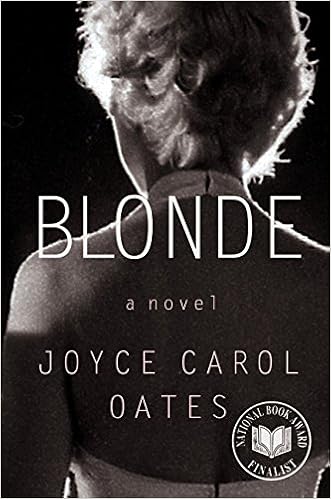
I finished The Godfather and now I'm reading Blonde by Joyce Carol Oates, a great American novel that fictionalizes (somewhat) the life of Norma Jeane Baker, better known as that sacrificial goddess of the American pantheon, Marilyn Monroe.
It is often chosen as the favorite and best of Oates's wide-ranging oeuvre. After years of research she attacked the project obsessively, and brings "Marilyn" to life in great detail. The book is epic in scope; I'm one third in, and she has just been given her new name by her agent, as her small, scene-stealing role in The Asphalt Jungle catapults her to fame.
Who's the blonde?
The book explores the specifics of Norma's life with her paranoid schizophrenic mother, who claims her father is a studio star (his identity was never proven) but also serves as a historic record for what it was like being a girl and a woman in mid-century America, which is not so great. Norma wants more than other women. Like many, she enjoyed the meaningful work in defense factories during the war, only to be thrown away afterward when men came back and needed those jobs. Oates uses repetitive phrases like she's smooth as a silk purse down there as a revolting leitmotif, to show how girls are sexualized from birth. By the time Norma is twelve, the piano teacher has stuck his tongue in her ear, and by fifteen her foster mother doesn't like how her husband is looking at their ward, and plots to get her married so she'll be "safe."
Out of the frying pan, into the fire. Her husband is immature and emotionally illiterate, and chooses to join the war effort rather than accept that she has any agency; he forces her to pose nude, and carries the photos around to show her off like the head of an eight point buck in his den. Her earnest innocence is forever mistaken for empty-headed naivete, and she takes acting more seriously than anyone expects her to. They expect and want her to ride on her looks, and never see her as a person. You're not that dumb a blonde, stop acting like it.
When writers tell me they "can't get into" Joyce Carol Oates's style, I always ask, "Which one?" She's written everything from Gothics to serial killer novels, stream of consciousness, and her own deceptively readable prose, which switches from addressing the reader like a Greek chorus, third-person omniscient, third person limited, first person, interspersed with italic passages of thoughts and dialogue whispered from the peanut gallery, the American version of a Greek chorus. When I first encountered this style in Foxfire: Confessions of a Girl Gang, I found it confusing and tilted, but once I took it as multiple viewpoints and the criticisms of the little-minded around us, rather like Orson Welles did with the camera stopping during narrated sequences to hear what the locals had to say in The Magnificent Ambersons, it made more sense and became easier to read. It can be hard to keep up--Oates often writes in a whirlwind of ideas with asides in parentheses, but it makes for a rich tapestry of thoughts and pictures, for she works out the secret fears and sneers we never share in public.
I'm only a third through Blonde and I need to put it down to review another of her books, the Hard Case Crime reissue of The Triumph of the Spider Monkey, which at first glance seems to be like her masterpiece Zombie, a hellride in the head of a psychopath. She's one of the most consistently daring writers, criticized for fictionalizing everything from Marilyn Monroe to JonBenet Ramsey and Jeffrey Dahmer, but what else do writers do? I think it's more honest the way she does it, rather than trying to conceal the true-life inspirations. In one scene in Blonde, a young "Bob Mitchum" tears up the nudie photos that Norma's husband is showing his coworkers, saying "what kind of man does that to his wife?" Is it true? Rumor? Fantasy?
Does it matter? It was thrilling to read and wish were true. As Oates's late second husband Charlie Gross said of another insertion of a real-life person into a story, "who cares? it's fiction."
Subscribe to:
Posts (Atom)