Showing posts with label Jim Winter. Show all posts

Thursday, January 16, 2014

The Devil They Know?

Guest post by Jim Winter

A few years back, I read an interesting theory about The Great Gatsby that suggested Jay Gatsby might have been black trying to “pass” in the more racially rigid 1920’s. It was an interesting theory, but I wish I’d read the novel before the article as it changed my perceptions of the story. Then again, there also was nothing in the book suggesting Gatsby resembled Robert Redford, so my perceptions were already altered by Hollywood. 
However, that idea played into a story I wrote for Spinetingler a few years later. “Profiled” told the tale of an undercover cop born in Tehran. In the post-9/11 era, if Gatsby were black, he would not have had to pass himself off as white. If anything, he would get called out for fostering the same prejudice that would have made his charade more acceptable in the twenties. It’s easier to call people out on racial bias, and these days, gays are finding it much easier to be open about themselves. But are there some groups that, no matter what, are going to draw suspicioin? In “Profiled,” Eddie Soroya tackles this very issue.

When we meet him, he’s sitting on a commuter train in a Midwest city posing as a homeless man while watching for trouble in our terror-panicked world. When a woman calls him a “raghead,” Soroya swears at her in Spanish. In a city with a large Mexican population, the perceived insult would warrant a harsher response. As he rides from the city’s lakefront to the airport, watching a suspicious duffle bag, we find out he is actually from the Middle East, that speaking Spanish becomes a defense that not even a badge can give him. People – black, white, Hispanic – are paranoid since those planes crashed in 2001. Unfortunately, that means people are automatically suspicious of entire groups.

When dealing with people’s biases, you have to walk a thin line. Despite what some of the more hysterical pundits on 24-hour news like to tell us, we aren’t quite in 1930’s Germany. But you hear the slurs, the misconceptions, and the outright hatred that seems to have found a new outlet.

In a way, though, Soroya is between a rock and a hard place. We also live in a nation wary of illegal immigration, so posing as a Mexican to keep people from flagging the nearest TSA worker or FBI agent is a double-edged sword. Without a badge, he’s still likely to get pulled over. He faces a different kind of harassment from what he would get if he were open about his Iranian origins. Granted, it’s easier to fight by simply sliding into his normal accent, a Rust Belt twang I myself have not been able to get rid of after 22 years, but it’s still more than most people have to deal with in this day and age.

It goes back to a conversation I once had (and was part of the impetus for “Profiled”). A friend and I were discussing, of all things, the bias against obesity. At one point, I said, “You know, most of the bullshit you have to deal with everyday stares back at you from the mirror in the morning.” And it’s true. Race, gender, weight, age, physical imperfections, and even disabilities all come back at us when we look in the mirror. Things like sexual preference, religion (or lack thereof), and politics (a stupid bias since that one causes most wars) are all internal aspects of who we are. We can hide those. We can act straight or gay. We can keep our religion and politics to ourselves. But the things that define us physically to other people are there in the mirror, which means they’re out there for all the world to see. Being a straight white male is, as John Scalzi puts it, playing life on the lowest difficulty setting. That’s not to say life is easy for anyone. We still have to deal with our personalities, and we still need to have a strong sense of self. We also need to be aware that, over time, it’s how we react to the world around us that ultimately determines how we get by in the world.  The question “Profiled” asks, and leaves hanging, is whether Eddie Soroya made the right choice about it.

---

Born near Cleveland in 1966, Jim Winter had a vivid imagination – maybe too vivid for his own good – that he spun into a career as a writer. He is the author of Northcoast Shakedown, a tale of sex, lies, and insurance fraud – and Road Rules, an absurd heist story involving a stolen holy relic. Jim now lives in Cincinnati with his wife Nita and stepson AJ. To keep the lights on, he is a web developer and network administrator by day. Visit him at http://www.jamesrwinter.net , like Jim Winter Fiction on Facebook, or follow him on Twitter @authorjimwinter.

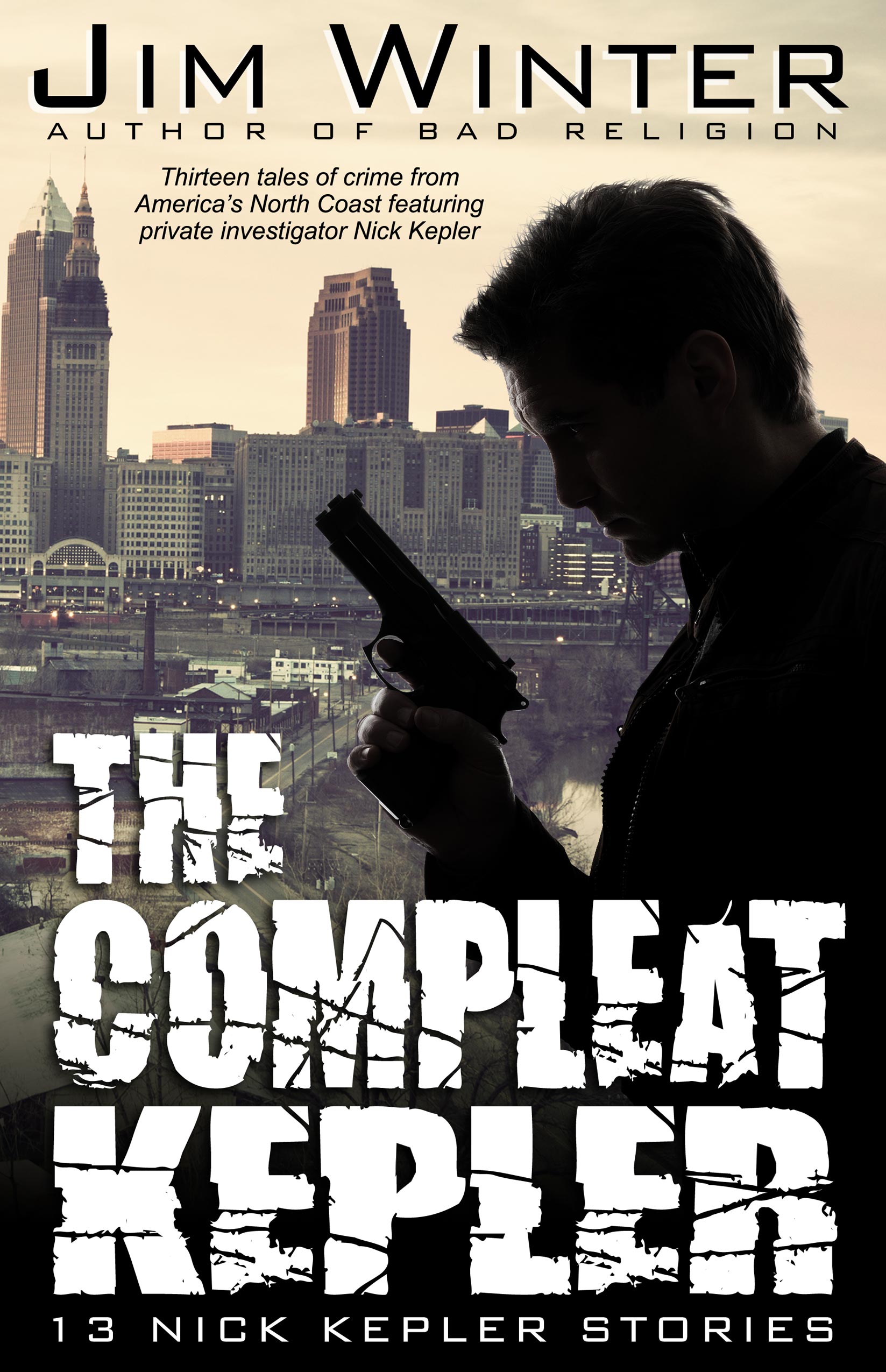
Pick up some Jim Winter right here.

Wednesday, June 19, 2013

Guest Post: The Code

By Jim Winter

Most PI characters have a code, whether it’s stated outright or implied by the character’s actions.

There are lines Spenser would never cross. Marlowe gets damned preachy about it. Hammer’s even more physical, using his fists to emphasize his point. The PI story is often about what the protagonist believes.

Bad Religion is more about the protag questioning what he believes. For starters, if you read Second Hand Goods (and if you haven’t, it’s $2.99 on most ereaders. Go. Now. I’ll wait.), you know that Nick and his married secretary Elaine had a fear-driven one-night stand. As Bad Religion begins, Nick is already pondering if that was the mistake they told each other it was or something more. What prompts Elaine to start dangling the forbidden fruit once more, aside from her crumbling marriage, is an opportunity for them to leave their patrons at TTG Insurance for an office of their own.

Nick says no when he realizes a Russian mobster with delusions of legitimacy is the money man behind the potential new client. Nick refuses to “sell his soul to the devil,” only to learn that a criminal with his own set of rules is not the worst person to do business with.

And then there’s the case itself, an associate pastor of a popular suburban church accused of skimming the collection plate. As Nick and Elaine dig into church politics and shady real estate deal, Nick is forced to face that pesky God issue he’s ignored since he was a teenager. Nick was never the most devout Catholic and never embraced atheism, but he is forced to define himself as he watches two reverends – one genuine and humble, the other a preening huckster – struggle with their own beliefs. True to his ambiguous nature, Nick doesn’t really resolve the issue.

In the end, Nick is left wondering what the hell happened. He knows even less about what he believes and has crossed lines he would never have dreamed of even days before the story begins.

About the only thing he believes in at the end is guilt.

He doesn’t need God for that. He’s racked up enough of it on his own.

Kindle | Nook | Smashwords

Wednesday, January 23, 2013

Character Evolution

Guest Post from Jim Winter


I am a middle-aged college student. That probably means nothing to you unless you read my blog and listen to me bitch about the profs sucking up all my primo writing time. But one of the classes I’m taking this semester is physical anthropology, which is the study of evolution. And it’s of evolution I wish to speak today.

Yeah, that was a long-winded way to get to character evolution, but here we are. Specifically, how do series characters evolve before we ever see them in their debut books. For Nick Kepler, it was a long, drawn-out process. The first anyone saw of him was in the original Plots WithGuns where he’s doing a sort of back-and-forth describing why he’s walking along a deserted stretch of highway at 3 AM in a light rain and how he got there. 

That character looks nothing like the one in the outline to Northcoast Shakedown ($2.99 on Amazon, Nook, and Smashwords, not to mention a whole bunch o’ other readers.)  But then he looks nothing like the poor schmuck who is stalked by his client in “Valentine’s Day,” and definitely not the guy who, in a moment of fear, starts boffing his married secretary in Second Hand Goods.

How much of this is the character? And how much is the writer? I’d have to say it’s about 50/50. In the beginning, I had no clue who this guy was. By the time I finished “A Walk in the Rain,” I knew Nick Kepler was, in 2001, 33, played in a bar band that did classic rock covers, and had a friend named Lenny who stole cars for a living. By the end of Second Hand Goods, his life is a lot more complicated.

But I’ve seen this sort of thing before. When Stephen King wrote the first story about Salem’s Lot, there was nothing about the Marsten House or any clue that there was anything more special about the place except for a bizarre spot in the woods where some evil stuff took place around the time Nathaniel Greene was cracking British skulls in that part of New England. One novel and a bad miniseries later, we get a vampire novel that has as much in common with Twilight as the Rolling Stones have in common with the Spice Girls.

A lot of times, the short stories authors create are little more than rough drafts of a character they opted to share with the public. Sometimes the author gets lucky, as I have, and can keep the storyline consistent. Other times, you have to accept the fact that the author had no clue what he or she was doing.

Amazon | Nook | Smashwords

Jim Winter programs web sites by day, attends college and writes nasty tales by night. Born in Cleveland, he lives in Cincinnati with his wife Nita and stepson AJ.  Find out what he is up to at http://www.jamesrwinter.net