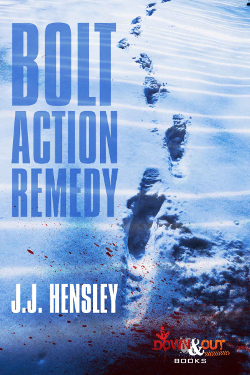
For several days, social media has been in the grips of a debate on how we can protect our children. One of the suggestions bandied about is to arm school teachers. If you follow J.J. Hensley on Twitter, @JJHensleyauthor, then you've had a little bit of education on the problems with arming teachers (or anyone) to take down the perpetrator with a gun in a school. J.J. is the author of several books, the most recent being Bolt Action Remedy, published by Down & Out Books, and a contributor to the new anthology The Night of the Flood. He is also a former police officer and former Special Agent with the U.S. Secret Service. I asked JJ if he would write something around the idea of arming school teachers. Much thanks to J.J. for taking the time to write this guest post. - David Nemeth
 |
| Firearms instructors at the James J. Rowley Training Center. (USSS Instagram) |
By
J.J. Hensley
About seven months. That's how long one has to train to be a Special Agent in the U.S. Secret Service. The first step is to complete a basic criminal investigator training program at the Federal Law Enforcement Training Center. Next up is the Special Agent Training Course at the Secret Service Academy in Maryland. Throughout the training, agent candidates are instructed in relevant topics such as investigative techniques, the appropriate use of force, defensive tactics, legal procedures, physical fitness, and the proper use of firearms. The firearms training consists of shooting tens of thousands of rounds in a controlled environment as well as going through a myriad of scenarios in which the trainee must exercise the proper judgment. The drills are repeated over and over again so as to create what is called muscle memory; where one reacts automatically – and correctly – in a stressful situation. The reason for this is because people will often react inappropriately when potentially dangerous circumstances present themselves or they will not react at all.
Of course many of the trainees have had previous training either through prior law enforcement or military experience. So before a new agent hits the street, it's likely he or she has been exposed to not only countless hours of classroom lecture reinforced by practical exercises that simulate actual hostile situations, but also real-life experiences. Additionally, law enforcement agents and officers are vetted through mechanisms such as background checks, drug tests, polygraphs, and psychological evaluations.
For agencies like the Secret Service, the scenarios trained on include those in which an individual or individuals must be protected from an assailant. It's difficult to express the importance of these exercises because it is difficult to train the students to act contrary to their natural inclination toward self-preservation. Additionally, those with previous law enforcement or military experience were trained to take cover when the bullets start flying, not to become the cover. As anyone who has been through similar training can attest, unlearning a set of movements is nearly always harder than learning them in the first place.
As someone who underwent the training and worked countless protective assignments during my time in the Secret Service, I recall being involved in plenty of events in which there were multiple people in one place, all designated as "protectees" of the Secret Service. For example, every Presidential Inauguration, Christmas tree lighting at the White House, or United Nations General Assembly will involve multiple protectees in close proximity to one another. So, how does an agent respond when an active threat appears?
There are a few basic rules to remember when working protection. One important one is that the minimum number of agents will address the problem (threat) and the maximum number will move to the protectee. This is Protection 101 and is a philosophy used by government and private sector security details all over the world. If you have every agent trying to take out an attacker, then your protectee could be left out in the open and vulnerable to another attacker. Another rule is to "sound out" the threat. This is done by yelling "gun" or some other word that the rest of your security force will recognize as the code word identifying an imminent threat. Then, if you are the security professional closest to the attacker, you address the threat. But what does this mean? You might be surprised that an agent drawing his or her weapon is likely a last resort. Why is that?
Remember how I gave examples of multiple protectees being present at an event. Well, events like campaign rallies and awards presentations can involve large crowds. So try to imagine you are an agent working an inauguration event and you spot an armed man who is twenty yards away from you. Imagine the man begins firing into the crowd. Imagine addressing a threat by pulling a gun and, through the crowd, taking aim on the attacker. Keep in mind that law enforcement hit rates in a shooting are somewhere between 18 to 30 percent.
Imagine the unpredictable nature of a gun battle around a panicked crowd.
Imagine not only having to worry about trying to hit your target center mass, but also having to account for what is behind the shooter, should your bullet miss or pass through the assailant.
Imagine not knowing if he is a lone gunman or if there may be another gunman who is maneuvering into a position to shoot you.
Imagine not knowing if an innocent person will run in front of your gun sights just as you pull the trigger.
Imagine you aren't at an inauguration event.
Imagine the venue is a school.
Imagine the members of the crowd are young school children.
Imagine you never had seven months of training.
Imagine you did not spend hour after grueling hour going through shoot or don't-shoot scenarios.
Imagine you don't have the muscle memory developed through training and experience.
Imagine not knowing if you should try to cover and evacuate your young protectees, or to go after the threat.
Now imagine you aren't there. Imagine your child is at the school and the person attempting to respond appropriately to a shooter is Mr. Stanley the third grade teacher who may or may not have taken a week-long firearms training course. He's raising a gun as screaming children rush by in front of him and he thinks the shooter is aiming at him.
Imagine.
For my last few years with the Secret Service, I worked on the Protective Intelligence side. The agency wisely dedicates massive resources to intelligence and advance work. This is because the best way to take care of your protectees is to prevent weapons from being present in the first place. As one former Secret Service Director liked to say, "If the guns come out, we've already lost."
Right now, in our schools, we are losing and the nation is divided on how to address this crisis. I don't have all the answers, but I know one thing: If someone sneaks a weapon into a Secret Service venue tomorrow, the response the next day won't be, "Well, we should add more guns."