Showing posts with label Emotions. Show all posts

Saturday, April 6, 2024

What Book Packed a Real Emotional Punch?

By

Scott D. Parker


When was the last time a book delivered an emotional response?


One of my science fiction book club guys texted me earlier this week. He had finished a book that he admitted wasn’t great, but the sad ending actually touched him. He recalled the book  REDSHIRTS by John Scalzi as one about which I very much had an emotional response. Heck, that response smacked me in the face so much so that I could barely relate the ending of the book to my wife without bawling. Later, when the book club met, I still was rather emotional in explaining why I loved the book so much.


My friend remarked that maybe the genre books lack emotional storytelling. If we are judging strictly by books the group has read—and not, say, the Harry Potter series that, for me, did deliver a wallop to the gut—then the number of times a book has given me an emotional response of any kind is quite rare. 


The Fundamental Reason to Read Fiction

Before we get too deep, let’s not forget that fundamental reason we read fiction: to be entertained. If a book tells a story you enjoy, then it has done its job. If a book entertains and also makes you feel, that book is special.


What Kind of Emotional Response?


When I hear that a book gave a reader an “emotional response,” I almost instantly think of crying first. But that’s not the only emotion out there. Thrillers quicken the heart rates of readers as they breathlessly turn pages as fast as they can read. Romances give you that warm and fuzzy feeling in the pit of your stomach as the characters fall in love. Horror books often terrify or sicken depending on the author and the subject. There’s always anger like when a character is treated badly for no good reason. Back in the day, after I finished reading A FAREWELL TO ARMS, I hated the ending so much that I threw the book across the room. 


So an emotional response can really be anything.

Visual Storytelling Seems Easier


Not sure what it is about the visual medium—TV and movies—but I tear up somewhat regularly when I’m watching TV shows or movies. My wife and I just finished season 2 of “Parenthood” and, for the most part, we are entertained by the story of the four adult siblings and their children. But every now and then, out of nowhere, boom! An emotional beat lands. Same with “Cold Case.” 


Movies, especially action and adventure ones, have my heart pounding in my chest. There are certain moments in movies that gave me chills in the theater (and every time I watch it again afterwards). 


But then there are the tearjerker movies, the gushy rom-coms, and let’s not forget the comedies that make you laugh so hard your stomach aches. Emotions from movies just seem easier.


A Short List of Books That Gave More Than a Story.


REDSHIRTS is still one of the gold standards of books that more than delivered but there were a handful more in the club. REPLAY by Ken Grimwood brought tears to my eyes. DEAD SILENCE by SA Barnes literally made the hairs on my neck stand up at certain parts. It was truly eerie and scary. THE SEA OF TRANQUILITY by Emily St. John Mandel turned out to be my favorite book of 2022…and I didn’t even pick it. THE MARTIAN by Andy Weir had me nearly cheering at the end. 


Outside of the SF club, a few others come to mind. The ending of FALLING by TJ Newman gave me goosebumps and I pumped my fist in the air with triumph and jubilation. Her next book, DROWNING, scared the crap out of me because of the very real possibility of something like that happening. CHARM CITY ROCKS, a rom-com by Matthew Norman gave me all the feels I expect in a romance.   


But a book giving me an emotional response is rather rare. I just finished a book club book and, well, it was interesting, but it was not too invested into the story other than to know what happened next. So, that’s curiosity. And I was marginally entertained.


I guess that’s good enough, right? 


What are those special books that gave you some sort of emotional response?

Saturday, June 25, 2022

All the Feels or All the Logic?

by
Scott D. Parker

Why do you consume a story?

I use the word ‘consume’ because you could watch a movie or TV show, read a book, or listen to an audiobook or podcast.

My wife watches quite a bit of the true crime shows on TV and various streaming services. She likes to learn the intricate details of how the investigators discovered the culprit and, in most cases, land the perp in jail. She’s way more logical than I am and these shows give her a sense of order and justice. That drive for order is a large reason why she and I both enjoy BBC TV shows and other crime and mystery programs as well as books and movies.

But when it comes to established stories that have more than a twinge of nostalgia, I really enjoy the feels. How does the story make me feel?

I ran across this twice this week. The smaller version is my re-watch of the 1996 Mission: Impossible movie. My twenty-year-old son hadn’t seen it so we all watched it together. The way the movie is constructed—with its descriptions of how they’re going to break into various places and the spy stuff—is something I really dig. In fact, I found myself grinning like a goofball throughout the entire movie. Well, except for the vault sequence. Watching it again, I was in rapt silence.

By the end, I was buoyed by the story and ready to, I don’t know, hang by a wire from the ceiling. The story works, but the feels are fantastic.

The same is true for the Obi-Wan Kenobi finale this week. And spoilers are coming.

I’ve said it before but I think my favorite time of being a Star Wars fan is that initial era from 1977-1980. In those years, the galaxy was wide open and not some family drama. And I associate that feeling most with the first half of Star Wars, while the action centered on Tatooine. As such, I really enjoyed the Obi-Wan show.

From a logical point of view, the writers delicately threaded  this series through established canon and I think they did a great job. It’s a testament to how much I enjoyed the show that even though I knew who lived, I found myself constantly on the edge of my seat. Will young Leia survive? Will Obi-Wan be killed by Vader?

But the finale proved to be one of my favorite Star Wars things. We got an epic lightsaber battle between Obi-Wan and Vader, complete with Hayden Christensen looking out from a seared-open Vader mask. We go a neat and tidy button on Obi-Wan’s infamous phrase to Luke: Vader betrayed and murdered your father.

And we got some fantastic character moments, a feat especially impressive considering the action. In fact, it was the character beats in the final ten minutes that really struck me and brought the tears. Oh, and the inclusion of Princess Leia’s theme from Star Wars? Icing on the cake. That piece of music ranks as one of my all-time favorite themes in the entire franchise and it was used so well.

That last shot? [won’t spoil this one] Perfection.

So, with Obi-Wan, in my mind, I got the logic of the storytelling but I also got the feels. That’s what often sends a story over the top for me. It’s why I enjoyed Jurassic World: Dominion so much. It’s why I dig La La Land, Toy Story 3, any random episode of New Amsterdam, and John Scalzi’s book, Redshirts.

I want the feels, and any story that delivers is a winner in my book.

How about you? Do you want the feels or is logic more your speed?

P.S. I wrote this piece late afternoon on Friday. Last night, I watched the new Baz Luhrmann "Elvis" movie. Add one more to the feels list. Except this one was tragic. My wife and I just sat there for a few minutes while the main credits rolled. I had teared up at the end. So we just sat and listened and thought about the creative spirit of Elvis Presley. 

I don't know about you, but when I take in a story in which a creative person is tamped down or abused or taken advantage of, I feel my own creative spirit wanting to burst out and soar.

P.P.S. Since I watch every new episode of Star Trek: Strange New Worlds on Saturday morning while enjoying my weekly do-nuts, I only saw the latest episode, The Elysian Kingdom, less than an hour ago. Adding this one to the Feels List. Oh my, did the feels wash over me. 

Tuesday, October 13, 2009

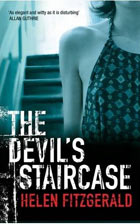
The Devil's Staircase, Helen Fitzgerald.

By Jay Stringer


I met Helen Fitzgerald on the night Michael Jackson died. That interesting fact has little to do with today’s blog, but it lets you know that we both have an alibi.

I was there for a launch of three books; Alan Guthrie, Tony Black and Helen Fitzgerald all gave readings from their books, answered questions about crime and pets, and generally made good conversation. I’d been aware of Helen’s books, and my curiosity had been piqued by a good review by Ray Banks, but I hadn’t taken the plunge.

After hearing what she had to say, both the Gurrl and I were interested in the dark little hardback that Helen gave a reading from, The Devil's Staircase.

I was laid up with a bad back recently and it gave me a chance to catch up on a few things. I cracked the cover to the book, read the first page, and then several hours later I’d finished. That’s a big deal for me. For a number of reasons, I’m quite a slow reader. I don’t read books in a day, but this one I couldn’t put down.

Trying to place Helen as a writer is as interesting as trying to place her characters. We love setting. I myself have spent many thousands of words online saying how important it is to me for an author and a book to identify with its setting. That can lead to a few misleading ideas though, and it can close a few doors. Helen is from Australia originally but now lives in Scotland. She tends to write stories set in Britain. Gets confusing, eh? No, not really. A writer doesn’t have to be part of the DNA of an area in order to explore it. And for every character who is defined by the hometown that owns them, just as many are defined by the home that they’ve escaped. And that is true of The Devil's Staircase.

The story starts in Australia, with the 18 year old Bronny facing up to being diagnosed with a condition that will destroy her life, or to something maybe even worse; a clear diagnosis that means she has wasted half of her life living in fear. She makes one of those great decisions that only the young can make: she jumps on a plane and travels halfway across the world to have a go at living.

That may sound like I’ve dumped a load of the plot on you right there, but in all honesty I’ve not even scratched the surface. That’s just the pre-title sequence. The real plot of the books is there if you want to look for it: it’s in the title, it’s on the dust jacket. But sometimes you really just need to open a book and jump in, you know?

Once the plot reaches London we meet a full cast of young runaways. Each is running from (or in one case to) something in their past. Each has a story and a motivation, but the book lets you discover them as you go along. There’s no rush to dump these things on you. We see them trying to earn a living, trying to find themselves, and trying to get as drunk and as high as they can. For a while the book is a free and simple exploration of youth and love as each of these runaways come together to form their own community in the midst of one of the world’s busiest cities.

You’re never left far from the main plot though, and just as you’ve settled in to this fun coming of age love story, the book punches you and drags you into it’s dark underbelly, something that has been hiding beneath the surface for the whole story.

The book pulls off something like a magic trick. It has a surface that’s a fun, and funny, story of youth and love. Dig a little deeper and it starts to get very dark indeed. But the trick is that neither of these take away from the real heart of the story. It’s a book that looks at love and loss, at desperation and grief. It deals with real human emotions which, as I’ve written before, is sadly rare in fiction.

I’ll be returning to this theme soon to expand on it, but this is a great example of a book that takes the time to show consequences. If someone dies, then someone is grieving. If someone fails then someone is guilty. There are a few moments late on when we get to see the various different forms of grief or guilt that the characters are dragging around with them. Normally I don’t like it when the narrative decides to tell us what characters are thinking, but if it’s used well it can add just the right note. And this carries over into its twists.

Some storytellers use twists as a way to escape consequences. They can throw in something crazy, or some deus ex machina, to write their way out of a whole. But good twists, good plots, carry the weight of consequences and, sometimes, inevitability. Some twists happen because that’s what needs to happen. This is a book that has a fair few of them, nasty and grisly in turn. Each time you hope that the story will go one way, it reminds you that it needs to go the other. Each time you root for the characters to have a breather, the page turns to remind you that things just don’t work that way.

There are some really good writers working in Britain right now, but the industry doesn’t seem to know how to point them out.

I’ll be interviewing Helen soon. That is, as soon as I get the questions sorted out. In the meantime, pick this up and prepare – I really wasn’t prepared for how good it was.

Tuesday, September 22, 2009

The Heart Of The Matter

Writing inside-out
by Jay Stringer

I’ve been trying to crack a story lately. I’m working on a manuscript and, while I know I’ll manage to beat it into submission eventually, I’m still at the point where I haven’t quite cracked the heart of the story. But while I'm thinking about it, I’m realising a few things about my tastes.

I like writers that go inside-out.

What I mean is the emotion.Something Dave has touched on before. I need to get into the emotions before everything else falls into place. I’ve found a problem with all fiction, but one I notice more in crime, is that not enough writers really tackle issues like grief or loss.
Sure, loneliness and isolation get used, but often more as short hand for establishing a moody character. These are some of the key emotions that we all experience, and if a writer shies away from those, what do they have to build on when they want to tackle things like love or hope? In a genre that is built on dark deeds, marginalisation and death, the emotional fall-out of these things seems all to easy to overlook.

I’m generalising, of course. For every writer that I’ve just tarred with that brush, there are many more who deal with emotions. Reed Farrell Coleman built a whole PI series -the Moe Prager books- out of loss, grief and melancholy. Ken Bruen at his worst can do more with grief and guilt than I could do in a lifetime at my best. Our very own Russel D McLean’s The Good Son was a book that tackled these things head on, that actually managed to build a plot on top of emotion.

An example of what I mean is in my first book, currently being pitched by my ace agent. As I looked at where the story was headed on my last rewrite, I realised that I let the death of a teenager pass without any real sense of loss. So I stared at the screen until my forehead bled, trying to write a funeral. It wasn’t working. I’ve been to enough of them, I know what happens and when. But every time I started to write the scene, that’s all it became; a report of what happened and when.

Then, by chance, I wrote about the flowers on the coffin. I realised that some of those flowers would have been placed there by the boys’ mother, and bam….emotion. Writing the scene was easy from there; I had a way in. Once I had that one emotion on the page, the other followed, a broken heart and a bruised ego makes its way into the chapter. Anger bustles its way in. And just like that, a dull and lifeless scene became a chapter that managed to sum up each issue I was trying to get across in the book.

And thinking about all this recently has made me realise that this is what I look for in writers. All writers, be they films, novels, songs, comics, bleach bottle labels….

I often try and explain to friends that I need music to hit me in the heart and the gut before the head. I’m a lyrics man, no doubt, always have been. But they have to get me emotionally. If your song needs to be thought about before it can be felt, it’s not going to stick with me.
And that comes from an economy of words, I think. I real writer, for me, is one who can break your heart with the fewest words possible.

I’ve wasted many thousands of words online trying to explain what it is I love about Paul Westerberg. I mean, his lyrics are amazing, but to try and explain it that way is to make it sound wordy and complex. What really gets me? His lyrics get me into the heart of an emotion in a matter of seconds. He doesn’t need a whole song; he can do it with a flick of his lyrics;

“How do you say ‘I miss you’ to an answering machine? How do you say ‘Goodnight’ to an answering machine?”

Boom. Loneliness. Guilt. Love. Loss. Heartbreak. In two lines. THAT is writing.

“The bride groom drags you cross the room, you said ‘I do,"
But honey you were just a kid, your eyes say ‘I did.’ "

Again. Right into the heart of it, a whole story told straight away.

Springsteen, too, has become a master at it. His early albums, the ones where he sounded like a street poet with a record contract, were full of words. Free and easy, jangling guitars and rhyming dictionaries in flames. Then he seemed to get a little darker, a little older and he found focus the way some people find religion. He crafted his sentences, stripped away at them like a hardboiled writer until he became the most effective storyteller to ever pick up a telecaster.

“To the dead it don’t matter much, about who’s wrong or right.
You asked me that question, I didn’t get it right.”

Slipped into the middle of a rock song, hidden away amidst other songs that got scrutinised for any political meaning, was the simplest assessment of a foreign policy. And more than that, it was done through regret and a sense of loss, rather than anger or blame. Or how about one of the few moments in song that matches Folsom Prison Blues for getting to the heart of darkness;

“They wanted to know why I did what I did,
Well sir I guess there's just a meanness in this world.”


Sometimes a total lack of emotion can be just as pure as any hatred or love. Here, a cold blooded killer looks you in the eye and tells you he killed innocent people for no real reason. Chilling. Terrifying.

How about our man Waits? Natural born storyteller. Look at this little turn of phrase and see how complete a story can be told with a throwaway line;

“It’s a battered old suitcase to a hotel someplace, and a wound that will never heal.”

Okay, okay. Everybody writes about Westerberg, Springsteen and Waits. This is true. But some clichés are still important. It doesn’t stop with them, though. There’s a songwriter by the name of Ben Nichols, the front man of Lucero, who I think is well worthy of attention.

“When this world was made, it was never meant to save everyone in kind.
I don’t believe God much had me, had me much in mind.”

I’ll be returning to Ben in future to look at his album, The Last Pale Light In The West. But back to today, it seems somewhat counter intuitive to love such economy. I mean, if a story can be told with 12 words, why read a book that takes thousands? Well, different mediums have different strengths, but the principle holds true. There’s an old joke that a gentleman is someone who can play jazz guitar but doesn't. Along those lines, I think a great writer is someone who doesn’t put too many words into a sentence. And I'm sure that Weddle fella could turn this little article on its head by bringing his knowledge of poetry, another way of relating complex emotions through simple words.

All of the writers that really stay with me are the ones who can get me into the very heart of the story. As I've already said, going for the pure driving emotion of the scene and writing inside-out. Why? I don't know. I've written before about how comic books taught me to read, so maybe it comes from that. Maybe its because I'm dyslexic, and its a survival instinct -the fewer words there are, the more chance i have of getting the point. Maybe it's just because the sky is blue, i don't know.

How about you guys? Who does this for you?

Thursday, August 27, 2009

Emotional Readers

I've been watching the Little League World Series. I always tune in every year and watch a few innings here or there. The play isn't great, but it's fun to watch. The thing that sticks with me, though, is the end of the games.

The kids jumping up and down, excited to win.

And, of course, the kids on the losing side crying.

Now the cynic in me says these kids have watched enough TV to know how to get on a SportsCenter highlight. But my heart says most of these emotions are true. They feel right.

And, to me, that's the key part in writing a novel. Getting to the true emotions of the characters.

You can't write how you think they're going to feel. You can't have someone crying just because they SHOULD cry in that situation. A good reader isn't going to buy that. It's going to take them right out of the book.

No, you have to figure who you character really is. And once you figure that out, you can figure out how he or she is going to react in certain situations.

And if you bear down to a real emotion, if you get your reader to believe that's how your character is really going to react, it's going to make a story even stronger.

You can write a sad story and people don't have to cry, if that's who the characters are. You can write a happy story without having the characters jump up and down.

And, if you do it right, you might get your reader to cry.

Or jump up and down.