By Steve Weddle
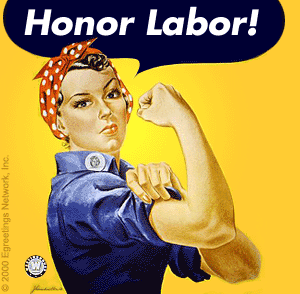
Today is Labor Day, the day we set aside to honour the recent contribution to letters made by Tony Blair, former prime minister of the Britains.
Hahaha. Yeah. It's the day we in the colonies set aside to let our work pile up in order to make Tuesday the Following more of a hell.
So you're not supposed to do work on Labor Day. But the Pharisees said I could work on Labor Day if I pull my ox out of the ditch.
And speaking of work and reading and writing, here's something you can help me with -- um, with which you can help me, Mr Prime Minister.
You know when you finish a novel and then lean back in your chair as you set the book aside? That perfect moment in which you savor the moment of completion? The beginning of that opportunity, that beautiful land of openness in which you can now read whatever book you want. That moment, that's what makes life worth living, isn't it? Kinda like when you started a new year at school and you had all your notebooks and you hadn't messed them up with IRON MAIDEN RULES pen-carved into the covers.
The brightness of possibility.
That's why I love reading. I can pick up someone I've never read and find out why everyone loves this writer. I can hit the latest cool thing and join in on the discussion. I can crack open some Chekov I haven't read before and find out what really happened on the Starship Enterprise.
And then, every so often, the pain comes. That awful moment when you realize the book is crap. That you like this and that, but can't stand such-and-such. And you have to decide whether it's worth it to read the book.
The first 100 pages of DRAGON TATTOO, for example.
The first day on the job, the finding where the doughnuts are kept, the fresh office supplies -- suddenly this becomes work.
What do you do then?
Whether it's reading or writing, at some point, sometimes this becomes work. Maybe it's when the publisher sends the edits back. Maybe it's book tours. Maybe it's plotting.
For readers, maybe the first thirty pages are work for you. Maybe starting a book is tough. Or maybe it's getting lost in all the characters.
When does the book -- whether reading or writing -- become work for you? Does it happen often or rarely?
For me, hand-writing ideas is never work. I like to scrawl out thoughts and characters and dialogue on paper. When it becomes work is when I have to move one scene to the next, when I have to accomplish all I wanted to. When I have to get all the little pieces to meet, like a jigsaw puzzle when I don't yet have all the pieces -- or any idea what the picture is supposed to be.
And that point when I'm reading that I force myself to get to page such-and-such. Another 20 pages and if it doesn't get better, I'm giving up.
Sometimes there's nothing better than reading and writing through the holiday. And sometimes, you know, it's like pulling an ox out of a ditch.
------------
Bonus: Contest at NEEDLE.
Monday, September 6, 2010
Sunday, September 5, 2010
A Rose By Any Other Name
by Joelle Charbonneau
Okay. I’m confused. I’m hoping some of you can help me out. This week, I saw a moniker for the first time that made me blink. Maybe it’s been out there for a while and I’m lagging behind the pack. With the impending release, I tend to be less plugged in. (Who am I kidding – I’m always lagging behind, but the release gives me a great excuse so I’m using it.) Anyway, this week, several self-published authors have begun using the term “independently published” to describe their publishing path.
Up front, let me say that I am not against self-publishing. I think every author has to decide what is right for his or her own career and make a choice as to how best to pursue it. Self-publishing has and always will be a viable option. Some argue that the rise of the e-book has made it a better option than traditional publishing. Hey – it might be. It gives authors total control of their books (which freaks me out – because I am not certain I should ever have total control of anything) and the right to set pricing. It also gives authors a way to connect with readers without going through a middleman. If this option feels right to an author, I say go for it.
But the thing I don’t get is the new “indie published” label. Saying a book is indie published doesn’t change that it has been self-published. It’s kind of like saying a duck isn’t a duck if I call it a goose. Changing the name doesn’t change the content. So why do it at all?
I’ve also noticed that some of the authors using this new label are very aggressive in pushing back when someone questions it. They are offended if someone calls them self-published. Why? If you act as your own publisher, you have self-published a book. Why would someone be offended by that term?
The only thing I can come up with is that these authors think that changing “self-published” to “independently published” is going to make people take their work more seriously. Personally, I think the content will do that more than the label. If a book is well-written, well-edited and entertaining, I don't care what you call it. Do you?
So, help me out here. What is the logic that I’m missing behind saying you are independently published versus self-published? What am I missing?
Saturday, September 4, 2010
Comic Review: Joker by Brian Azzerello and Lee Bermejo
by Scott D. ParkerOf all the things Heath Ledger did for the character of the Joker, making the Clown Prince of Crime a thug tops my list. I’ll not go so far as to say that the comic book version of Joker was genteel. He was always a murderous character, more so in the last twenty-five years. But you always got the sense that the Comic Book Joker didn’t want to get his hands dirty. Sure, he’s shoot you but he’s leave it up to someone else to clean up the mess.
Not so with Ledger’s Joker. He’s a thug. He’s dirty. He’s vicious. And he’d just as soon stab you with a knife and have you bleed on his hand as shoot you. It was a characteristic of Joker that I welcomed. It’s the difference between noir and pulp. Pulp is fun, gritty at times, but, in the end, kinda light. Noir is dark, brutal, always gritty, seamy, unsettling.
With the original graphic novel, Joker, that sensibility is alive and well. Joker is noir.
The graphic novel is about Joker but it’s also about Jonny Frost. He’s the narrator, a young punk who doesn’t know what he’s getting into when he agrees to go pick up Joker from Arkham Asylum. It seems someone thought the Joker cured and got him released. Wonder if that doctor isn’t an inmate in the asylum. Nonetheless, Frost picks up Joker and starts his crash course in revenge, Joker-style.
Another difference with Ledger’s Joker is his obsession with controlling the crime in Gotham. As that stack of money burns, Ledger’s Joker announces he controls Gotham now. In the comics, you never really got the sense that Joker was after power or control. He was just out to have some demented fun at everyone else’s expense. Azzerello’s Joker is, again, more in the Ledger vein than previous incarnations. Joker, upon his release, discovers that his organization has gone to the crapper. And he’s out to fix that situation no matter how many bodies pile up.
The first body is that of Monty, the man who is a lieutenant in Joker’s army who didn’t please the master well during the master's absence. Literally, Monty is skinned alive. Frost is shocked (as are we readers) but then Joker gives a little speech. And Frost is…awestruck. The artwork by Lee Bermejo is painted, not your typical four-color art. Every frame is beautiful despite its occasional grisly nature. The frame with a starstruck Jonny Frost tells more than an hundred words. Jonny Frost is in the spell of the Joker.
The story progresses as we watch Joker, Frost, and Harley Quinn (a stripper) go see various members of Gotham’s rouges gallery. “Killer” Croc is a big-ass black man with acne scars. Croc is drawn so huge on the page that it feels like the white frames surrounding the artwork won’t be enough to hold him in. Abner (aka Penguin) is the moneyman of Gotham, something Joker doesn’t have enough of and something that he craves. Two-Face is here and he seems to be as vain as Harvey Dent used to be before a punk threw acid on his face. He’s the big cheese, too. It’s all about Joker getting back what’s his from Two-Face. And the Riddler, er, Edward Nigma, is here and he’s, well, weird.
All this is to say that this is almost an alternate universe kind of thing but it speaks to what makes the Joker tick just as good as 1988's The Killing Joke or other famous Joker-centric stories. There’s a few scenes of honest empathy if you’ll allow yourself to feel for a psychopath. In one crucial four-page sequence, Joker takes a broken bottle to the face of another thug, blows up a building, and then, is seen crying and hugging on Harley. This is almost as shocking as the violence.
If Joker’s involved, you just know Batman will eventually make an appearance. For the most part, however, he's merely a looming presence off-screen. To be honest, the way the story moves, I didn’t need Batman to show up. I knew he was coming...and I almost didn't want him to. Just as I enjoy the Gotham Central comics (featuring the police officer of the G. C. P. D.), I was quite enjoying all the criminals without the hero. But he’s called (you’ll never guess by whom and how) and dispatched. Quick as lightening, the story wraps up.
A bit too quickly for my tastes. The ending, while decent, wasn’t the gee-whiz ending of, say, The Killing Joke or Branded Woman by Wade Miller. It was just an ending. It spoke to why the Joker was released from the asylum but never really answered the question why he was released. Unless the answer is in some subtext, I missed it.
Azzarello can do believable dialogue with the best of’em. It’s fun seeing these hardened, yet flamboyant criminals talk trash to each other. In a cast full of insanity, it’s even fun to read two of them joke about a third person:
Abner/Penguin: Someone is very sore at you.What about Jonny Frost? Well, let’s just say he’s us. He’s the “us” who looks at the movies and comics and sees all the havoc created by a man who looks like a clown and thinks “That’s cool. I want to be like the Joker.” Jonny Frost thinks that, too, at the beginning. He gets his first row seat to the madness that is Joker. Jonny looks into the abyss and makes a decision. It’s the most crucial decision of his life.
Joker: Really? That’s wonderful news. I just like to make him sore. It’s what drags me out of bed.
Abner/Penguin: No, not him. Though I’m certain he’s not very happy about what you’ve been up to either. I’m speaking of Dent.
Joker: Harvey’s mad? Which one?
Abner/Penguin: Ha!
Joker: You think it’s funny, Abner?
Abner/Penguin: I think it’s a fair question. I don’t know how to answer it.
What this book boils down to, for me, is this: it’s a kind-of sequel to 2008's “The Dark Knight.” Visually, Joker is drawn as the perfect blend of Ledger’s Joker with the comic book Joker. Characteristically, he’s more Ledger’s Joker than the gentlemanly version from the comics. You get in the head of a killer. And you see things you never expected. Just be sure to go into the story with an open mind. It’s a good story and well worth your time.
Subscribe to:
Posts (Atom)