By Russel D McLean
Yes, its the time of year where everyone does their "best of" lists of the year, so I figured I'm one for jumping on bandwagons and therefore give you my top 5 reads of this year (in no particular order and probably missing out one or two that I completely forgot about, but these are in my brainpan right now):
1) THE CRY - Helen Fitzgerald: Wow. Oh, wow. A devastatingly well written novel about a woman whose child is killed during a holiday and the aftermath of the terrible decision she may or may not have made. Its got a straight from the headlines hook, but Fitzgerald is such an exceedingly clever author that she never once judges her characters or their decisions, leaving the reader in the uncomfortable position of having to work out who to trust and who not to believe. Its a brilliant and unsettling novel that you absolutely have to read.
2) ONION STREET by Reed Farrel Coleman: Coleman's Moe Prager series is drawing to an end, which is sad news for fans of the conflicted and always intriguing wine-store owning hardboiled eye from Brooklyn. But this book - which skips to Moe's college years - is one of his finest adventures yet; a mix of recent history, character development and brilliant plotting that confirms Coleman's place among the greatest crime writers you might not yet have read. If you haven't read Moe yet, you really need to start. Now.
3) WOUNDED PREY by Sean Lynch. An unexpected entry for me as this one just kind of dropped through the letterbox. But with its Michael Connelly-esque feel and its brilliant understanding of the psychotic nature of its bad guy, this is one of the few serial killer novels I really enjoyed this year. Or indeed, ever (I'm not a big serial killer novel fan, so they have to do a lot to convince me) Lynch has a great future in the genre, and I'm glad to have got in at the ground level.
4) THE HARD BOUNCE by Todd Robinson. Another debut, and one I admittedly read a year or so ago (but it was just released this year - yeah, check the front pages, this one's got a blurb on it from me) - - but its a great read and Robinson has an authentically tough new voice. THE HARD BOUNCE is the kind of novel I love. Full of street level violence and barely any hero cops to be seen. Boo Malone is a brilliant creation and frankly I'm looking forward to whatever Robinson does next.
5) NOS4R2 by Joe Hill. Hill has been on my watchlist for a while. His HEART SHAPED box was a little too constrained by its King-esque conventions (and yes, Hill is King's son, but I didn't know that, then) but was very readable and great fun. HORNS was brilliantly good fun, although fell apart a little towards the end. Still, an original concept and even more assured writing. But NOS4R2 is brilliant. A sustained (and huge - we all know I usually don't like big novels) and thrilling novel that never quite does what you expect, it starts with a killer whose car takes him to his "inscape"; a place inside his own head he calls Christmasland. Our killer takes children to Christmasland in the belief that he is helping them. To do this he employs the assistance of a strange individual known as GasMask Man. Meanwhile, a girl discovers her own inscape and soon finds herself in the path of this monstrous killer. Nothing happens the way you might expect, and Hill creates an imaginative, epic horror that never once forgets about character or atmosphere. Its all a little surreal but very well conceived, and I admit to shivering more than once. I can't wait to see where Hill goes from here.
Showing posts with label Helen Fitzgerald. Show all posts
Showing posts with label Helen Fitzgerald. Show all posts
Friday, December 20, 2013


Tuesday, June 15, 2010
Women, Bloody Women
Guest review by Lisa-Marie Ferla
Before I get started, I should probably admit to being one of those people who “didn’t really read crime fiction” before shacking up with Do Some Damage’s own Jay Stringer. In fact, there are some who would argue that I still don’t really read the stuff - but that’s only because his second manuscript is a six-inch stack of A4 on top of the record player.
I don’t like to think of myself as any kind of literary snob, and so the past few years have proved invaluable in breaking down my personal prejudices around the genre. I’ve been a reader of DSD from the beginning, and although I tend to keep quiet in their comments a few related sites have found their way onto my feed reader. Discussions around “literary vs. genre” and parallels drawn between the medium and film or music have proved of particular interest.
And so I’ve come to discover that crime fiction isn’t all grizzly hard-drinking PIs, listening to classic rock and hating on their ex-wives in smoky front seats. For one thing if a stakeout counts as a place of work nobody’s smoking in any of them these days; and for another there’s work by the likes of Megan Abbott in the to-read pile or Joelle Charbonneau’s witty and engaging columns on this site every second Sunday. Just recently I found myself heading off for a Stringer-free week away laden down with the latest books from a couple of Glasgow-based female contributors to the crime fiction genre - Donna Moore and Helen Fitzgerald - and I’ve let the other half persuade me to take a night off from writing about bands for my own site in order to let you know what I thought.
Bloody Women isn’t the first Helen Fitzgerald novel I have read - that honour goes to 2009’s The Devil’s Staircase - but it was no less engaging for all that even if possibly not the best thing to read six weeks off my own wedding to a crime writer. The novel’s heroine, Catriona Marsden, is about to marry a handsome Italian hunk and settle into the good life in sunny Tuscany; but before she does so she’s determined to tie up some loose ends, as it were - in the form of four ex-boyfriends. And when they all turn up dead, there’s only one obvious conclusion.
Here’s another genre that gets vilified: so-called “chick lit”. Quite rightly so, from the few examples I’ve skimmed through on holidays for lack of anything else to do, which is why you might find it surprising I’d tentatively tag Fitzgerald’s writing with that much maligned label. There are no pink cupcakes or six-inch high heels on the cover of this book. The average twenty-something airport shopper is unlikely to pick it up. Fitzgerald probably wouldn’t appreciate it if her publishers took that tack anyway, but there’s something so incredibly refreshing about her writing style that I pity those judge-a-book-by-its-cover types who are missing out. Bloody Women is an intelligent, frank and at times downright disturbing read, peopled with twisted characters you don’t want to like but who are crafted so skillfully and believably you find yourself doing so anyway. Quite apart from that this book is funny as all hell, as well as being one of the most unpredictable things I have ever read. Fitzgerald is already a master of her genre, and frankly I’m begging for more.
Old Dogs, the second novel from Donna Moore, does have some pink cupcakes on the cover - but it also has a smoking handgun, so don’t let that put you off. As I was already a big fan of Moore’s writing through her Scottish crime fiction blog, Big Beat From Badsville, I was looking forward to this arriving and it doesn’t disappoint - the same wicked irreverence with which she tells her famous stories of the number 62 bus permeates her fiction writing and this is an accomplished debut. Depending on your level of politeness, and possibly your native dialect, the “old dogs” of the title are either some jewel-encrusted antique Shih Tzus or two hard-drinking elderly sisters in punk rock t-shirts and motorcycle boots who somehow manage to disguise themselves as Italian aristocracy with hilarious - and, for some, fatal - consequences.
This book cries out for a film adaptation, particularly as far as its climatic museum scenes are concerned: protagonists cross paths and fall over each other with the screwball comedy - albeit with a sinister edge - of all the best capers and Moore’s lively prose brings it all to life perfectly. It would actually more than likely be a low budget STV adaptation, just because Hollywood would doubtless balk at all the swearing and fail to get the accents right anyway.
There aren’t really any good guys in this one, but there’s a fair few you’ll find yourself rooting for anyway. Moore doesn’t shy away from a few violent scenes where it’s needed to get her point across - and with my native city so vividly captured on the page, I’ve looked twice when passing a fair few alleyways recently.
Anyway, if you’ve got a few weeks off coming up and you want your summer reading engrossing, entertaining and thoroughly dark-hearted, you could do worse than to check out these two.
Amazon links:
Bloody Women: http://www.amazon.co.uk/Bloody-Women-Helen-FitzGerald/dp/1846971330/ref=sr_1_1?ie=UTF8&s=books&qid=1276554915&sr=8-1
Tuesday, October 13, 2009
The Devil's Staircase, Helen Fitzgerald.
By Jay Stringer
I met Helen Fitzgerald on the night Michael Jackson died. That interesting fact has little to do with today’s blog, but it lets you know that we both have an alibi.
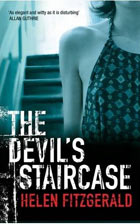 I was there for a launch of three books; Alan Guthrie, Tony Black and Helen Fitzgerald all gave readings from their books, answered questions about crime and pets, and generally made good conversation. I’d been aware of Helen’s books, and my curiosity had been piqued by a good review by Ray Banks, but I hadn’t taken the plunge.
After hearing what she had to say, both the Gurrl and I were interested in the dark little hardback that Helen gave a reading from, The Devil's Staircase.
I was laid up with a bad back recently and it gave me a chance to catch up on a few things. I cracked the cover to the book, read the first page, and then several hours later I’d finished. That’s a big deal for me. For a number of reasons, I’m quite a slow reader. I don’t read books in a day, but this one I couldn’t put down.
Trying to place Helen as a writer is as interesting as trying to place her characters. We love setting. I myself have spent many thousands of words online saying how important it is to me for an author and a book to identify with its setting. That can lead to a few misleading ideas though, and it can close a few doors. Helen is from Australia originally but now lives in Scotland. She tends to write stories set in Britain. Gets confusing, eh? No, not really. A writer doesn’t have to be part of the DNA of an area in order to explore it. And for every character who is defined by the hometown that owns them, just as many are defined by the home that they’ve escaped. And that is true of The Devil's Staircase.
The story starts in Australia, with the 18 year old Bronny facing up to being diagnosed with a condition that will destroy her life, or to something maybe even worse; a clear diagnosis that means she has wasted half of her life living in fear. She makes one of those great decisions that only the young can make: she jumps on a plane and travels halfway across the world to have a go at living.
That may sound like I’ve dumped a load of the plot on you right there, but in all honesty I’ve not even scratched the surface. That’s just the pre-title sequence. The real plot of the books is there if you want to look for it: it’s in the title, it’s on the dust jacket. But sometimes you really just need to open a book and jump in, you know?
Once the plot reaches London we meet a full cast of young runaways. Each is running from (or in one case to) something in their past. Each has a story and a motivation, but the book lets you discover them as you go along. There’s no rush to dump these things on you. We see them trying to earn a living, trying to find themselves, and trying to get as drunk and as high as they can. For a while the book is a free and simple exploration of youth and love as each of these runaways come together to form their own community in the midst of one of the world’s busiest cities.
You’re never left far from the main plot though, and just as you’ve settled in to this fun coming of age love story, the book punches you and drags you into it’s dark underbelly, something that has been hiding beneath the surface for the whole story.
The book pulls off something like a magic trick. It has a surface that’s a fun, and funny, story of youth and love. Dig a little deeper and it starts to get very dark indeed. But the trick is that neither of these take away from the real heart of the story. It’s a book that looks at love and loss, at desperation and grief. It deals with real human emotions which, as I’ve written before, is sadly rare in fiction.
I’ll be returning to this theme soon to expand on it, but this is a great example of a book that takes the time to show consequences. If someone dies, then someone is grieving. If someone fails then someone is guilty. There are a few moments late on when we get to see the various different forms of grief or guilt that the characters are dragging around with them. Normally I don’t like it when the narrative decides to tell us what characters are thinking, but if it’s used well it can add just the right note. And this carries over into its twists.
Some storytellers use twists as a way to escape consequences. They can throw in something crazy, or some deus ex machina, to write their way out of a whole. But good twists, good plots, carry the weight of consequences and, sometimes, inevitability. Some twists happen because that’s what needs to happen. This is a book that has a fair few of them, nasty and grisly in turn. Each time you hope that the story will go one way, it reminds you that it needs to go the other. Each time you root for the characters to have a breather, the page turns to remind you that things just don’t work that way.
There are some really good writers working in Britain right now, but the industry doesn’t seem to know how to point them out.
I’ll be interviewing Helen soon. That is, as soon as I get the questions sorted out. In the meantime, pick this up and prepare – I really wasn’t prepared for how good it was.
I met Helen Fitzgerald on the night Michael Jackson died. That interesting fact has little to do with today’s blog, but it lets you know that we both have an alibi.
I was there for a launch of three books; Alan Guthrie, Tony Black and Helen Fitzgerald all gave readings from their books, answered questions about crime and pets, and generally made good conversation. I’d been aware of Helen’s books, and my curiosity had been piqued by a good review by Ray Banks, but I hadn’t taken the plunge.After hearing what she had to say, both the Gurrl and I were interested in the dark little hardback that Helen gave a reading from, The Devil's Staircase.
I was laid up with a bad back recently and it gave me a chance to catch up on a few things. I cracked the cover to the book, read the first page, and then several hours later I’d finished. That’s a big deal for me. For a number of reasons, I’m quite a slow reader. I don’t read books in a day, but this one I couldn’t put down.
Trying to place Helen as a writer is as interesting as trying to place her characters. We love setting. I myself have spent many thousands of words online saying how important it is to me for an author and a book to identify with its setting. That can lead to a few misleading ideas though, and it can close a few doors. Helen is from Australia originally but now lives in Scotland. She tends to write stories set in Britain. Gets confusing, eh? No, not really. A writer doesn’t have to be part of the DNA of an area in order to explore it. And for every character who is defined by the hometown that owns them, just as many are defined by the home that they’ve escaped. And that is true of The Devil's Staircase.
The story starts in Australia, with the 18 year old Bronny facing up to being diagnosed with a condition that will destroy her life, or to something maybe even worse; a clear diagnosis that means she has wasted half of her life living in fear. She makes one of those great decisions that only the young can make: she jumps on a plane and travels halfway across the world to have a go at living.
That may sound like I’ve dumped a load of the plot on you right there, but in all honesty I’ve not even scratched the surface. That’s just the pre-title sequence. The real plot of the books is there if you want to look for it: it’s in the title, it’s on the dust jacket. But sometimes you really just need to open a book and jump in, you know?
Once the plot reaches London we meet a full cast of young runaways. Each is running from (or in one case to) something in their past. Each has a story and a motivation, but the book lets you discover them as you go along. There’s no rush to dump these things on you. We see them trying to earn a living, trying to find themselves, and trying to get as drunk and as high as they can. For a while the book is a free and simple exploration of youth and love as each of these runaways come together to form their own community in the midst of one of the world’s busiest cities.
You’re never left far from the main plot though, and just as you’ve settled in to this fun coming of age love story, the book punches you and drags you into it’s dark underbelly, something that has been hiding beneath the surface for the whole story.
The book pulls off something like a magic trick. It has a surface that’s a fun, and funny, story of youth and love. Dig a little deeper and it starts to get very dark indeed. But the trick is that neither of these take away from the real heart of the story. It’s a book that looks at love and loss, at desperation and grief. It deals with real human emotions which, as I’ve written before, is sadly rare in fiction.
I’ll be returning to this theme soon to expand on it, but this is a great example of a book that takes the time to show consequences. If someone dies, then someone is grieving. If someone fails then someone is guilty. There are a few moments late on when we get to see the various different forms of grief or guilt that the characters are dragging around with them. Normally I don’t like it when the narrative decides to tell us what characters are thinking, but if it’s used well it can add just the right note. And this carries over into its twists.
Some storytellers use twists as a way to escape consequences. They can throw in something crazy, or some deus ex machina, to write their way out of a whole. But good twists, good plots, carry the weight of consequences and, sometimes, inevitability. Some twists happen because that’s what needs to happen. This is a book that has a fair few of them, nasty and grisly in turn. Each time you hope that the story will go one way, it reminds you that it needs to go the other. Each time you root for the characters to have a breather, the page turns to remind you that things just don’t work that way.
There are some really good writers working in Britain right now, but the industry doesn’t seem to know how to point them out.
I’ll be interviewing Helen soon. That is, as soon as I get the questions sorted out. In the meantime, pick this up and prepare – I really wasn’t prepared for how good it was.
Subscribe to:
Posts (Atom)