Tuesday, April 30, 2024

Topical Versus Timeless

Years ago, when I was working as a tutor at a community college in New York, I was having a conversation about something (I don't remember what) with a fellow tutor of mine who was from Nigeria. In relation to whatever we were discussing, I mentioned "the Civil War". I took it as a given that my colleague would know which war I was talking about (THE Civil War), but he said to me in reply, "Which Civil War?". Good question. There have so many civil wars over time, and in relation to Nigeria alone the Nigerian Civil War, or Biafran Civil War, from 1967 to 1970 -- at least 100,000 military casualties and millions of deaths from war-related starvation -- is much more recent than the war I was referring to and took for granted he would know I was talking about, the American Civil War. Of course, he did know which war I was referencing, but he wanted to make it a point that I was being a little American-centric in saying "the" Civil War when maybe that isn't the most important civil war, historically speaking, to every person from every country. Anyway, it's odd, but this was a thought I had leaving the film Civil War, which I went to the other day.


First off, let me say, I liked the film, which is an exercise in grim, almost non-stop tension. And I get why Alex Garland, in conceiving and then executing the story, did not want to make it so topical in its reference points to US current events that people watching the film, say, ten years from now might find it hopelessly dated. But at the same time it seems a little bit narratively disenguous to title a film Civil War at this particular historical moment in the United States and then make it so vague in its political underpinnings that it in effect becomes a film about war, or civil war, in general, a war that could be taking place anywhere in the world. That in and of itself is not a paltry aim, and, once again, the film is compelling. It doesn't sugarcoat anything. But a United States in which the states of Texas and California, forming the Western Alliance, are allies against an authoritarian president who has refused to leave office after a second term begs for at least a little explanation. Or is it the film's oblique suggestion that the two large and powerful states, which are are so different in their politics, have indeed banded together to fight a common fascistic enemy? This does seem to be implied. And there are other alliances mentioned in the film such as the Florida Alliance. In other words, the United States has descended into a state of semi-chaos, and I think a character mentions at one point that once the president's loyalist forces are defeated, the forces fighting the rebellion very well might turn against each other, a development that has happened in many a civil war in many countries. Once the enemy is defeated, allies become enemies and war grinds on. The film is plausible, and in today's world it is true that things change so fast and alliances are made that are so unexpected, but I for one could have used a bit more background, however speculative, in exactly how the country has devolved into the state portrayed in the film.

As it stands, journalists are the film's heroes, and there's nothing wrong with that of course. In this regard, the film reminded me a bit of the excellent 1983 film Under Fire, starring Gene Hackman, Nick Nolte, and Joanna Cassidy. That film is set during a real revolution, in the last days of the Somoza dictatorship in Nicaragua, as the government forces and a horrible authoritarian regime are being overthrown by the rebel Sandinista forces. Like Civil War, the conflict is seen through the eyes of journalists who put their asses on the line to document the war. It's a film absolutely worth seeing, by the way, and not unlike Civil War, Under Fire ends at a moment almost everyone can agree is a relative high point, a brief moment of optimism, before the inevitable fighting that will ensue between the victorious forces and their factions. Before the new authoritarians, before the inevitable corruption of ideals, the defeat of the one who deserves defeat happens. Civil War, like Under Fire, ends on just the right beat.


Is it possible to make a politically oriented film that is almost aggressively topical but not so topical in its references that it dates fast? It's difficult, but besides Under Fire while watching Civil War, I also thought about films from the Cold War era that tackled nuclear war fear and all the anxieties the US had about Soviet and Chinese communism. The best films of that time, whether dramatic or satiric, tap into then current events and the audience's worries but also do stand up to later scrutiny because they're detailed, well-told stories, films like Fail Safe and The Manchurian Candidate, and, yes, Dr. Strangelove. Those are films both specific to their time but also that can illuminate aspects of human weakness, aggresstion, stupidity, and so forth that are timeless. They are good models for capturing and understanding a particular historical moment in the United States but that also have a broader scope. Civil War almost if not quite gets there, but what is there in the film is strong.


Saturday, April 27, 2024

Are There Any Literary Jump the Shark Moments?

by

Scott D. Parker

(The day job ate up all my time this week so I'm posting another rerun, this one from 2021. I am working on two new posts starting next week.)

Sometimes old things trigger new questions.

For the longest time, our front living room was television-less. That’s where the library is, it’s where we set up our Christmas tree, and it serves as the guest bedroom. We didn’t mind not having a TV in the front room, but during last year’s NFL season, I pulled out an old TV we had and one of those digital antennas and converter box and set up the TV. I’m the only one in the house who enjoys football and I didn’t want to hog up one of the good TVs just to watch a game.

It’s been kind of fun having that old TV available. I plugged one of our VCRs (yes, really) and a portable DVD player so I could watch the occasional show on it. In terms of live television, however, when it’s not being used for football, it’s on MeTV.

Imagine my surprise, a couple of weeks ago, when suddenly MeTV was not where it usually was. The network recently purchased a station here in Houston and started broadcasting from that new channel. A channel my old converter box/antenna combo did not receive. Cue a drive to Target to purchase a new combo setup. Viola! They work perfectly and I now can get MeTV.

But this new converter box also has a recording feature. It’s like a DVR but only for over-the-air channels. No problem for me. So one afternoon I pulled out the instruction manual to figure out how to record things.

And I received a happy surprise.

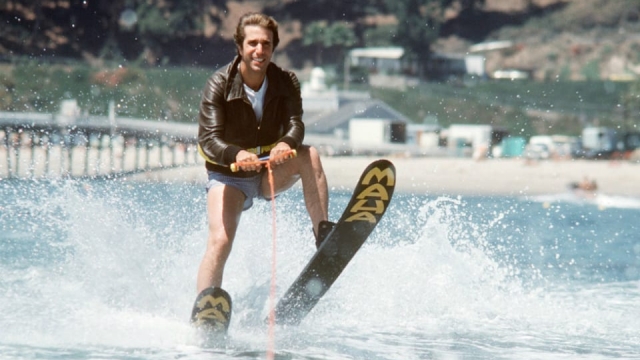
“Happy Days” was airing at that time and wouldn’t you know it, the episode in question was “Hollywood, Part 3.” What? You don’t know that episode by title? Well, it’s the exact fifth episode where Fonzie jumps the shark.

Naturally, I ended up watching the rest of the episode.* Yeah, it’s as cheesy as you remember it to be, but I reckon my nine-year-old self was glued to the TV in suspense, just like the Cunninghams were.

The term “jumping the shark” has been used to define when a TV show went off the rails. That is, when it stopped being the original thing it was and became something else, usually a shell of its former self. Just me writing this brings to mind many a show to your minds. That time when Bruce Willis and Cybil Shepherd got together in “Moonlighting.” That time when Victoria Principal discovered Patrick Duffy’s Bobby Ewing in the shower and they told you the entire season you had just watched…was a dream. That time when David Duchovny left “The X-Files.” Those are just off the top of my head.

Then I got to thinking: Are there literary “jumping the shark” moments? Are there books in long-running series that jump the shark? I know there must be, but I’m not coming up with any. Granted, I’ve not read many long-running series. There are 52 In Death books by J.D. Robb (Nora Roberts). John Sandford has written 31 in the Prey series. Twenty-five Jack Reacher books exist and I don’t even want to start counting the number of series James Patterson has written. Erle Stanley Gardner wrote 80 Perry Mason novels (and 30 Cool and Lam novels). The old pulp writers Lester Dent (Doc Savage) and Walter Gibson (The Shadow) wrote a novel a month for years.

The point is, there are many a long-running series in the book world. Have (or did) any of them jump the shark?

Follow-up Question


By the way, Happy Days went on for another six years, eleven seasons in total. Were all those post-shark episodes bad? Probably not. The TV show Dallas recovered from the Bobby-in-the-Shower moment, but The X-Files and Moonlight didn’t.

So if there is a book series that jumped the shark, did that series recover?
 

*Side note: The other plot for this episode (and probably parts 1 and 2) was Richie mulling over a choice of whether or not to attend college or head out to Hollywood and sign a film contract. I had completely forgotten this since I probably saw the episode on the date of its airing and then never again since. But there’s a nice scene between Richie and his dad. Howard Cunningham gives his son a nice pep talk, ending with a reminder: no matter what Richie choose, his father will support him and be proud of him. Now that I’m a dad myself, this scene got to me in a way my nine-year-old self couldn’t possibly have imagined.

Saturday, April 20, 2024

History Comes Alive With The Lincoln Conspiracy

by

Scott D. Parker

(To commemorate the Apple TV series, Manhunt (the story of the search for John Wilkes Booth and his co-conspirators), here is a review (from 2020) of a book that looks at the first attempt on Lincoln's life.)

There's a moment in The Lincoln Conspiracy: The Secret Plot to Killed America's 16th President - and Why It Failed where the President-elect hears dire warnings from two independent sources that his life is in danger and he takes action. He agrees to sneak out of a pre-Inauguration Day party in Harrisburg, Pennsylvania, don a disguise, and be whisked away by train, all in an effort to thwart the plot to kill him in Baltimore. That moment consists of me breathlessly wondering: Is he gonna make it?

It's been 155 years since his death. There's a giant statue of President Lincoln in Washington, He's on the penny. He's one of the most famous Americans of all time. He might be recognized in nearly every corner of the world here in 2020. Of course he makes it.

But that's the testament to the writing skill of Brad Meltzer and Josh Mensch: they weave the story and the details in such a way as to make history read like a thriller. And dang if this story won't thrill you.

We all know Lincoln's ultimate fate on Good Friday, 1865, but few know of the first plot to kill him before he even took office. I'll admit I learned about it back in grad school at the University of North Texas but it was only in passing. I knew it was foiled and that private detective Allan Pinkerton played a key role. But I never knew the details that fill over 350 pages in this remarkable book.

Much like they did with The First Conspiracy: The Secret Plot to Kill George Washington (2019), Meltzer and Mensch dig deep into the details of this 1861 plan hatched by a cabal of Southern loyalists. They didn't want the president-elect—who carried no slave-holding states in the recent election—to take his place in the White House. At the time, the Republican Party was against the institution of slavery even if Lincoln himself tried to steer a narrow line between free and slave.

Following a tradition dating back to America's first president, Lincoln traveled from his home in Springfield, Illinois, to Washington, D.C., in the weeks leading up to his inauguration. Two things gave the Southerners fuel for their plot: Lincoln's itinerary was published in many papers and the rail-splitter from the west would have to change trains in Baltimore. What made this transfer problematic was not only was Maryland a slave state, but the transfer wasn't merely changing trains in a single station. No, this change from one rail line to another involved literally moving a train car about a mile from one station to the next. In that time, with the expected throngs of Southern sympathizers clogging the streets, the president-elect's life would be in jeopardy.

Hired by one of the railroad men to protect threats against the railroad, Pinkerton and one of his agents, Kate Warne, uncovered the real plot. It was then Pinkerton urged Lincoln to change his plans. The new president demurred until a fateful night when word of the plot arrived from his recent rival and future Secretary of State, William Seward. Convinced of the threat, Lincoln finally allowed himself to be disguised and sneak into the nation's capital under the cover of darkness.

Like they did with their Washington book, Meltzer and Mensch write their prose in the present tense. It gives the story an immediacy, a will-he or won't-he vibe that's pretty darn exciting. Often, they'll recount a scene and then cut to a contemporary scene in another part of the country. You really get a bird's eye view of the whole situation.

If you are a fan of audiobook, preeminent narrator, Scott Brick, reads the book. He could read the phonebook and I'd pay to hear it. He narrates everything he does so well, and I especially like the timbre of his voice as he reaches the end of the book and reads the last lines from Meltzer and Mensch.

History isn't just names and dates, laws and wars, pop culture and events. It is people, real people, living their lives and making decisions based on the best knowledge they have at any given time. Some decisions are momentous: the outcome of the 1861 election, the secession of the Southern states, the foiled assassination in 1861 and the successful one four years later. This book peels away some of the veneer Lincoln now lives with in the American imagination in the 155 years since his death, showing us a real guy, beset by personal and national tragedy, who is doing the best he can. Ditto for Pinkerton, Warne, and the Southerners.

Books like these breathe life into history, and as a historian, we need more books like this so folks in the 21st Century can be entertained and learn a little something along the way.


Highly recommended.

Tuesday, April 16, 2024

Patricia Highsmith's Chillers

You could say that the current Netflix series Ripley goes retro since it uses black and white. Of course that use reflects the era Ripley is set in, but for a different kind of retro connected to Patricia Highsmith, there is an old TV series called Chillers, which I hadn't thought about in a while until I saw Ripley’s trailers and began thinking about all the Highsmith adaptations there have been over the years. I wrote a long piece once about many of these adapations, starting with 1951's Strangers on a Train and running through the 2009 adaption of The Cry of the Owl (I wrote the piece before Carol, The Two Faces of January, and the new Deep Water came out), for the now inactive Hardboiled Wonderland blog, and if you're interested, that's a piece you can still find here, Picture Books: Patricia HighsmithI mention Chillers in the piece, but I thought now would be as good a time as any to bring up the series again because among Highsmith adaptations, it seems to be one less known. 

Chillers aired from 1990 to 1992. There were twelve episodes in total, and each one is based on a Patricia Highsmith short story. It's a TV series that has the look of its time, but with its solid production values, stellar casting, and drolly cruel storylines, it's quite entertaining. A British-French co-production, the series is in the mode of the series Tales of the Unexpected, the show that featured many adaptations of Roald Dahl stories and that Dahl often introduced himself. For Chillers, Anthony Perkins serves as host, giving the audience a sardonic and slightly sinister verbal preview of the tale to come. And the quality of the stories themselves clearly helped draw the excellent actors involved, with people such as Ian McShane, Edward Fox, James Fox, Tuesday Weld, Nicole Williamson, Ian Holm, Marisa Berenson, and Ian Richardson in leading roles. I won't go over every episode here, but if you want to check the series out by watching one, I would start with the one called Day of Reckoning. It's adapted from a story of the same name from the collection The Animal-Lover’s Book of Beastly Murders, and what makes this episode of the twelve noteworthy is its director – Sam Fuller.


Fuller’s emotive, tabloid style would seem ill-suited to Patricia Highsmith’s frostiness.  But maybe the reason he decided to accept this assignment is because of how weird the plot is.  It has to do with a young man visiting his aunt and uncle’s chicken farm, an automated abomination of a place where new technologies torture the chickens but make them astonishingly productive egg layers.  The uncle, played by Phillipe Leotard, is ecstatic about what the new methods make possible, but his wife, Assumpta Serna, has reservations.  Manipulating artificial days and nights for the cooped up chickens, never letting them feel natural dirt, the uncle doesn’t seem to know or care that all the mistreatment has made the birds insane.  In the building where they’re kept, they cluck incessantly, at a volume loud enough to make talking impossible.  The uncle loves his newfound profits (traditional chicken rearing left him struggling financially), but the aunt and the visiting nephew feel uncomfortable with the business despite its success.  Also in the mix is the married couple’s pre-teen daughter, a sweet girl who loves her kitten, and it’s a misfortune that happens to her that prompts the story’s final wicked and wickedly funny actions.


As I say, I think it was the strangeness that drew Fuller.  The source material allows him to play, like in the baroque shots he does showing the farm reflected off a chicken’s eye.  There is a dream sequence in the episode that does not occur in the story, its wildness unadulterated Fuller, especially its musical section and the chicken talking to the nephew with the voice of the aunt.  But for the most part, Fuller and his co-writer Christa Lang are faithful to the short story, transposing to the screen the ideas in it.  Human greed, exploitation of animals, science run amuck, and the danger that Nature may turn on man – all these are in the story and episode both.  Fuller brings a cockeyed energy to the project, but he also exercises discipline to foreground what Highsmith stresses.  Although it’s a mere 50 minute episode, and an eccentric episode at that, Day of Reckoning is an example of a work that melds two unlike sensibilities.  It’s also a hell of a lot of nutty fun.

I'd say start with Day of Reckoning, and if you like it, go from there to other episodes of Chillers. They're all easy to find, streaming in places like Amazon Prime and Tubi.


Saturday, April 13, 2024

Reading Outside Your Usual Genre Can Deliver Surprises


by

Scott D. Parker


In his newsletter this week, author Rob Hart gave some recent recommendations, including one outside of his typical genre. I concur but mere days earlier, I had done the same thing.


To quote a wise man, I have taken my first step into a larger world.


How It Started


My wife has read nearly every book Elin Hilderbrand has written. Back five, six years ago, I even created a list on my phone with the books we had so that if I found myself at a bookstore and I happened upon one of her books, I knew which ones we owned. Heck, we even went to an event where we got to meet her and get her autograph.


Recently, I checked out Hilderbrand’s latest, The Five-Star Weekend, from the library and, predictably, my wife flew through the pages. A couple of Fridays ago, she put it on the kitchen table, a signal for me to return the book to the library. For whatever reason, I picked up the book and read the description on the dust jacket. 


The Five-Star Weekend tells the story of a middle-aged widow, Hollis, who, as a means of moving on from her husband’s death the previous December, invites four women to her home on Nantucket Island for a weekend of curated food, wine, activities, and more wine. The catch is that she invites women who represent certain phases of her life. Tatum from childhood, Dru-Ann from college, Brooke from when they both were new moms in their thirties, and Gigi, a woman Hollis knows (but has never met in real life) via Hollis’s cooking blog. To document everything, Hollis hires her daughter, a film student, to create a documentary (and hopefully break down the wall that stands between them). 


Now, having read the dust jacket, I was intrigued. I opened the first page to see how it started.


Twenty-nine pages later, I walked into the next room, book in hand, and said, “I am in!”


The Relatable Characters


I’ll admit that one of the reasons I locked into this story was that the characters were my age. I even laughed out loud when, in chapter one, Hilderbrand mentions Hollis was part of the high school Class of 1987. That’s me. 


I saw aspects of myself in each character. I related to Tatum’s down-to-earth outlook on life. I lamented when Dru-Ann’s character experienced manufactured outrage that was completely false. I sometimes experience the imposter syndrome Brooke feels (don’t we all?), and I look at certain groups and pine to join them like Gigi. I also understood how each woman views the others. 


As you would imagine, each woman has things to hide and each woman has thoughts about the others and, over the course of a long weekend, it all spills out.


The bottom line: even though it’s a work of fiction, these five women are real people. And I really enjoyed spending time with them.


Effortless Reading


My wife loves Hilderbrand’s books because they are so easy to get into and read. I concur.


I ended up checking out the audiobook from the library as well so I was able to listen on my commutes and when doing yard work and read the hardcopy at night. Having the book in hand helped me see how Hilderbrand actually crafted her writing.


She changes points of view often, almost paragraph by paragraph if more than one character is in the given scene. She also writes in present tense, which gives the book an immediacy, especially when she writes phrases like “Brooke was thinking…[this]” and “Hollis was thinking…[that].” 


Loved it. As a writer who tends to write any given scene from the POV of a singular character, it was engrossing to be in the heads of all five characters, six when you include the daughter. 


The pages just flew by and I was completely enthralled with this story. Given last week’s post about books that pack an emotional punch, I’ll have to include The Five-Star Weekend in the list. While I got misty when it came to what happened to the characters, I really got the point where I didn’t want the fictional weekend—or the actual book—to end.


Readers of a Certain Age


The Five-Star Weekend asks questions of its characters and, by extension, its readers as well, but it clearly comes down on the side of friendship. They are special—at every phrase of our lives—and they need attention and cultivation and should never be taken for granted. This is a good thing for younger readers to understand but it’s also a gentle reminder for older readers as well. You know that friend you haven’t spoken to in years? Give them a call and catch up. You’ll be so glad you did.

Saturday, April 6, 2024

What Book Packed a Real Emotional Punch?

By

Scott D. Parker


When was the last time a book delivered an emotional response?


One of my science fiction book club guys texted me earlier this week. He had finished a book that he admitted wasn’t great, but the sad ending actually touched him. He recalled the book  REDSHIRTS by John Scalzi as one about which I very much had an emotional response. Heck, that response smacked me in the face so much so that I could barely relate the ending of the book to my wife without bawling. Later, when the book club met, I still was rather emotional in explaining why I loved the book so much.


My friend remarked that maybe the genre books lack emotional storytelling. If we are judging strictly by books the group has read—and not, say, the Harry Potter series that, for me, did deliver a wallop to the gut—then the number of times a book has given me an emotional response of any kind is quite rare. 


The Fundamental Reason to Read Fiction

Before we get too deep, let’s not forget that fundamental reason we read fiction: to be entertained. If a book tells a story you enjoy, then it has done its job. If a book entertains and also makes you feel, that book is special.


What Kind of Emotional Response?


When I hear that a book gave a reader an “emotional response,” I almost instantly think of crying first. But that’s not the only emotion out there. Thrillers quicken the heart rates of readers as they breathlessly turn pages as fast as they can read. Romances give you that warm and fuzzy feeling in the pit of your stomach as the characters fall in love. Horror books often terrify or sicken depending on the author and the subject. There’s always anger like when a character is treated badly for no good reason. Back in the day, after I finished reading A FAREWELL TO ARMS, I hated the ending so much that I threw the book across the room. 


So an emotional response can really be anything.

Visual Storytelling Seems Easier


Not sure what it is about the visual medium—TV and movies—but I tear up somewhat regularly when I’m watching TV shows or movies. My wife and I just finished season 2 of “Parenthood” and, for the most part, we are entertained by the story of the four adult siblings and their children. But every now and then, out of nowhere, boom! An emotional beat lands. Same with “Cold Case.” 


Movies, especially action and adventure ones, have my heart pounding in my chest. There are certain moments in movies that gave me chills in the theater (and every time I watch it again afterwards). 


But then there are the tearjerker movies, the gushy rom-coms, and let’s not forget the comedies that make you laugh so hard your stomach aches. Emotions from movies just seem easier.


A Short List of Books That Gave More Than a Story.


REDSHIRTS is still one of the gold standards of books that more than delivered but there were a handful more in the club. REPLAY by Ken Grimwood brought tears to my eyes. DEAD SILENCE by SA Barnes literally made the hairs on my neck stand up at certain parts. It was truly eerie and scary. THE SEA OF TRANQUILITY by Emily St. John Mandel turned out to be my favorite book of 2022…and I didn’t even pick it. THE MARTIAN by Andy Weir had me nearly cheering at the end. 


Outside of the SF club, a few others come to mind. The ending of FALLING by TJ Newman gave me goosebumps and I pumped my fist in the air with triumph and jubilation. Her next book, DROWNING, scared the crap out of me because of the very real possibility of something like that happening. CHARM CITY ROCKS, a rom-com by Matthew Norman gave me all the feels I expect in a romance.   


But a book giving me an emotional response is rather rare. I just finished a book club book and, well, it was interesting, but it was not too invested into the story other than to know what happened next. So, that’s curiosity. And I was marginally entertained.


I guess that’s good enough, right? 


What are those special books that gave you some sort of emotional response?

Tuesday, April 2, 2024

Alert Storytelling

I haven't read Dune or any of Frank Herbert's books and I didn't make any effort to go see the first Denis Villaneuve Dune film when it came out in 2021. I'm not quite sure why I didn't go see it since I liked Villaneuve's earlier films, including Arrival and Blade Runner 2049, the sci-fi ones he did before, quite a bit. Now with Dune: Part Two out, though, I decided finally I'd like to see the first film so that I can catch Part Two in a theater. The other night, I put Part One on.

At the story's start, as all Dune fans, I suppose, know, we learn that the galaxy's emperor has ordered one group of beings, the Harkonnens, to leave the planet they are exploiting, Arrakis. After they depart, they will be replaced on Arrakis by another group from the planet Caladan, whose leader, Leto Atreides, is the father of central character Paul Atreides. So far, so good, and the complicated tale goes on from there. The character who tells us in voiceover that the emperor has ordered the Harkonnens to leave Arrakis asks why the emperor gave this order. It's a good question; the Harkonnens have been, from their point of view, succesfully exploiting Arrakis' resources, which is what the emperor apparently wants. So what's going on? As the film progresses, I kept asking this question myself, and for quite some time the answer isn't clear. But just at the point in the film when I was starting to get a little frustrated, wondering when or if this essential point that kicks everything in the plot off was going to get cleared up, another major character in the film asks the same question: why did the emperor issue this decree? 


Perfect timing -- the asking of this question for a second time. As events unfold from this point, we do come to understand why the emperor made this important decision, but what I liked about the question being asked a second time, at that precise point, is that it signalled that the screenwriters were very alert to precisely how the audience is taking the story. It's as if they understood that a viewer will be asking this question and seeking clarity on this major plot point by this time in the narrative, and now they restate it as if to let you know that they know what they're doing. They've left the question unanswered till this point on purpose, not because they overlooked the question or are being sloppy in their storytelling. That's the kind of moment I love when involved in a story, whether in a film or any other medium, because it tells you that you are asking the question or questions the creators of the work want you to ask and at the right juncture in the story. They know what you are thinking, acknowledge what you're thinking, and then proceed to go on with the telling from there, hopefully with the same kind of skill and confidence. In the case of Dune: Part One, the skill and confidence continue unabated, and what could be tangled and confusing (there's a lot going on, though I recoginize that the film gets rids of characters and subplots from the book, as the film must) proves quite easy to follow. The movie doesn't overexplain or get bogged down in exposition but balances questions and answers, mysteries and solutions (or partical solutions) efficiently. There's epic scale balanced by alert and intimate storytelling craft, and that's a balance that's rare. I'm eager to see Dune: Part Two and hope the storytelling in it is as well-tuned as in Dune: Part One.