Wednesday, October 3, 2018

Crime Fiction's Economic Imperative

Crime Fiction's Economic Imperative
By Danny Gardner, Author
A NEGRO AND AN OFAY

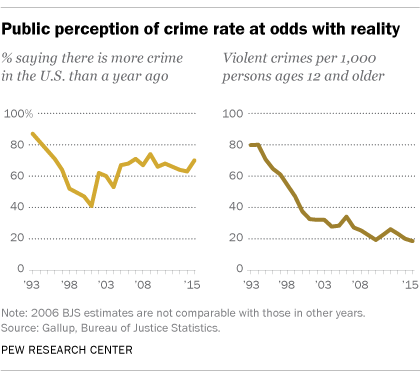
Public perception of crime rate at odds with reality


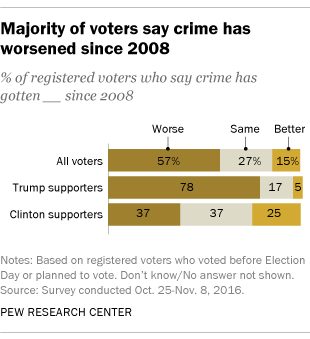
Majority of voters say crime has worsened since 2008


Put plainly, at a time when the biggest news in mystery is an annotated edition of The Big Sleep, I’m not seeing many opportunities for anyone with a new voice in our genre. Everyone knows the entire industry is worried about its future while there is what I firmly believe to be untapped demand for new voices, from both authors of color and those whose politics don't reflect the era of recognized canon. Reaching back through the past to reissue books lost to the strictures of racially stratified history mean economic opportunity, as will the books that will be built upon an expanded canon that includes those who have served as the face of crime for America since our inception as a nation.

This data expresses, in my worldview, an economic imperative in crime-mystery-thriller, which will continue to carry all of the American publishing industry through 2025 (IIRC, those numbers from Pew may have changed since I last read them,) and somehow charts similarly to Pew's research on attitudes toward crime in America. This Guardian article sums up many of my points about the global market, which has different attitudes toward minority writers of all colors than we do in the US:

https://www.theguardian.com/books/booksblog/2018/apr/12/mystery-crime-fiction-bestselling-book-genre-sophie-hannah

As a smart business professional, my dollars in the future are intended for those crime-mystery-thriller concerns that recognize the value of this untapped potential and grow our market larger and more robustly. There's room at the intersection points for a lot of economic value to be had by all. I'm looking forward to participating in this growth.

I'm excited to discuss how these points of data correlate and even intersect.

D

Tuesday, October 2, 2018

My Favorite Memoir

No matter what period you're living in, who doesn't, on occasion, like to block out the news and escape to a different time and place?  Nothing can provide this better than reading, and it's remarkable how effective memoirs from the past can accomplish this. A memoir I love, and which I've read a couple of times, is Far Away and Long Ago by W.H. Hudson.  Published in 1918, when Hudson was living in England and 77 years old, the book describes the author's years growing up on a different continent.  Among other things, it's a book that now comes across as unusual because - get this - it's actually about what used to be called a happy childhood. 


Of course family trauma and the abuse of children have existed since the beginning of time, so the fact that Hudson experienced neither is not because he lived in the past.  He happened to be fortunate. His childhood was a particularly rich and interesting one spent with loving parents but few restrictions on the wild stretches of the Argentinian pampas in the 1840s and 50s. His Anglo-American parents had settled as immigrants in Argentina and that's where he was born. Though his father's attempt to make a living were struggles (he had to give up sheep farming and a grocery store he opened later also failed), Hudson loved where he grew up. The house was full of books, and the only formal education he got was from traveling schoolteachers and tutors who would turn up sometimes at the house and stay for awhile.  After catching rheumatic fever from being out in a hailstorm while herding cattle, the pre-teen Hudson was given the freedom of an invalid, though, in fact, he was hardly that. This meant little was expected of him and he didn't have much parental supervision. To his heart's content, he could wander alone out on the plains, ride horses, and study the animals, birds and plant life of the region. He was also a close observer of the people in the area--this a time when real gauchos were out and about and Argentina was chock full of eccentric immigrants and untamed characters. Hudson himself says he could hardly have asked for a freer childhood, and there's no doubt that those impressionable years studying nature helped turn him into one of the world's great nature writers and naturalists, something he became as an adult when he moved to England and settled there. In England, Hudson would also become a charter member of the Royal Society for the Protection of Birds.


Hudson wrote Far Away and Long Ago when the world he was describing had already pretty much vanished.  He had not been back to Argentina for over 40 years. The book has a poignant tone that is really moving yet not without humor, and the descriptions of the landscape, the wind, the sun, the flora, the animals are vivid and precise and lyrical. As a number of people have commented, from Jorge Luis Borges to Joseph Conrad to Virginia Woolf, Hudson ranks among the very greatest stylists of English prose; his sentences flow with an effortless ease and clarity. I was taken away to a totally different time and place when I read this book, and when I'd leave my room after some reading, I felt as if there was nothing I wanted to do more than go back to the mid-eighteen hundreds, as a child, and take a walk through the Argentinian pampas. I happen to like reading memoirs very much, and Far Away and Long Ago is the one that would get my vote for my all time favorite.  It a great memoir to sink into, an enriching read during any period, even - yes - the one we are living through.

Monday, October 1, 2018

Into the light.


Why victims of sexual abuse and assault hide in the shadows.


There are a million different ways to hurt. And there are a million different ways to deal with suffering. I believe it is small-minded and careless to judge another human on how they deal with the unimaginable. Many victims have well-founded reasons for not coming forward.

How you will be treated.

When a victim of sexual abuse or assault finds the strength to come forward and report the offense they are often questioned over their own behavior leading up to the abuse. What were you wearing? Were you alone? Were you drinking? They are made to feel they had a part in their own attack. They are not only questioned over circumstance, but how seriously they tried to fight back. Did you push him away? Did you hit him?

During Bill Cosby's trial his victims were questioned about why they took drinks from him or why they went to his apartment. Similar questions were put forth in the Harvey Weinstein cases. Fact is, if a person did not say yes to something and it was done to them against their will, it's assault. No matter where you take a meeting. No matter what you’ve had to drink or if you happen to wear fitted pants or high-heels.

If you go to the police you’ll be asked if you were penetrated and if yes, how many times? What position were you in? What happened after the rape? What did they say? If you choose to take a rape-kit you will be put through a physical exam. Samples taken. Pictures taken. You may feel violated all over again.

How you will be seen.

Elizabeth Smart was abducted at 14 years of age and held for nine-months by her tormentors. Smart once said at a human trafficking and sexual violence conference at Johns Hopkins University, "I felt like my soul had been crushed. I felt like I wasn't even human anymore. How could anybody love me, or want me or care about me? I felt like life had no more meaning to it, and that was only the beginning of my nine months of captivity."

Shame and confusion are chains around the neck of many victims. Sexual assault is a dehumanizing act. Invasive and humiliating. It makes you feel broken. Ashamed. The need to hide is overwhelming. Maybe you wear bigger clothes, heavier jackets. Perhaps you stop going outside. You are so lost and afraid you forget to how to be human.

Those who don't believe you.

As a secretary in a small, cut-rate dress studio in NYC I was in charge of phones, keeping the showroom and clothes neat and clean, and keeping the owner on schedule and well-caffeinated. One afternoon, while hanging the new summer dresses, the owner’s driver was waiting in the studio. We were the only people in the office. Trapping me in a corner, he forced himself on me and only stopped once I started to tear up.

At the time, my direct supervisor was the designer. She was a single-mom, excited by her first job and generous with her knowledge, often giving me creative assignments. When I told her what happened with the driver she immediately waved it off. Said it was nothing. Said he must like me.

A few Mondays later I showed up to work to find the offices locked tight and the lights out. The company had finally gone belly-up. I never got my final two checks and I never heard from the owner or his driver again.

Weeks later, the designer called me at home. She cried and told me that the driver was known for his sketchy behavior and she should have spoken up. She wanted to help, but the owner owed her several paychecks and she was afraid he would never pay her if she said anything. Two people too afraid to speak up.
The cost and the worth.
According to the Rape, Abuse, and Incest National Network (RAINN), citing Department of Justice, Office of Justice, Office of Justice Programs and Bureau of Justice Statistics National Crime Victimization Survey 2010-2014, for every 1,000 rapes reported, 994 of perpetrators will walk free. When your voice doesn't seem to matter, many who suffer won't see the value in coming forward.

Why don’t the wounded come forward? Because they don’t want to be victimized again.

If victims of abuse and assault will be expected to come forward immediately after a crime, as recent government rulings would suggest, coming forward needs to become a safer experience. We need to provide people and a process that will help the victim feel as if they are taken seriously. There needs to be dignity and there needs to be justice.